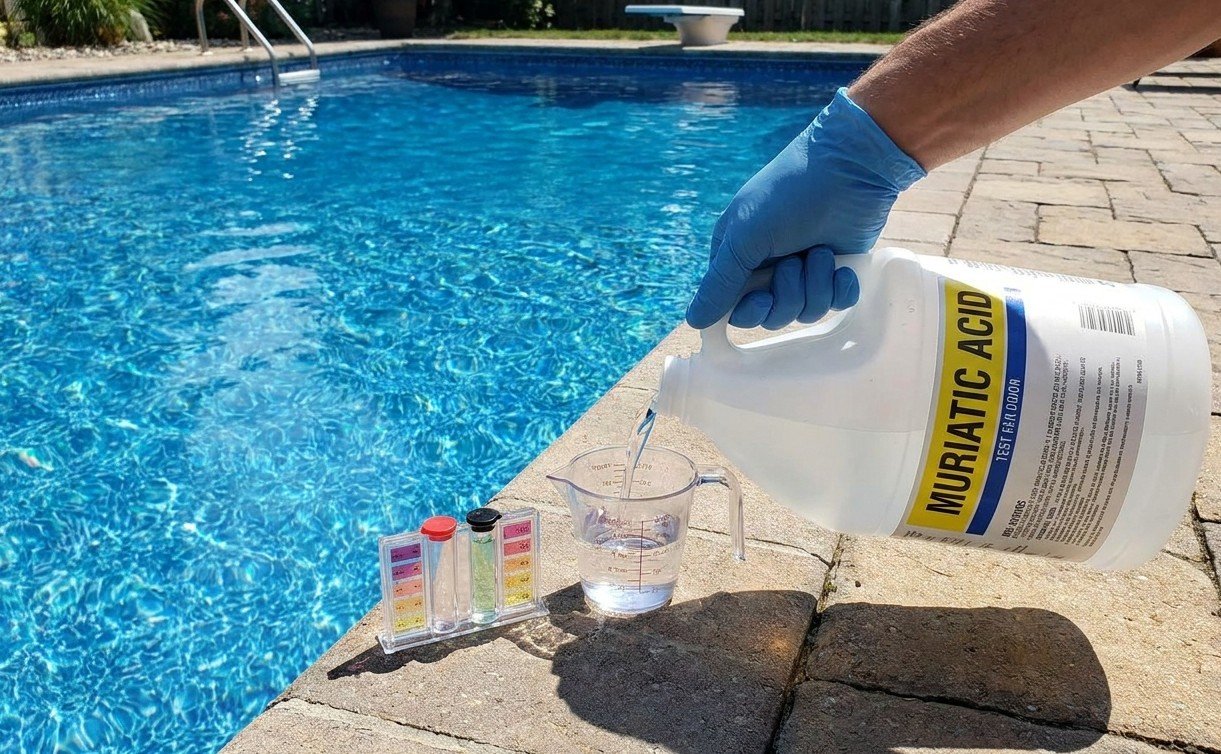
Key takeaway: “Pool acid” is almost always hydrochloric acid: the same chemical Americans call muriatic acid, sold in Australia at roughly 30–33% strength, used to bring down a pool’s pH and total alkalinity. Published dosing guides disagree by more than 10x on how much to add per 10,000 litres for the same pH drop, because the real dose depends on your total alkalinity, not just your pool’s volume. Test both before you dose, correct alkalinity first, and add acid in small amounts.
Pool acid is a strong acid added to swimming pool water to bring pH and total alkalinity back down when they drift too high. In Australia it’s almost always sold as hydrochloric acid at around 30–33% strength (called muriatic acid in the US, same chemical, different name), or occasionally as sodium bisulphate, sold as “dry acid.” High pH stops chlorine from working properly and can sting skin and eyes; pool acid corrects that. It’s also classified as a hazardous, corrosive chemical, so handling it safely matters as much as getting the dose right.
The rest of this guide covers what it actually does, roughly how much to use, and the handling rules that matter, including the one thing most dosing charts online skip. For the wider basics of keeping pool water balanced, see our full pool water chemistry guides.
What You’ll Need
- A current pH and total alkalinity reading: test strips or a liquid kit, not a guess
- Liquid hydrochloric acid (pool acid), or granular sodium bisulphate (“dry acid”)
- Chemical-resistant gloves and eye protection
- A clean plastic bucket or jug for liquid acid, never metal
- Your pool’s volume in litres. A pool volume calculator makes this quick (coming soon on this site)
How to Add Pool Acid Safely
Correct total alkalinity before you touch pH. This is the step most guides skip, and it’s the reason published dosing charts disagree so widely: alkalinity buffers pH change, so a pool with high alkalinity needs several times more acid to shift pH by the same amount as a pool with normal alkalinity. Aim for a total alkalinity of roughly 80–120 ppm first.
- Test pH and total alkalinity before doing anything else.
- If alkalinity is outside 80–120 ppm, correct it first. Acid also lowers alkalinity, so this is usually the same step, not an extra one.
- Work out your pool’s volume in litres so any dosing chart or calculator is scaled to your actual pool, not a generic “average” size.
- Add acid to water, never water to acid. Pour the measured dose into a bucket of pool water, never pour water into a container of acid.
- With the pump running, pour the diluted acid slowly around the perimeter of the deep end, away from the skimmer intake.
- Wait at least 30–60 minutes with the pump circulating, then retest.
- Add in small increments and retest each time, rather than guessing a single large dose from a chart.
On dose size: published Australian pool-care guides vary enormously here: some suggest as little as 15–20 mL of 30% hydrochloric acid per 10,000 litres to shift pH by 0.1, others suggest closer to 150 mL for the same shift. Neither figure is wrong on its own; they’re just assuming different starting alkalinity. That’s exactly why step 2 above matters more than any fixed number, and why a small first dose followed by a retest beats trusting any chart, including this one.
Common Mistakes
- Adding a full “chart” dose in one go without testing alkalinity first
- Pouring water into acid instead of acid into water, which causes violent spattering
- Mixing acid directly with chlorine products instead of dosing at least 30 minutes apart
- Guessing pool volume instead of measuring it
- Swimming immediately after dosing, before the acid has fully circulated and been retested
When to Call a Pro
If pH keeps climbing back to the same high reading within days of correcting it, something else is usually driving it: a miscalibrated auto-chlorinator, aerating water features, or naturally high-alkalinity fill water are common causes, and a pool shop water test can usually find it faster than repeated guessing. If you’re not confident handling a corrosive chemical yourself, most local pool shops will dose it for you as part of a service visit.
Safety
Liquid pool acid is classified as a hazardous and dangerous chemical under SafeWork Australia and ADG Code criteria, and it causes serious skin and eye burns and its vapour is a respiratory irritant (Clark Rubber Safety Data Sheet: Liquid Pool Acid). Always work outdoors or in a well-ventilated area, wear chemical-resistant gloves and eye protection, and store it away from chlorine products in a cool, dry, ventilated spot, never in a metal or aluminium container. If it splashes in the eyes, flush continuously with running water for at least 15 minutes and seek medical help.
For any exposure, call the Australian Poisons Information Centre on 13 11 26, available 24 hours a day from anywhere in Australia.
Liquid Pool Acid vs Dry Acid
| Product | Typical strength | Form | Best for |
| Hydrochloric acid (liquid pool acid) | ~30–33% | Liquid | Larger pH/alkalinity corrections: the cheapest option per litre and the most common choice |
| Sodium bisulphate (“dry acid”) | ~93–95% | Granular | Small, precise doses: easier to store safely, no fumes, but costs more per equivalent dose |
Testing and Dosing Without Guessing
The single biggest difference between a confident acid dose and a wasted one is testing before and after, not the brand of test kit or the exact chart used. A basic liquid reagent kit reads pH and total alkalinity accurately enough for backyard use; strips are fine for a quick check between proper tests.
Once you know your pool’s volume and current readings, a dedicated dosing calculator removes the guesswork this guide has been warning about. We’re building one now that takes your actual volume and current-vs-target readings and does this maths properly, correcting alkalinity before pH the way this guide recommends.
Frequently Asked Questions
What does pool acid actually do?
Pool acid lowers pH and total alkalinity in swimming pool water. Without it, pH tends to drift upward over time from fresh water fill, some chlorine products, and swimmer use, which reduces how well chlorine sanitises the water and can irritate skin and eyes.
How much acid should I add to my pool?
It depends on your pool’s volume and current total alkalinity, not a single fixed number. Published guides vary from roughly 15 mL to 150 mL of 30% hydrochloric acid per 10,000 litres for a 0.1 pH drop, because alkalinity changes how much acid the water absorbs before pH actually moves. Test alkalinity first, dose in small amounts, and retest rather than trusting one chart.
How long after adding acid to a pool can you swim?
Wait until the acid has fully circulated, generally at least 30 to 60 minutes with the pump running, and until you’ve retested and confirmed pH is back in the normal 7.2 to 7.6 range. Swimming immediately after dosing means swimming in water with a pocket of concentrated acid that hasn’t mixed through yet.
When’s the best time to add acid to a pool?
Evening or early morning, with the pump running and nobody about to swim, works best. It gives the acid time to circulate and the pH time to stabilise before the pool is used again.
What’s the difference between liquid pool acid and dry acid?
Liquid pool acid (hydrochloric acid, about 30 to 33%) is the cheaper, more common option for larger corrections. Sodium bisulphate (“dry acid,” about 93 to 95%) is a granular alternative that’s easier to store and produces no fumes, but costs more per equivalent dose. It suits smaller, more precise adjustments.
Is pool acid dangerous to store at home?
It’s classified as a hazardous, corrosive chemical, so it needs to be stored properly: in its original container, in a cool, dry, well-ventilated spot, away from chlorine products, and never in a metal or aluminium container. Handled and stored correctly, it’s routinely used by backyard pool owners across Australia.

1 thought on “What Is Pool Acid? What It Does and How Much to Use”