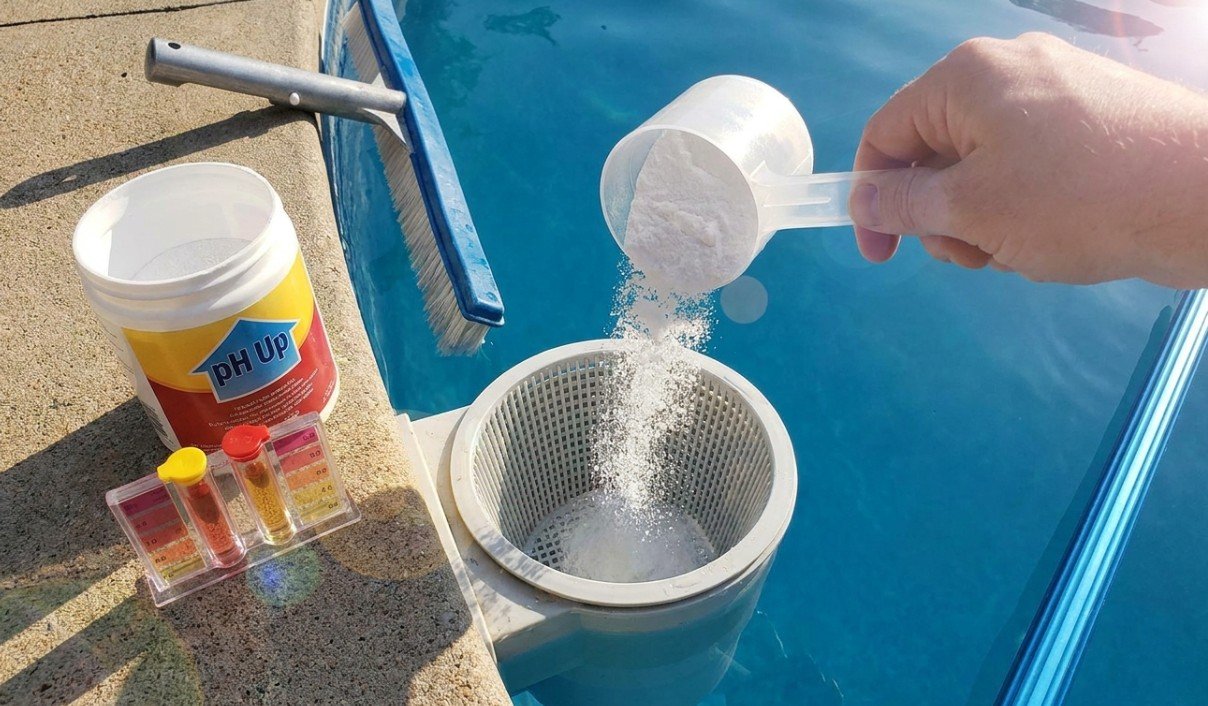
Key takeaway: Soda ash (sodium carbonate) is the standard way to raise pool pH in Australia, but the right dose depends on how low your pH already is, not one fixed number. One common AU product’s own label calls for 100g per 10,000 litres below pH 6.8, dropping to just 40g per 10,000 litres between pH 7.0 and 7.2. Add half the calculated dose, wait at least 3 hours with the pump running, then retest before adding more, that single habit prevents almost every overshoot.
Add a scoop of pH increaser, walk away, come back a day later to a pool sitting at 8.2 instead of the 7.4 you were aiming for: it’s one of the most common pool chemistry mistakes, and it usually comes down to guessing a single dose rather than checking how far the water actually needs to move. Low pH lets chlorine burn off faster and can sting eyes and skin, so it’s worth fixing properly, not overcorrecting into a second problem. This guide covers the actual dose, why it varies, and the habits that stop it swinging too far. For the wider basics, see our full pool water chemistry guides.
What You’ll Need
- A current pH and total alkalinity reading, test strips or a liquid kit, not a guess
- Soda ash (sodium carbonate) pH increaser, sold at Australian pool shops as a powder
- Your pool’s volume in litres. A pool volume calculator makes this quick (coming soon on this site)
- A clean bucket for pre-dissolving, plus gloves and eye protection
- Patience: dose in half-measures and wait at least 3 hours before retesting
How to Raise pH Without Overshooting
- Test pH and total alkalinity before adding anything. Total alkalinity buffers pH change, the same principle that applies when lowering pH with pool acid, just in reverse: a pool with high alkalinity needs more soda ash to shift pH by the same amount, and a pool with low alkalinity moves further per gram than a generic chart assumes. Low alkalinity is exactly when overshoot risk is highest.
- Work out your pool’s volume in litres so any dosing table is scaled to your actual pool.
- Use a tiered dose, not a flat one. One widely sold Australian product’s label scales the dose to how low your pH already is: 100g per 10,000 litres below pH 6.8, 80g per 10,000 litres between 6.8 and 7.0, and 40g per 10,000 litres between 7.0 and 7.2. For a 40,000-litre pool sitting at pH 6.9, that’s 80g × 4 = 320g of soda ash, not a single fixed scoop regardless of starting pH.
- Add only half that calculated dose first. Manufacturer tables assume average conditions, and your actual water rarely matches exactly, halving the dose turns a possible overshoot into, at worst, a top-up.
- Pre-dissolve the dose in a bucket of pool water, or broadcast it evenly over the surface on a still day, away from the skimmer and pool edge so drifting dust doesn’t land on you.
- Run the pump and wait at least 3 hours before retesting. Testing too early catches the water mid-dissolve, reads falsely low, and tempts you to add more when the first dose hasn’t actually finished working yet, one of the most common causes of a genuine overshoot.
- Retest, and only add the remaining half (or a smaller top-up) if pH is still below target.
Common Mistakes
- Adding a full flat-rate dose regardless of how low pH actually is, rather than scaling it to your reading
- Confusing soda ash with bicarb (baking soda): soda ash raises pH strongly with a smaller alkalinity bump, bicarb raises alkalinity strongly with a smaller pH bump, use the wrong one and you either overshoot pH or barely move it
- Retesting before the full 3 hours is up, then adding more because the reading looks low
- Broadcasting powder upwind of yourself or the pool edge on a windy day
- Ignoring total alkalinity entirely and only chasing the pH number
When to Call a Pro
If pH keeps swinging high again within days of correcting it properly, something else is usually driving it: aerating water features, a miscalibrated auto-chlorinator, or naturally high-alkalinity fill water are common causes, and a pool shop water test usually finds it faster than repeated guessing. If low pH keeps coming back instead, and it’s not just heavy rain or a fresh top-up, check for a leak, since fresh fill water is often behind a stubborn low reading.
Safety
Soda ash pH increaser is milder than pool acid, it’s not classified as a Dangerous Good for transport, but its own safety data sheet still carries a DANGER signal word: it’s classed as a skin irritant and causes serious eye damage, with some risk to the respiratory tract from the dust (Clearchem pH Increaser Safety Data Sheet). Wear gloves and eye protection when handling it, avoid breathing in the powder, and wash your hands afterwards. If it splashes in the eyes, flush continuously with running water and seek medical help if irritation persists. For any exposure concerns, the Australian Poisons Information Centre is available 24 hours a day on 13 11 26.
