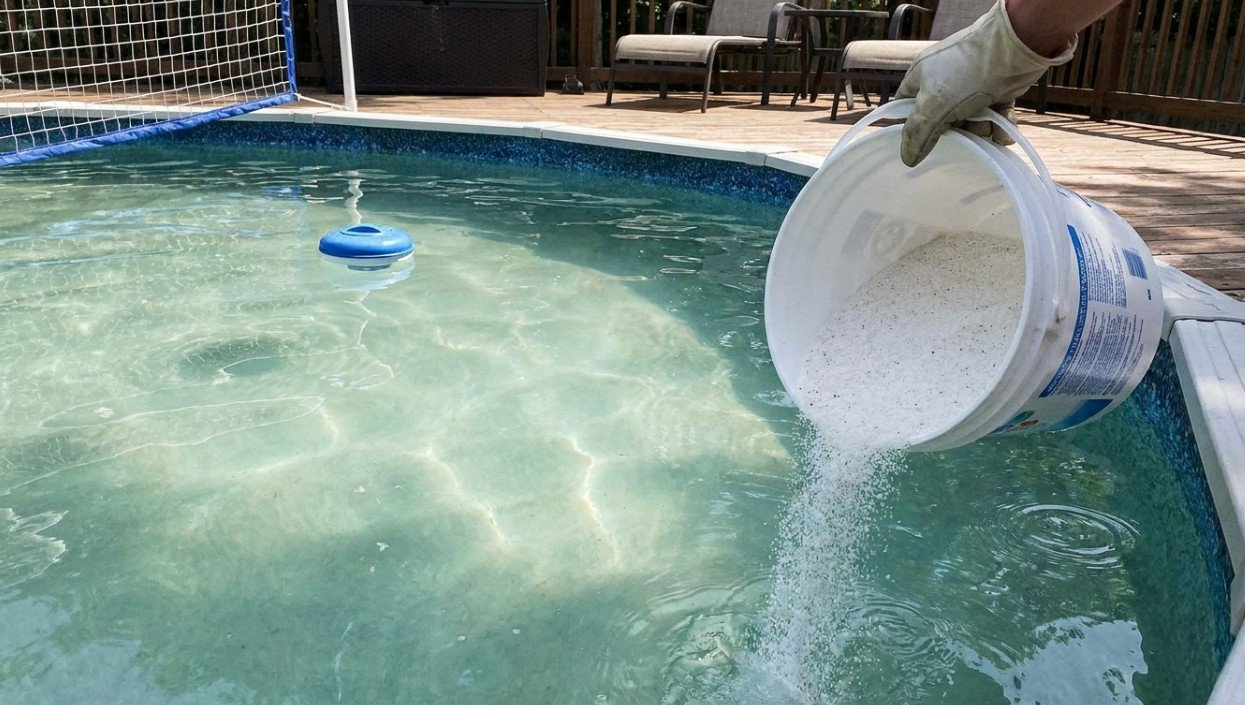
Key takeaway: shocking means temporarily pushing free chlorine to roughly 10x your combined-chlorine reading — about 5–10 ppm for routine upkeep, 20–30 ppm for a genuine algae bloom — to burn off chloramines and kill what normal daily chlorine can’t. You don’t need to do it on a fixed weekly schedule; only when a specific trigger shows up. And the exact grams per 10,000L depends entirely on which product you use, not a single internet rule of thumb.
“Pool shock” isn’t a special ingredient — it’s just a much bigger dose of chlorine (or occasionally a non-chlorine oxidiser) added all at once, to push free chlorine high enough, fast enough, to overwhelm something normal daily dosing can’t: a chloramine smell, a genuine algae bloom, or contamination after heavy use or a storm. Most well-maintained backyard pools don’t need it on a fixed weekly schedule — only when one of a handful of specific triggers shows up, covered below.
This guide is part of our Pool Water Chemistry 101 hub. If algae is the reason you’re here, our Why Is My Pool Green? guide covers that specific fix in full.
Safety: shock products are concentrated, hazardous chlorine chemicals. Add chemicals to water, never water to chemicals, never mix different chlorine products or shock with pool acid directly, and wear gloves and eye protection. For any chemical exposure, call the Australian Poisons Information Centre on 13 11 26, available 24 hours a day.
When You Actually Need to Shock
Some guides tell you to shock every week regardless of how the pool looks — that’s overkill for most well-maintained backyard pools, and it wastes product without fixing anything, because shock corrects a specific chemical problem, not a calendar date. Shock when:
- A chlorine smell gets stronger, not weaker, when you add more chlorine — the classic sign of chloramines (combined chlorine), not too much chlorine
- The water is visibly cloudy, green, or growing algae
- You’ve just had a big pool party or an unusually heavy swimmer load
- Heavy rain or a storm has just hit the pool
- You’re opening the pool after winter dormancy
What you don’t need to do: shock a pool that’s already clear, odour-free and testing normally on your routine weekly check. If none of the triggers above apply, save the product.
The Ppm Math Behind the Dose
The underlying rule — called breakpoint chlorination — is that free chlorine needs to reach roughly 10x your combined chlorine (chloramine) reading before it “breaks” the chloramine bond rather than just adding to it. That’s why a genuinely smelly pool needs a real shock dose, not just a bit more daily chlorine.
| Situation | Target free chlorine | Typical trigger |
|---|---|---|
| Routine upkeep shock | 5–10 ppm | Chloramine smell, heavy bather load, post-storm |
| Slight algae bloom | ~10 ppm | Faint green tinge, slippery surfaces |
| Moderate algae bloom | ~20 ppm | Cloudy green water |
| Severe algae bloom | ~30 ppm | Dark green, long-neglected pool |
Here’s the part most guides skip: the actual grams (or mL) needed to hit any of those ppm targets depends entirely on your product’s percentage of available chlorine, not a single fixed “X grams per 10,000L” rule. Worked example for granular calcium hypochlorite at roughly 65% available chlorine: raising free chlorine by 1 ppm in 10,000L takes about 15g of that product (10,000L × 1ppm = 10g of pure available chlorine needed, divided by 0.65 available chlorine = ~15g of product). So a 10 ppm routine shock is roughly 150g per 10,000L for that product — a 30 ppm severe-algae shock is roughly 450g per 10,000L. A different product with a different available-chlorine percentage needs a different weight for the exact same ppm result, which is exactly why fixed dosing charts you find online disagree with each other so often.
Use our Chlorine Dosing Calculator to get the right figure for your actual product and pool volume rather than converting the maths by hand every time.
Which Shock Product to Use
| Product | What it does | Watch out for |
|---|---|---|
| Calcium hypochlorite (cal-hypo) | The strongest, most common granular shock — roughly 65–70% available chlorine, no stabiliser | Raises calcium hardness with every dose — avoid repeated use if your calcium is already high |
| Sodium dichlor / liquid chlorine | Dissolves clean with no cloudiness; a common choice for vinyl-liner and saltwater pools | Dichlor contains cyanuric acid, so repeated use can push stabiliser too high over a season |
| Non-chlorine shock (potassium monopersulfate) | An oxidiser, not a sanitiser — clears chloramines fast and you can swim again in about an hour | Doesn’t kill algae or bacteria — it’s not a substitute for chlorine shock during an actual bloom |
How to Shock a Pool, Step by Step
- Test first — free chlorine, combined chlorine (or total minus free) and pH. Correct pH into 7.2–7.6 before you shock; chlorine barely works above pH 7.8.
- Choose the right product for your situation and pool type from the table above.
- Calculate the dose for your actual pool volume using our Pool Volume Calculator and Chlorine Dosing Calculator rather than a generic chart.
- Add it at dusk or after dark, with the pump running — UV burns off unstabilised chlorine fast in daylight and wastes a large share of the dose.
- Let it circulate for at least 6 hours (overnight is easiest) before retesting.
- Retest free chlorine and don’t swim until it’s back down in the normal 1–3 ppm range — not immediately after adding shock.
Common Mistakes
- Shocking on a fixed weekly schedule regardless of whether the pool actually needs it
- Shocking in full sun, which burns off a large share of the dose before it can work
- Using cal-hypo repeatedly on a pool that already has high calcium hardness
- Assuming non-chlorine shock will fix an actual algae bloom — it won’t, it’s an oxidiser, not a sanitiser
- Swimming as soon as the shock is added, instead of waiting for chlorine to drop back into the normal range
When to Call a Pro
If a chlorine smell or cloudiness persists after two properly-dosed shock treatments, the cause usually isn’t the dose — it’s more likely cyanuric acid locked too high for chlorine to work, a circulation problem, or a source of contamination that keeps returning. A pool shop water test can usually isolate it faster than a third round of guessing.
Frequently Asked Questions
What is pool shock, exactly?
Pool shock is a much larger, one-off dose of chlorine (or a non-chlorine oxidiser) added to rapidly push free chlorine high enough to burn off chloramines or kill an algae bloom — the same chemistry as your normal sanitiser, just a bigger, deliberate dose rather than a daily top-up.
How often should I shock my pool?
Only when a specific trigger shows up — a chloramine smell, algae, heavy bather load, a storm, or opening the pool for the season — not on a fixed weekly or monthly schedule regardless of how the water looks.
How long after shocking can I swim?
Wait until free chlorine has circulated for at least 6 hours and retested back down into the normal 1–3 ppm range; non-chlorine shock is the exception, at around an hour.
Can I use pool shock in a saltwater pool?
Yes — a saltwater pool still runs on chlorine, so it can develop the same chloramine or algae problems and needs the same shock treatment; sodium dichlor or liquid chlorine are common choices since they don’t add extra calcium the way cal-hypo does.
Do I need algaecide as well as shock?
Shock is what kills an existing bloom; algaecide is mainly a prevention step afterwards, at a normal maintenance dose, to make a repeat bloom less likely.
Sources
- Aussie Pools – How to Shock Chlorinate a Pool (breakpoint chlorination formula)
- Factory Pools Perth – Complete Guide to Pool Shocking (algae dosing tiers)
- Better Health Channel (Victorian Government) – Swimming pools: water quality
- SPASA Victoria – Fact Sheet 5: Water Balance
- Australian Government – Poisons Information Centre
