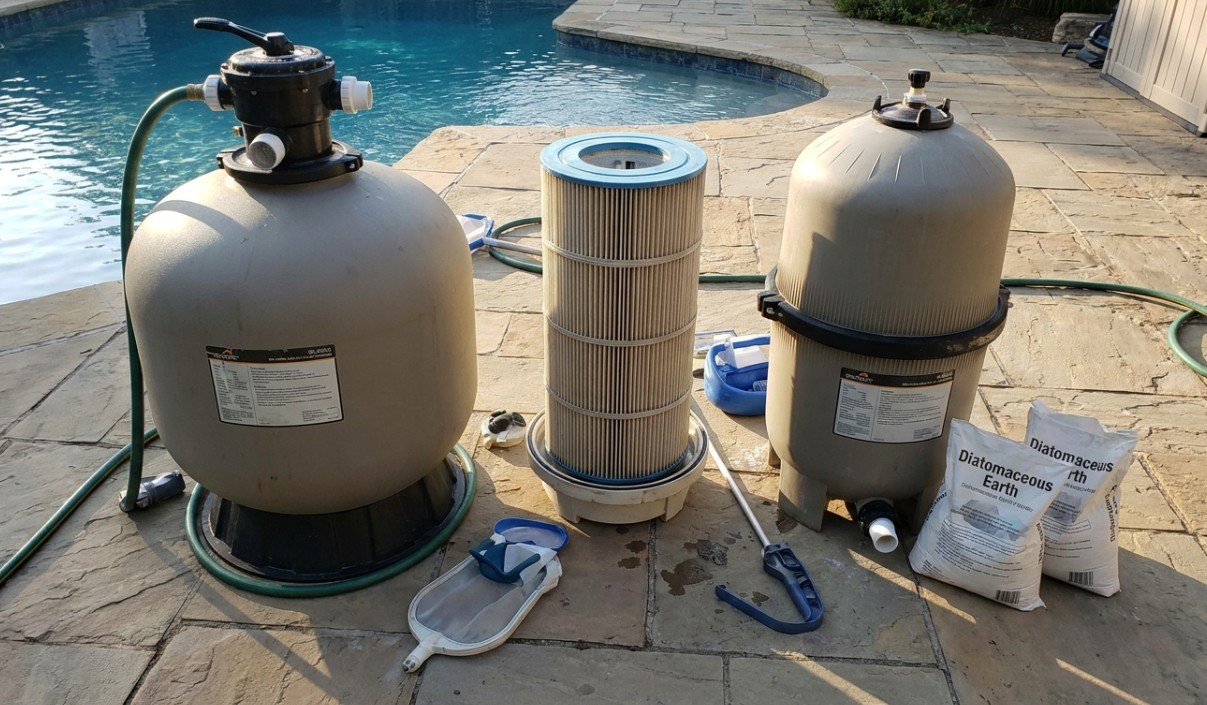
Key takeaway: A DE filter traps particles down to about 2 microns, a cartridge filter down to roughly 30 microns (Waterco’s own figure; some brands rate finer), and a sand filter anywhere from 3 to 40 microns depending on how loaded the bed is. Even the lowest-maintenance option, cartridge, still needs hosing off every few weeks. No residential pool filter is genuinely maintenance-free.
Every backyard pool runs one of three filter types: sand, cartridge or diatomaceous earth (DE). They all do the same basic job, pulling water through a filtration medium to strip out dirt, algae and debris before it goes back into the pool, but how fine they filter, how often you touch them, and what they cost to run over time are genuinely different. This guide is the hub for our filters and filtration content, and it exists to give you the actual numbers competitor guides usually skip.
Sand vs Cartridge vs DE, at a Glance
| Factor | Sand | Cartridge | DE (diatomaceous earth) |
| Micron rating | 3 to 40 microns (finer as the bed loads with debris) | Down to roughly 30 microns (Waterco); some brands rate finer, around 10 to 15 microns | Down to about 2 microns |
| Typical AU unit cost | Roughly $550 to $1,700 | Roughly $550 to $650 for an entry model, more for premium brands | Rarely sold as a complete residential unit in Australia; see below |
| Maintenance method | Backwash when pressure reads 8 to 10 psi above clean baseline | Remove and hose off the element every 4 to 12 weeks | Backwash plus recharge with fresh DE powder each cycle |
| Typical cycle | Roughly every 4 to 6 weeks in normal use | Every 4 to 12 weeks, plus an occasional deep soak | Roughly every 4 to 6 weeks |
| Media lifespan | Sand replaced every 3 to 5 years | Element replaced every 12 to 18 months | Grids or fabric last 3 to 5 years; powder is single-use per cycle |
The micron rating is the number that actually matters day to day. A finer rating catches smaller particles and leaves genuinely clearer water, but it also means more resistance to flow, which means more strain on your pump. That’s the real trade-off behind these numbers: sand is the most forgiving and cheapest to run, DE gives the sharpest polish, and cartridge sits in between with the least hands-on water waste.
What Each Type Actually Costs to Run
Sand itself is cheap to replace, roughly $45 to $100 every 3 to 5 years, but a sand filter backwashes to waste, so you’re also paying for the water you tip down the drain every 4 to 6 weeks. Cartridge elements cost more per replacement, roughly $100 to $250 every 12 to 18 months, but you hose them off rather than backwash, so water waste is minimal. DE is the odd one out in Australia: mainstream retailers rarely stock a complete residential DE unit at all, and several AU systems marketed as “DE-style” actually run on AquaPerl, a perlite substitute, instead of true diatomaceous earth. If a supplier quotes you a DE system, it’s worth confirming exactly what media it uses before you buy.
One honesty check worth making here: cartridge filters are frequently marketed as low-maintenance or backwash-free, which is true, but that gets stretched into “maintenance-free” in a lot of product copy. It isn’t. The element still needs removing and hosing down every few weeks, and it still needs replacing on schedule. Skip that and flow drops off before you notice anything else wrong.
A Safety Note on DE Powder
Diatomaceous earth powder contains fine crystalline silica, and Safe Work Australia sets a workplace exposure standard of 0.05 mg/m³ for respirable crystalline silica dust. Wear a mask when handling or recharging DE powder, and avoid creating dust clouds when you add it to the skimmer.
Which Filter Actually Suits Your Pool
- Choose sand if your pool collects a lot of leaves or debris, or you want the lowest-cost, lowest-fuss option and don’t mind the water lost to backwashing.
- Choose cartridge for the best balance of clean water and low water waste in most suburban backyard pools. It’s the most common upgrade from an ageing sand filter.
- Choose DE only if you specifically need the clearest possible water, for example a pool that clouds easily or has recurring fine-algae issues, and you’re comfortable with the extra handling and limited local availability.
If your backyard runs bore or well water, expect faster clogging on any filter type. None of the AU sources we checked address bore water specifically, so treat any filter choice there as a starting point, not a guarantee, and be prepared to clean more often than the ranges above.
Frequently Asked Questions
Which pool filter is best?
It depends on your priority: cartridge for a good balance of clean water and low water waste, sand for handling heavy leaf or debris loads, and DE if you need the clearest possible water and don’t mind the extra handling.
How often should I backwash a sand filter?
When the pressure gauge reads 8 to 10 psi above its clean baseline, which usually lands around every 4 to 6 weeks in normal Australian backyard use.
Is a DE filter worth it for a home pool in Australia?
Rarely. Complete residential DE units are hard to find at mainstream Australian retailers, and the extra clarity usually isn’t worth the added handling and cost for a typical backyard pool.
How long do cartridge filter elements last?
Around 12 to 18 months before the element needs replacing, though you should still remove and hose it off every few weeks in between.
Are cartridge filters really maintenance-free?
No. They waste far less water than a sand filter, but the element still needs removing and hosing down every few weeks, and it still needs replacing on schedule.
Does a finer micron rating strain my pump?
Yes. Finer filtration media has more resistance to flow, so a DE filter puts more load on your pump than a cartridge filter, which in turn works harder than a sand filter.
Can I switch from a sand filter to a cartridge filter?
Yes, as long as the replacement is sized to match your pump’s flow rate. Get a pool professional to confirm sizing before you buy.
