Key takeaway: robotic cleaners ($400 to $3,700+) run independently of your pool pump and cost the least to run, suction cleaners ($350 to $850) are the cheapest to buy but only work well with a single-speed or variable-speed pump already running, and pressure cleaners ($1,900 to $2,200+ including a booster pump) handle leaves and coarse debris best but add a second motor’s worth of running cost. Manual vacuums ($90 to $160) are the cheapest option of all if you don’t mind doing the work yourself.
Four genuinely different cleaning mechanisms get sold as “pool cleaners” in Australia, and picking the wrong one for your pool and budget is an easy way to spend twice. This guide compares real AU pricing, running costs and maintenance for robotic, suction-side, pressure-side and manual cleaners, so you can match the mechanism to your pool rather than just the marketing.
At a Glance
| Type | Typical AU price | Best for | Needs your pump running? |
|---|---|---|---|
| Robotic | $400 – $3,700+ | Hands-free cleaning, lowest running cost, fine debris and algae | No, independent motor |
| Suction-side | $350 – $850 | Budget cleaning on pools with a decent single-speed pump | Yes |
| Pressure-side | $1,900 – $2,200+ | Leaves and coarse debris, offloading wear from your main filter | Yes, plus its own booster pump |
| Manual vacuum | $90 – $160 | Occasional spot-cleaning on a tight budget | Yes |
Robotic Pool Cleaners
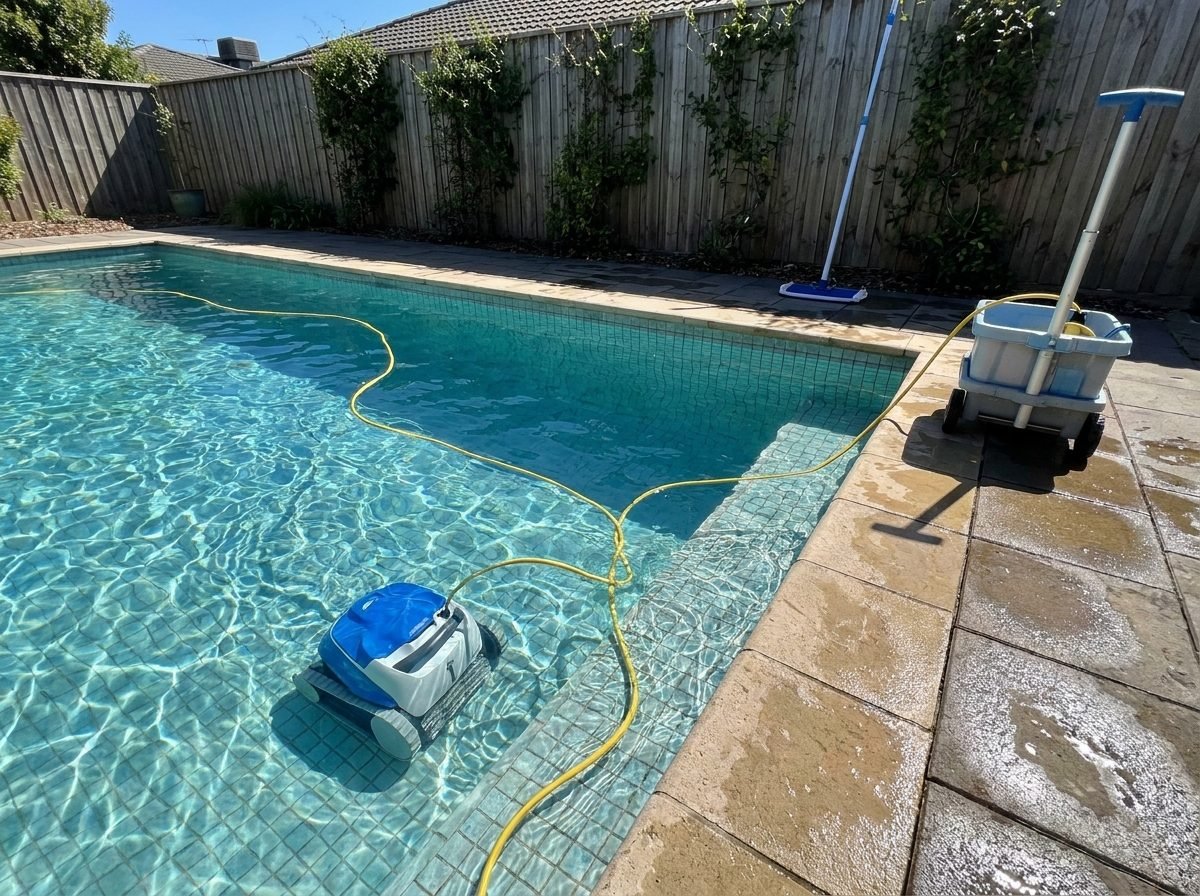
Robotic cleaners have their own motor, pump and filter bag, so they don’t touch your pool’s filtration system at all. That’s what makes them the cheapest to run: a typical unit draws a similar amount of power to a household appliance for a couple of hours a day, not a full pool pump cycle. They’re also the most capable across debris types, fine sediment, algae and leaves alike, which is why Zodiac Australia’s own buying guide recommends them for larger pools or pools that collect a lot of debris. The trade-off is upfront cost: entry-level models start around $400, but a full-featured robotic cleaner with app control and wall-climbing can run past $3,700.
Suction-Side Cleaners
Suction cleaners plug into your skimmer or a dedicated suction port and use your pool pump’s own suction to crawl the floor and pick up debris, similar in principle to manually vacuuming a pool but automated. They’re the cheapest automated option to buy, but they lean entirely on your existing pump, so a weak or ageing pump means a weak cleaner. They’re also the one type that doesn’t pair well with a variable-speed pump run on its lowest, most efficient setting: most suction cleaners need a higher flow rate than an eco-mode VSP provides to crawl properly, which is a real and often overlooked compatibility issue.
Pressure-Side Cleaners
Pressure-side cleaners connect to your pool’s return line rather than the suction side, and most need a separate booster pump to generate enough force, a second motor that most buyers don’t budget for when comparing sticker prices. That’s why they land at $1,900 to $2,200 or more once the booster pump is included. In exchange, they handle leaves and coarser debris well and take that load off your main filter, which suits gum nuts, jacaranda flowers and similar Australian tree debris better than a fine-media suction cleaner does. They’re a smaller part of the AU retail market today than robotic or suction cleaners, so shop around for local stock and support before committing.
Manual Vacuums
A manual vacuum head, telescopic pole and hose is the cheapest way to clean a pool floor, typically $90 to $160 for the components, and it uses your existing pump’s suction the same way a suction-side cleaner does. The catch is obvious: you’re doing the walking. It suits pools that only need an occasional clean between swims, or as a backup for the specific debris an automated cleaner missed. See our full guide to vacuuming a pool manually for the step-by-step technique.
Running Costs: The Number Most Buyers Miss
Suction and pressure cleaners are only as efficient as the pump pushing them, and that pump is usually the biggest ongoing cost in the comparison. A single-speed pool pump can cost roughly $1,000 to $1,800 a year to run, while a variable-speed pump (VSP) doing the same job can cost as little as a few hundred dollars, a saving AstralPool Australia and Canstar Blue both put at roughly $700 to $1,200 a year, with the pump typically paying for itself in 12 to 18 months. A robotic cleaner sidesteps this entirely: it runs its own small motor for a couple of hours rather than relying on your main pump, which is where most of its lower running cost actually comes from, not any efficiency of the cleaning mechanism itself.
Maintenance
- Suction cleaners: the diaphragm that drives their crawling action is the main wear part, and Kreepy Krauly Australia’s own maintenance guidance recommends an annual inspection for cleaners run daily, with the debris bag, hoses and diaphragm the parts that wear out first.
- Robotic cleaners: the internal filter needs regular rinsing, and the drive impeller or track system typically lasts several years before needing attention, longer than a suction cleaner’s diaphragm.
- Pressure cleaners: the booster pump is a second piece of equipment with its own seals and impeller to maintain, on top of the cleaner itself.
- Manual vacuums: virtually nothing to maintain beyond rinsing the head and checking the hose for splits, which is part of their appeal on a tight budget.
Which Should You Choose?
- Large pool, lots of debris, or you want to forget about it: a robotic cleaner earns its higher upfront cost back in lower running costs and less of your own time.
- Small to mid-size pool with a healthy single-speed pump and a tight budget: a suction cleaner does the job cheaply, as long as you’re not running a VSP on its lowest setting.
- Heavy leaf litter from nearby trees: a pressure cleaner or a robotic model rated for coarse debris will cope better than a fine-media suction cleaner.
- Occasional use or a very small pool: a manual vacuum is genuinely enough, and it’s the cheapest option by a wide margin.
