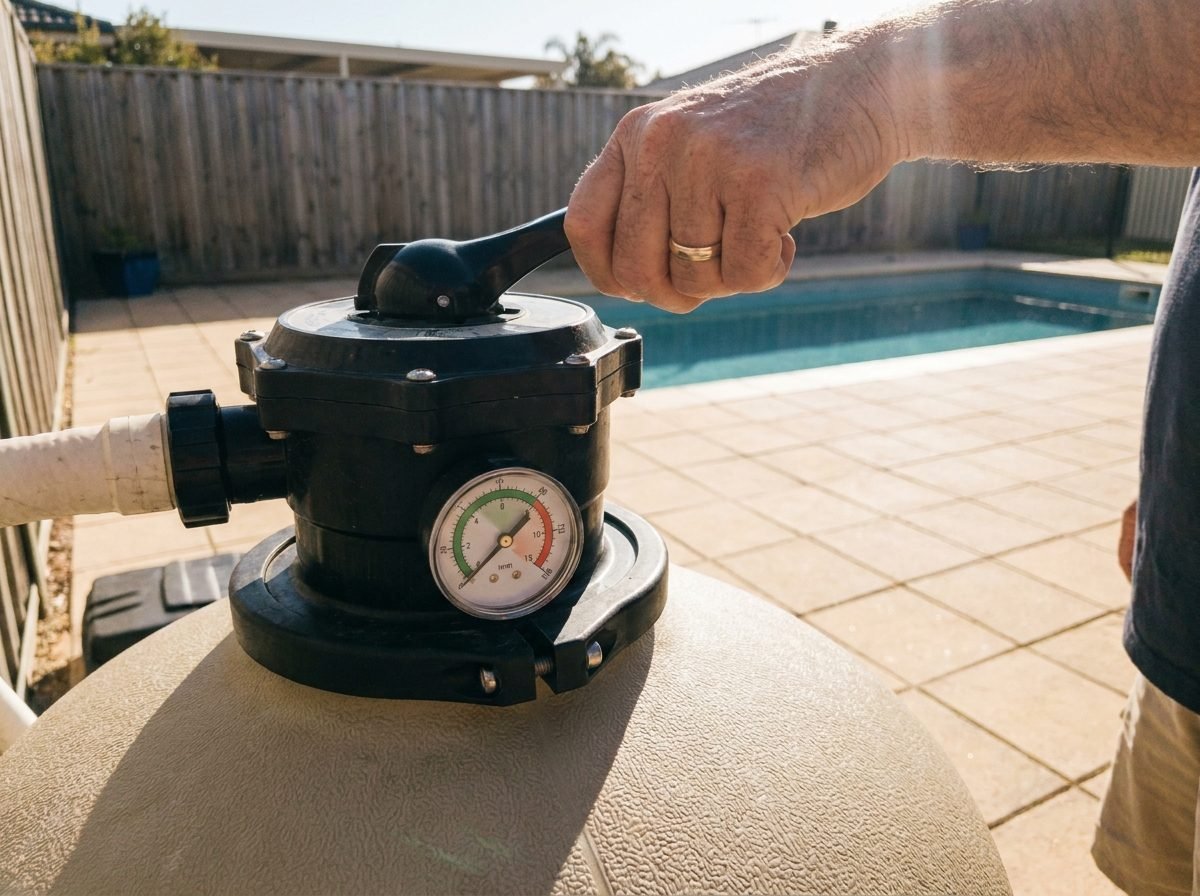
Key takeaway: a sand filter works by pushing pool water down through a bed of specially graded sand, which traps dirt and debris in the tiny gaps between sand grains rather than on a surface layer. Standard silica sand catches particles down to roughly 20 to 40 microns. Once the trapped dirt builds up enough to raise your pressure gauge 8 to 10 PSI above its clean baseline reading, it’s time to backwash, not run the filter until it clogs completely.
Of the three main filter types, sand is the simplest mechanically and the one most Australian backyard pools were built with, so it’s worth actually understanding what’s happening inside that tank rather than just flicking the valve when the pressure gauge creeps up. For how sand compares to cartridge and DE filters, see our full pool filters guide.
How a Sand Filter Actually Works
Pool water enters the top of the filter tank and is pushed down through a deep bed of graded sand, usually 300 to 500mm. This is depth filtration: dirt doesn’t just sit on the surface of the sand, it gets driven into the gaps between grains throughout the bed. A set of slotted pipes called laterals sits at the bottom of the tank, collecting the now-filtered water and directing it back through the multiport valve to your pool. As more dirt packs into the sand bed over days and weeks, the water has to work harder to pass through, which is exactly what your pressure gauge is measuring.
What Size Dirt It Actually Catches
Standard silica sand filters out particles down to roughly 20 to 40 microns, fine enough for algae and typical swimmer debris but coarser than the other two filter types. Finer specialty media exists: Waterco Australia’s own Micron Media range uses a glass-based media instead of standard sand to filter down to as fine as 3 microns in the same tank, at extra cost. If your pool never quite looks as clear as a neighbour’s despite a clean filter, the media itself, not just how often you backwash, is often the difference.
Multiport Valve Positions
| Position | What it does |
|---|---|
| Filter | Normal running position: water flows down through the sand and back to the pool |
| Backwash | Reverses flow to flush trapped dirt out through the waste line |
| Rinse | Resettles the sand bed after backwashing before returning to Filter |
| Waste | Bypasses the filter entirely, sending pool water straight to waste (used to drop water level quickly) |
| Recirculate | Circulates water without passing through the filter, used if the filter needs bypassing |
| Closed | Stops all flow, used only when servicing the equipment with the pump off |
When and How to Backwash
- Note your pressure gauge reading right after a backwash, when the filter is clean. That’s your baseline, not zero.
- Backwash once the gauge climbs 8 to 10 PSI above that baseline, not on a fixed weekly schedule regardless of the reading.
- Turn the pump off, switch the multiport valve to Backwash, then restart the pump and run it until the water in the sight glass runs clear, typically 2 to 3 minutes.
- Turn the pump off again, switch to Rinse, and run for 30 to 60 seconds. Skipping this step is what sends a cloud of disturbed sand straight back into your pool.
- Switch back to Filter and resume normal operation.
Common Mistakes
- Backwashing on a fixed schedule instead of watching the actual pressure rise, which wastes water when it isn’t needed yet
- Skipping the Rinse step and going straight from Backwash to Filter
- Letting pressure climb well past 10 PSI over baseline before acting, which just forces the pump to work harder for a worse clean
- Never replacing the sand itself. The media compacts and channels over time even if you backwash correctly, which is why filtration quality still degrades on old sand
How Often to Replace the Sand
Backwashing cleans the sand, but it doesn’t refresh it. Waterco Australia recommends replacing standard filter sand roughly every 3 to 5 years, sooner if the pool runs constantly or the sand has visibly channelled (water finding a fixed path through the bed instead of filtering evenly). If backwashing seems to help less and less each time, ageing sand rather than a pump or valve fault is the usual reason.
More on Pool Equipment
For how sand stacks up against cartridge and DE filters, see our pool filters guide. If your pump is the part making noise or losing pressure rather than the filter itself, see how long pool pumps last and the signs it’s time to replace yours.
