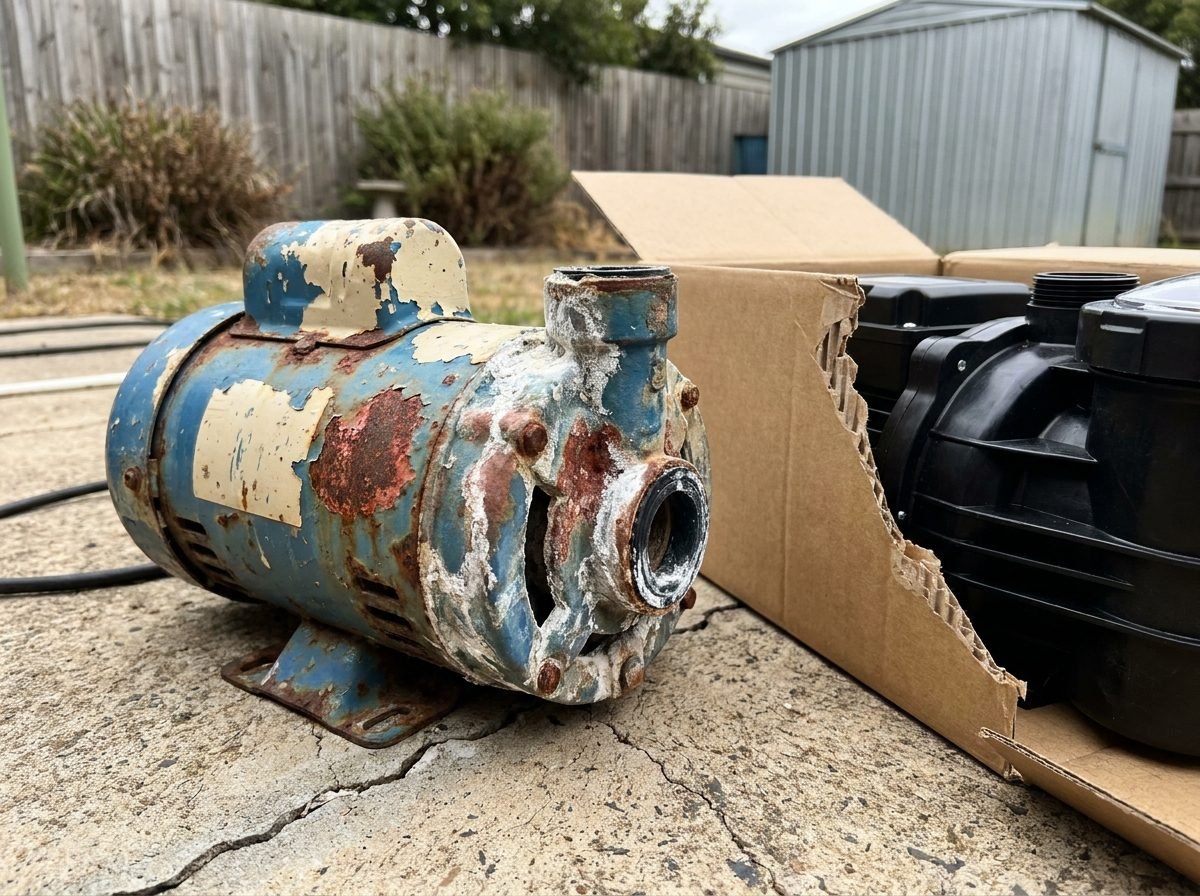
Key takeaway: most Australian pool pumps last 8 to 12 years, but heat, long summer running hours, salt systems and an undersized pump can cut that to 5 to 7 years. The clearest signs it’s on the way out are a grinding or screeching noise, a wet motor housing (a leaking shaft seal), reduced flow even after cleaning the filter, and a motor that trips out or overheats. A pump over 10 years old showing any of these is almost always cheaper to replace than to keep repairing.
A pool pump is a mechanical device with bearings, a seal and a spinning motor running for hours a day, every day, through an Australian summer, so it’s a question of when it wears out, not if. Knowing what a genuine failure looks like, versus a cheap part that just needs replacing, saves buying a new pump years too early or limping along on one that’s already costing you in electricity and repeat repairs.
Typical Pool Pump Lifespan
| Condition | Typical lifespan |
|---|---|
| Well-sized pump, moderate climate, regular maintenance | 8 to 12 years |
| Undersized or poorly maintained pump in a hot AU climate | 5 to 7 years |
| Salt chlorinated pool, coastal or high-use property | Often at the shorter end of the range, extra strain from salt and long run times |
Australian pumps generally work harder than the same model would overseas: long hot summers mean longer daily run times, salt systems add a corrosive element most pumps overseas never see, and a pump that’s the wrong size for the pool it’s running strains constantly rather than occasionally. A pump quoted as lasting 8 years in a mild climate can realistically deliver only 5 to 7 in Australian conditions if any of those factors apply.
Signs It’s Time to Replace, Not Repair
- Grinding, screeching or rattling noise. A healthy pump runs with a quiet, consistent hum. A rough or grinding sound usually means the bearings are worn and close to seizing.
- A wet motor housing. If the motor end of the pump is damp or wet, the shaft seal that keeps pool water out of the motor has failed, and water is getting where it shouldn’t.
- Reduced flow or pressure that cleaning the filter doesn’t fix. If you’ve already backwashed or cleaned the filter and flow is still weak, the pump itself, not the filter, is often the actual bottleneck.
- The motor trips out or overheats repeatedly. Occasional nuisance trips can be wiring or a capacitor, but a motor that keeps overheating under normal load is nearing the end of its working life.
- Visible cracks or leaks in the pump housing itself, as opposed to a fitting or union that just needs a new O-ring.
- You’re calling a pool tech for the same pump more than once a season. Repeated repairs on one unit usually cost more over a year than replacing it once.
Repair or Replace?
Not every symptom means a new pump. A leaking shaft seal is one of the cheapest and most common pool pump repairs, a seal kit typically costs $10 to $20 and is a straightforward swap for anyone comfortable opening the pump housing. A cracked housing, seized bearings, or a motor that has already been rewound once are a different story: at that point you’re paying to keep an old, less efficient motor alive rather than fixing a $15 part. As a rule of thumb, a pump under 5 years old showing one of these symptoms is usually worth repairing; a pump over 10 years old showing more than one is usually cheaper to replace outright once you add up the parts, the callout, and the electricity an old motor wastes compared to a new one.
If You’re Replacing It, Consider a Variable-Speed Pump
Replacing a failed single-speed pump with another single-speed pump is the cheapest option upfront, but a variable-speed pump (VSP) typically saves $700 to $1,200 a year in electricity on an average backyard pool, per both Canstar Blue and AstralPool Australia, with the price difference usually paid back within 12 to 18 months. If your old pump was also running a suction-side pool cleaner, check compatibility first: most suction cleaners need more flow than a VSP’s lowest, most efficient setting provides, as covered in our pool cleaner comparison guide.
More on Pool Equipment
If it’s the filter rather than the pump losing performance, see our guide to how a sand filter works and when to backwash it, or our full pool filters guide for how sand compares to cartridge and DE.
