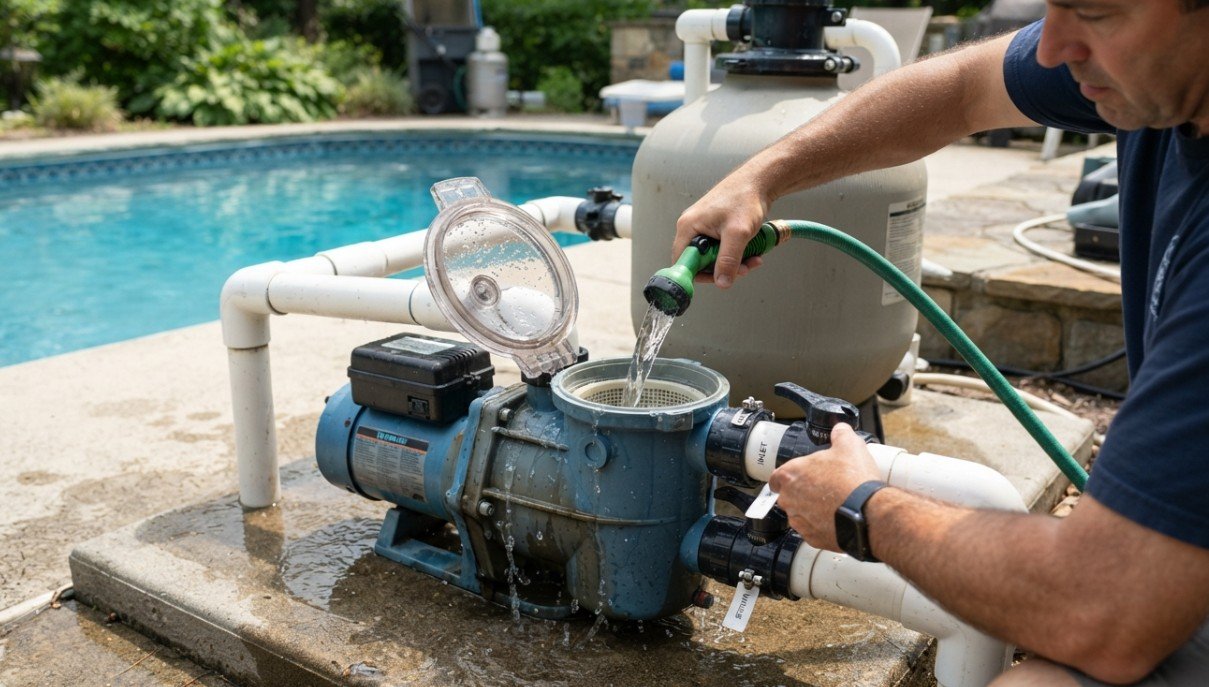
Key takeaway: Priming means forcing trapped air out of the pump so it can actually pull water. Turn the power off first, check the pool water sits at least mid-way up the skimmer opening, empty and refill the pump strainer basket housing with a hose until it is completely full, hand-tighten the lid with a lubricated O-ring, open the air relief valve, then switch the pump back on. A steady, bubble-free stream at the air valve within a couple of minutes means it has caught. Do not let the pump run dry while you troubleshoot, even 30 seconds without water can start damaging the mechanical seal.
A pool pump loses its prime whenever air gets into the system ahead of the impeller, after a filter clean, a power cut, low pool water, or a small suction-side air leak. An unprimed pump will run but will not actually move water, so priming it is a genuine step, not just flicking the switch back on, and doing it wrong (or leaving the pump running dry while you figure it out) is one of the more common ways a pool pump gets damaged.
How to Prime Your Pool Pump
- Turn off the pump at the switch or timer, not just at the pump itself, so it cannot restart while you have the lid off.
- Check your pool water level. It needs to sit at least midway up the skimmer opening, if it is lower than that, the pump will draw air through the skimmer no matter how well you prime it, top the pool up with a hose first.
- If your filter has a multiport valve, switch it to Recirculate before you restart the pump later in this process, sand and DE filters should not be run through Filter mode with air still in the system.
- Open the pump strainer lid and clear out any debris sitting in the basket, then check the basket itself for cracks.
- Check the lid O-ring is clean, undamaged, and has a light coat of silicone lubricant, a dry or cracked O-ring is the single most common reason a pump will not hold its prime.
- Fill the strainer pot completely with a garden hose, right up to the top, before you put the lid back on. A partially filled pot just means more air the pump has to push out on its own.
- Reseat the lid and hand-tighten only, a tool here risks cracking the lid.
- Open the air relief valve on the filter, then turn the pump back on. Watch the strainer basket through the lid and the air relief valve.
- Within about 30 to 60 seconds you should see a solid, bubble-free stream of water at the air relief valve. Close the valve at that point and switch the multiport valve back to Filter.
How Long Should Priming Actually Take?
Show your working: a healthy pump with a genuinely full strainer pot and no leaks should show a solid stream at the air relief valve within 30 to 60 seconds of switching on. If two or three minutes pass with only sputtering or bubbles, turn it off, do not leave it running “to see if it catches”, and repeat the fill-and-restart process. If it still will not hold after a second attempt, stop entirely, that points to an actual leak or blockage rather than trapped air, and running the pump dry while you keep testing is what causes the real damage. Guidance on exactly how long a dry pump can run before the mechanical seal is affected varies (some sources say as little as 30 seconds, others say the seal can tolerate a few minutes), which is exactly why the safer rule is to treat any dry running as something to fix immediately rather than a number to push up against.
Common Reasons a Pump Won’t Prime
- Pool water below the skimmer’s midpoint: the pump draws air through the skimmer regardless of how well the strainer pot itself was filled.
- A dry, cracked or missing lid O-ring: air leaks in around the lid itself, even a well-filled strainer pot will not hold prime with a bad seal here.
- A loose union or valve on the suction side: any fitting between the pool and the pump can pull in air instead of water.
- A clogged skimmer or pump basket: restricted flow can starve the impeller even with plenty of water available.
- A closed valve somewhere in the suction line: easy to overlook after any recent plumbing or equipment work.
Common Mistakes
- Leaving the pump running to “see if it catches”: every extra minute dry is extra heat on the mechanical seal, for no better chance of priming.
- Filling the strainer pot only part way: the pump then has to shift far more trapped air on its own, which is often the actual reason it will not catch.
- Skipping the O-ring check: a dry or cracked O-ring undoes a perfectly good fill-and-restart every time.
- Not checking the pool water level first: no amount of correct pump-side technique fixes a pool sitting below the skimmer.
- Using a tool to over-tighten the lid: hand-tight is enough, and a cracked lid creates a new leak rather than fixing the old one.
When to Call a Pro
Call a pool technician if the pump will not hold prime after a proper fill-and-restart with a good O-ring and correct pool water level, that combination points to a suction-side leak, a failing shaft seal, or an impeller problem that needs diagnosing rather than another attempt at the same steps. A loud screeching noise from the pump while it is running is also a stop-now signal, not something to keep running through.
Frequently Asked Questions
How do I know if my pool pump needs priming?
The pump runs (you can hear the motor) but little or no water is coming from the return jets, and the strainer basket housing looks empty or only partly full through the lid. That combination means the pump is spinning without moving water, which is exactly what priming fixes.
Why does my pool pump keep losing prime?
Repeated loss of prime almost always points to an air leak rather than bad luck: a dry or cracked lid O-ring, a loose union or valve on the suction side, or a pool water level that has dropped below the skimmer’s midpoint. Fix the underlying leak or water level rather than re-priming on repeat.
How long can I run a pool pump dry before it’s damaged?
Treat any dry running as something to stop immediately rather than a number to test. Guidance varies, some sources say the mechanical seal can start taking damage within 30 seconds, others allow a few minutes, but the safe approach is the same either way: if it has not primed within a minute or two, turn it off and check for a leak instead of leaving it running.
What water level does my pool need to be at for the pump to prime?
At least midway up the skimmer opening. Below that, the pump draws air through the skimmer regardless of how well you have filled and sealed the strainer pot itself, so check this before you troubleshoot anything pump-side.
Do I need to turn off the power before priming a pool pump?
Yes, always turn the pump off at the switch or timer, not just leave it running, before you open the strainer lid or touch the basket. This is a basic safety step, not an optional one.
Can a bad O-ring stop a pump from priming?
Yes, a dry, cracked or missing lid O-ring is one of the most common reasons a pump will not hold its prime, since it lets air leak in around the lid itself even when the strainer pot was filled correctly. Check and lubricate it every time you open the lid.
