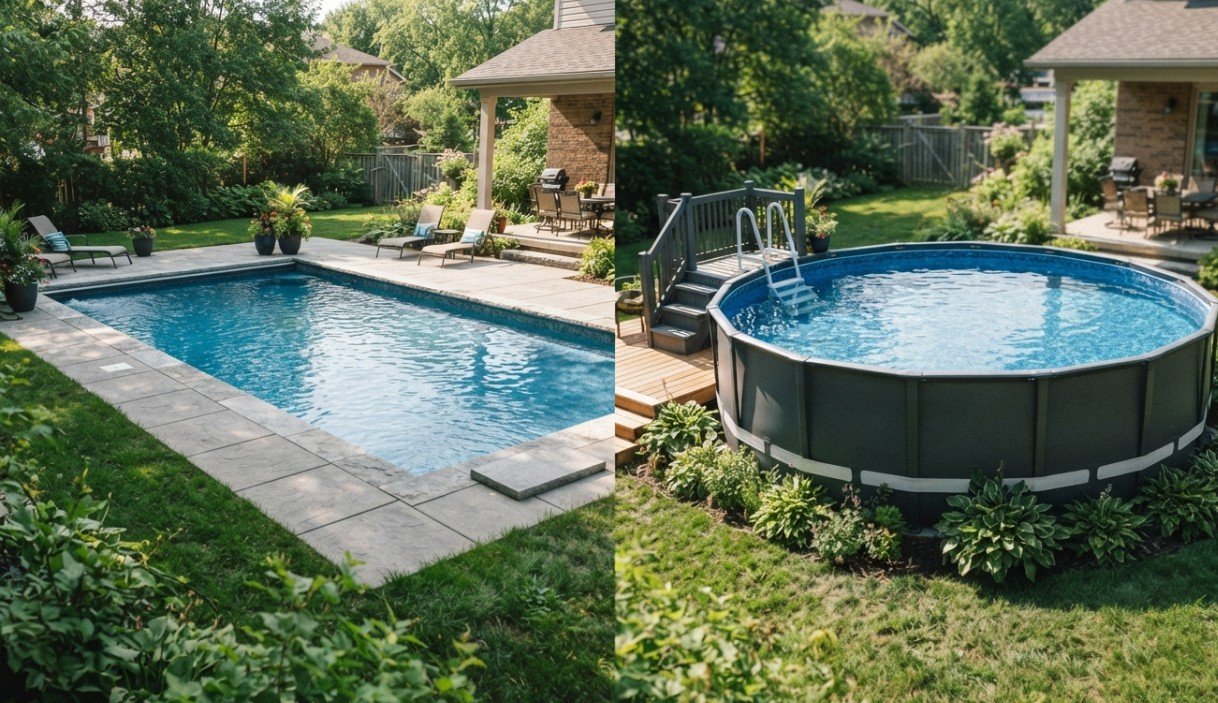
Key takeaway: a basic above ground pool installed in Australia typically costs $10,000 to $35,000 and can be swimming-ready within days. An inground pool runs $35,000 to $100,000 or more and takes 6 to 12 weeks to build. Above ground wins on price and speed; inground wins on lifespan and resale value.
If you’re weighing up an inground pool against an above ground pool, the honest answer comes down to how long you’re staying and what you can spend upfront. An above ground pool gets you swimming for a fraction of the price and in a fraction of the time, but it won’t last as long and won’t add much to your home’s value. An inground pool costs three to five times as much and takes months to build, but it’s a permanent fixture that can genuinely lift your resale price.
At a Glance
| Factor | Above Ground | Inground |
|---|---|---|
| Installed cost (AUD) | $10,000 – $35,000 | $35,000 – $100,000+ |
| Time to install | A few days to 2 weeks | 6 to 12 weeks |
| Typical lifespan | 10-15 years before the liner needs replacing | 20-30+ years (fibreglass), 25-50 years (concrete) |
| Adds resale value? | Little to none, often seen as temporary | Often 30-50% of build cost back |
| Standalone fencing required? | Usually – rules vary by state | Always |
Above Ground Pools: Cost, Speed and the Catch
An above ground pool kit from a retailer like Bunnings or Clark Rubber can be installed for $10,000 to $35,000 fully fitted out, and the basic units themselves start closer to $3,000 to $10,000 before installation, decking or fencing. That price gets you swimming within days rather than months, which is the entire appeal if you’re renting, planning to move within a few years, or just want summer sorted on a tight budget.
The catch is the vinyl liner. Most above ground liners last 6 to 10 years, stretching to around 20 years with careful water balance and consistent cover use, and replacing one typically runs into the thousands. The steel or resin frame underneath usually outlasts the liner, so budget for at least one liner replacement if you’re keeping the pool long term. Above ground pools are also generally viewed as temporary structures, so don’t expect the pool to add meaningful resale value to your home.
Inground Pools: The Bigger Spend, The Bigger Payoff
Inground pools start around $35,000 for a fibreglass shell and climb to $50,000-$100,000 or more for a custom concrete build, depending on size, finish and site access. The material you choose (fibreglass, concrete or vinyl liner) changes both the price and the maintenance workload significantly enough that it deserves its own comparison – see our full guide to fibreglass vs concrete vs vinyl liner pools.
Because an inground pool involves excavation, engineering sign-off and a licensed builder, the build itself typically takes 6 to 12 weeks once permits are approved, and permit approval alone can add weeks on top – see our guide to how long it actually takes to build a pool in Australia for a stage-by-stage timeline. What you get in return is a permanent structure that can add real value: a well-maintained inground pool can return roughly 30 to 50 percent of its build cost in added property value, compared with little to none for an above ground pool.
Pool Fencing: The Rule That Catches People Out
Safety note: pool fencing is state-based law in Australia, not a single national rule, so always confirm the current requirement with your own state or territory before you build or buy. As a starting point: in NSW, an above ground pool’s wall is never accepted as the barrier under any circumstances, so you need a fully compliant standalone fence regardless of pool type. In Queensland, an above ground pool’s wall can count as part of the barrier if it’s at least 1200mm high with no external footholds or bracing a child could climb, but the ladder or access point still needs its own compliant, self-latching gate. Other states apply their own variations, so verify with your local council or a licensed pool safety inspector before you rely on the wall itself.
The underlying technical standard is AS 1926.1, most recently revised in 2024 to clarify non-climbable zone guidance and gate hardware, though the 2012 edition is still the version referenced by the National Construction Code 2022 in most jurisdictions – check with your certifier which edition currently applies in your state before relying on either one. For a full state-by-state breakdown of heights, gaps and non-climbable zones, see our guide to how high a pool fence needs to be in Australia.
Running Costs and Maintenance
Both pool types need filtration and regular chemical dosing, but an above ground pool usually holds less water than an inground pool of a similar footprint, so both the pump size and the chlorine or salt needed per dose tend to be smaller and cheaper to run. The filter you pair with either pool matters more than the pool type itself for long-term running costs – see our guide to sand, cartridge and DE filters compared before you buy one.
Which Should You Choose?
- Renting, short-term, or on a tight budget: an above ground pool gets you swimming for the least money and the least commitment.
- Owner-occupier planning to stay long term: an inground pool costs more upfront but is the only one of the two that reliably adds resale value.
- Sloped or tricky block: an inground pool can be engineered around the slope; an above ground kit needs a level pad, which can mean expensive site prep that erases the price advantage.
- Want to install it yourself: above ground kits are built for DIY assembly; inground pools legally need a licensed builder.
Common Mistakes
- Assuming the pool wall counts as a legal fence everywhere. It doesn’t; NSW rules it out entirely, and other states attach conditions.
- Buying an above ground kit sized for the yard without checking whether the ground needs levelling first. Site prep is a common surprise cost.
- Assuming an above ground pool will add resale value the way an inground pool does. It generally won’t.
When to Call a Pro
Any inground pool build needs a licensed pool builder for the excavation, structure and plumbing. For fencing on either pool type, get a licensed pool safety inspector or certifier to confirm your barrier is compliant before you rely on it, rather than assuming it passes based on a general guide like this one.
Frequently Asked Questions
Is an above ground pool cheaper to run than an inground pool?
Usually yes, mainly because above ground pools hold less water. A smaller volume needs a smaller pump and less chlorine or salt per dose, so both your power bill and your chemical spend tend to come in lower than an inground pool of the same shape.
Can I put an above ground pool on a sloped backyard?
Not directly. Above ground pool kits are designed for a level base, so a sloped block needs cutting, filling or a levelled pad before the pool goes up, which adds cost and can erase the price advantage. An inground pool can be engineered to work with the slope instead of fighting it.
Do above ground pools still need pool fencing in Australia?
In most cases, yes. Some states let a compliant above ground pool wall count as part of the barrier if it meets the height and climb-resistance rules, but NSW does not allow this under any circumstances, and every state still requires a compliant, self-latching gate at the access point. Check with your local council before assuming the wall is enough.
How long do above ground pools actually last before you need to replace the liner?
Most above ground pool liners last 6 to 10 years, or up to around 20 years with careful water balance and cover use. The steel or resin frame underneath can outlast the liner, so a liner replacement is a normal, expected cost rather than a sign the pool has failed.
Does an inground pool add more value to my house than an above ground pool?
Yes, by a wide margin. A well-maintained inground pool can return roughly 30 to 50 percent of its build cost in added property value, while above ground pools are generally viewed as temporary and add little to no resale value.
