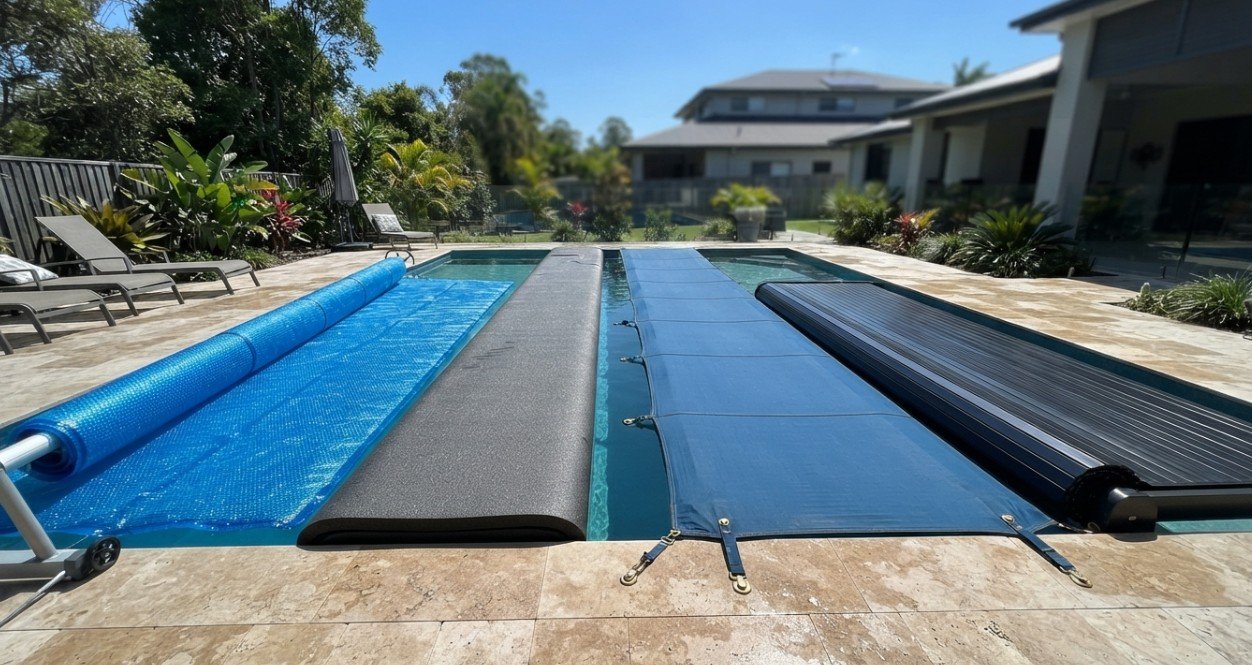
Key takeaway: A pool cover’s job depends on its type. Solar and thermal covers are for heat retention and can add up to 8°C while cutting evaporation sharply, safety covers add a layer of child protection but don’t replace a compliant pool fence in most Australian states, and automatic covers add convenience at a much higher price, typically starting around $20,000 fully installed.
“Pool cover” isn’t one product, it’s a category covering four genuinely different jobs: trapping heat, stopping evaporation, keeping kids and pets out, and keeping leaves off the water when you’re not swimming. Buying the wrong type for your actual problem is the most common mistake we see: a $200 solar blanket when what you actually needed was a compliant safety barrier, or a $20,000 automatic cover when a $450 bubble cover would have solved the real issue, which was heat loss. Here’s what each type does, what it costs in Australia, and how to choose.
Types of Pool Covers Compared
| Cover Type | What It Does | Typical AU Cost | Best For |
| Solar / Bubble Cover | Traps solar heat and cuts evaporation; can add up to 8°C to water temperature | $170 to $820 custom-cut (avg around $450) | Cheapest way to lift temperature and cut heating and water bills |
| Thermal / Foam Cover | Roughly double the insulation of a bubble cover, plus a longer UV life | $220 to $980 custom-cut (avg around $580), from $1,680 installed with a roller | Heated pools, or anyone wanting stronger heat retention than solar alone |
| Safety Cover (solid or mesh) | Rated to restrict access and support weight when fitted and used correctly | Fully installed manual premium vinyl from around $5,139 | An extra layer of protection, on top of (not instead of) a compliant fence in most states |
| Automatic Cover | Motorised, retracts on a track built into the pool coping at the push of a button | Fully installed from around $20,000+ | Convenience and reduced daily hassle, for buyers with the budget |
| Winter / Debris Cover | Heavy-duty tie-down cover that keeps leaves and dirt out of the water off-season | From around $1,099, avg around $2,600 | Cutting off-season cleaning, especially under trees |
| Rigid / Slatted Cover | Hard automated slats instead of a fabric sheet | $3,900 to $12,000+ | Combining safety-cover strength with automatic convenience at a mid-to-high price point |
How to Choose the Right Pool Cover
Match the cover to the actual problem, not the other way around:
- Pool never gets warm enough, or heating bills are high: start with a solar or thermal cover, not an automatic one. Heat retention is what these are built for.
- Young kids or pets around the pool: a rated safety cover adds a real layer of protection, but check your state’s fencing rules below before treating it as your only barrier.
- Constant leaves and debris off-season: a winter or debris cover is the cheapest fix and the one most owners skip until they’re sick of netting the pool every weekend.
- You want a cover you never manually drag on or off: automatic or rigid slatted covers deliver that, if the budget stretches to it.
Pool Cover Sizing and Cost
Most Australian backyard pools aren’t a perfect rectangle, so covers are made to measure rather than bought off the shelf, which is the main reason prices span such a wide range. A basic solar cover for a small rectangular pool can come in under $200, while the same style cut for a large freeform pool with steps and a spa can run past $800. Add a roller if you want to handle the cover without dragging it across the deck yourself; most buyers spend $400 to $850 on one. At the top end, automatic and rigid slatted covers are priced by the linear metre of track and the complexity of the pool’s shape, which is why full installs start around $20,000 and climb from there for anything non-rectangular.
Safety Covers and the Law
Safety note: A pool cover, even a rated safety cover, does not replace a compliant pool fence in most Australian states. Fencing law under AS 1926.1 applies to the pool itself, and NSW, Queensland and Western Australia only let councils approve an alternative barrier case by case, not automatically because a cover is fitted. The main exception is spas in some states, where a secure, child-resistant lockable cover can substitute for a physical barrier. If you’re relying on a cover for child safety, verify the current rule with your local council or building and planning department before assuming it’s compliant. See our state-by-state pool fencing guide for the actual height and barrier requirements.
Installing and Maintaining a Pool Cover
Rinse a solar or thermal cover with fresh water after use to clear chemical residue, dust and pollen, and let it dry fully before rolling or folding it for storage, since packing away a damp cover is the fastest way to grow mould on it. Keep it off rough pavers and coping edges when you’re dragging it on or off, since abrasion is what tears a cheap bubble cover within a season. For safety and automatic covers, check the anchors, track and edge seals each season, since a safety cover that’s failed at one anchor point is no longer doing its job even though it still looks intact from a distance.
Automatic Covers: Are They Worth the Extra Cost?
An automatic cover’s real value isn’t heat retention or evaporation control, solar and thermal covers do both of those jobs for a fraction of the price. What you’re paying $20,000 or more for is convenience and consistency: a cover that goes on and off at the push of a button, every single time, without anyone having to drag it across the deck. That matters more for households where the cover would otherwise sit off half the season because manually handling it is a hassle, and it matters for safety-conscious buyers who want a barrier that’s actually used every day rather than one that’s technically owned but rarely deployed. If cost is the deciding factor and daily convenience isn’t, a solar or thermal cover on a roller gets you most of the heat and evaporation benefit for well under a tenth of the price.
Pairing a Cover With Your Heating Method
A cover isn’t a replacement for a heater, it’s what stops your heater’s work from leaking away overnight. Solar heating in particular benefits from a cover, since the same sunny days that warm your collectors also drive the highest evaporation rates, and a cover claws a meaningful share of that heat back after the sun goes down. Heat pump owners get a similar payoff: a cover cutting effective heating costs by 50 to 70% changes the running-cost comparison between heating methods. If you’re deciding how to heat your pool at all, read our full guide comparing solar, heat pump, gas and electric heating before you commit to a cover type, since the right cover partly depends on which heater you’re pairing it with.
Common Pool Cover Mistakes to Avoid
- Buying an off-the-shelf rectangular cover for a freeform or stepped pool, then being surprised it doesn’t seal properly and barely improves evaporation.
- Storing a solar cover wet or folded tightly for months, which is the fastest way to shorten its 2 to 5 year lifespan through mould and creasing.
- Assuming any cover on the pool satisfies your state’s child-safety fencing requirements without actually checking, see the safety note above.
- Skipping a roller to save money, then giving up on using the cover at all within a season because dragging it on and off by hand is too much friction.
- Ignoring anchor points and edge seals on a safety cover after the first year, when wear there is exactly what turns a rated safety cover into an unrated one.
What to Look For When Buying a Pool Cover
Whatever type you land on, a few practical details separate a cover that lasts from one you’re replacing next season.
- Accurate measurements, not guesswork. Get the pool professionally measured, including steps, benches and spa attachments, since an ill-fitting cover loses most of its evaporation benefit at the gaps.
- UV-stabilised material. Cheaper covers without UV stabiliser degrade and go brittle within a season in most of Australia’s climate.
- Bubble or cell size, for solar covers. Larger, denser bubbles generally trap more heat and last longer than the thin, small-bubble budget option.
- A roller that matches the cover’s weight. A manual roller rated for a small solar blanket won’t hold up well under a heavier thermal or safety cover.
- Warranty length. Reputable Australian suppliers back solar and thermal covers with multi-year warranties against UV degradation, which is a reasonable proxy for material quality.
