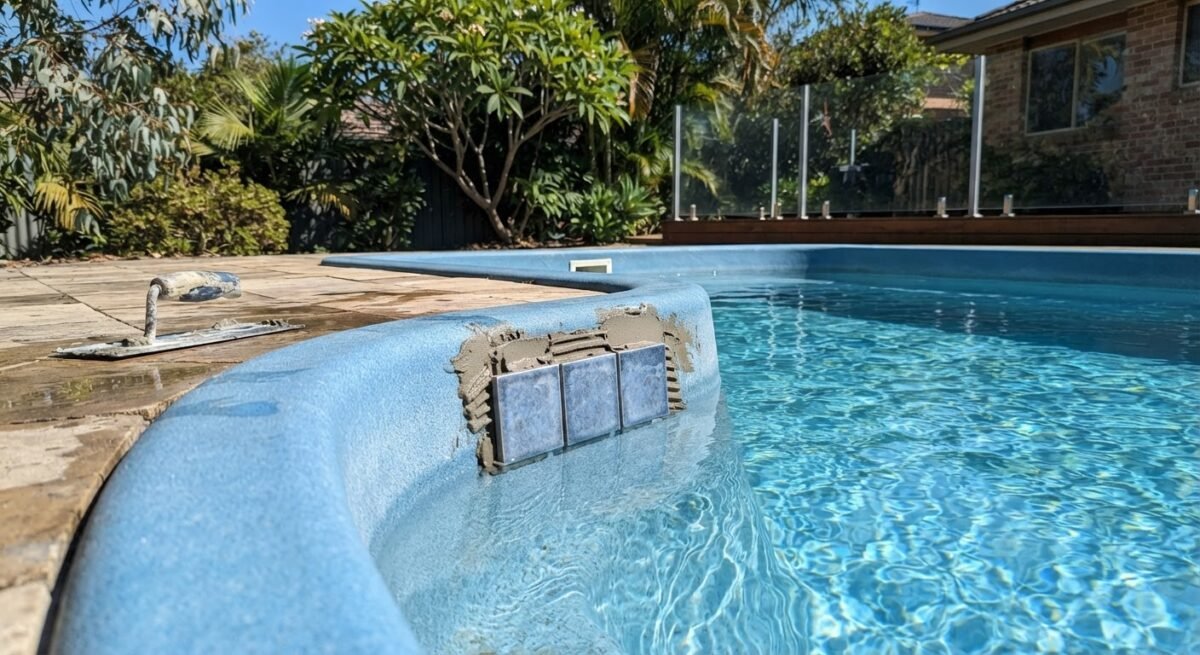
Key takeaway: Yes, but only in the waterline band, above, on and just below the water’s surface, not down the full depth of the shell the way a concrete pool can be tiled. The gel coat must be mechanically roughened and bonded with a flexible epoxy adhesive, not standard cement-based tile adhesive, and a full waterline retile typically costs $3,000 to $6,000 in Australia.
Yes, but only in the waterline band, above, on and just below the waterline, not down the full depth of the shell the way you can with a concrete pool. The fibreglass gel coat has to be mechanically roughened and bonded with a flexible epoxy adhesive rather than standard cement-based tile adhesive, and even then it’s a specialist tiling job, not a weekend DIY project.
Concrete pools can be tiled floor to waterline because the tile bonds directly to a porous, rigid cementitious surface. A fibreglass shell is a flexible, non-porous gel coat, it moves slightly with water pressure and temperature, and it simply isn’t designed to hold a full tiled surface at depth the way concrete is. Waterline tiling works because that band gets the surface prep and adhesive it actually needs, and it’s a manageable area rather than the entire pool interior.
How Waterline Tiling on Fibreglass Actually Works
- Confirm the scope. Waterline tiling only, above, on and just below the water’s surface, not the full shell below depth.
- Roughen the gel coat. The surface needs to be mechanically prepared to a rough finish, roughly equivalent to a CSP2 or CSP3 concrete profile, done carefully since overdoing it can compromise the fibreglass laminate underneath.
- Use an epoxy adhesive, not standard cement-based adhesive. Epoxy gives the best bond to a polyester gel coat surface, cement-based adhesives don’t reliably grip it.
- Check the tile itself. Sheet mosaics need at least 85% of the tile’s back face free for adhesive contact, and must not be backed with a mesh using a water-softening or soluble adhesive, both are common causes of tiles lifting off later.
- Grout with epoxy where possible. If using a cement-based grout instead, stick to white or off-white, coloured cement grout can bleach from pool chlorine over time.
- Account for suction cleaners. Automatic pool cleaners can dislodge a poorly bonded mosaic tile, bonding quality genuinely matters more on fibreglass than it does on a rigid concrete surface.
Common Mistakes
- Assuming the whole pool can be tiled like a concrete shell. This is the single most common misunderstanding, fibreglass tiling is a waterline-band job, not a full-interior renovation.
- Tiling straight across the joint between the pool shell and the surrounding coping. The shell and the concrete surround move differently, a rigid tile bonded across that boundary is likely to crack, a proper installation needs a genuine movement joint at that point.
- Using ordinary cement-based tile adhesive. It’s what most tilers reach for by default, but it doesn’t bond reliably to a gel coat surface, epoxy is the manufacturer-recommended choice.
- Skipping the gel coat roughening step entirely. A smooth, unprepared gel coat gives an adhesive nothing to grip, this is the most common reason a DIY attempt fails within a season.
When to Call a Pro
Essentially always. Roughening a gel coat without damaging the fibreglass laminate underneath takes real judgement, and choosing and applying the right epoxy system isn’t a standard hardware-store job. A waterline retiling job in Australia typically costs from around $180 per linear metre, or roughly $3,000 to $6,000 for a full waterline retile, and that price reflects genuine skilled labour, not just materials.
If you’re still deciding between shell types before you build, our comparison of fibreglass, concrete and vinyl liner pools covers this exact trade-off, tiling flexibility is one of concrete’s genuine advantages, and our guide to what it costs to maintain a pool covers where periodic jobs like this fit into your ongoing budget.
Frequently Asked Questions
Can you tile a fibreglass pool?
Yes, but only in the waterline band, above, on and just below the water’s surface, not down the full depth of the shell the way a concrete pool can be tiled. The gel coat needs to be mechanically roughened and bonded with an epoxy adhesive for the tile to hold.
Can you tile the entire inside of a fibreglass pool like a concrete pool?
No. A concrete pool’s rigid, porous surface can be tiled floor to waterline, but a fibreglass shell’s flexible, non-porous gel coat isn’t designed to hold a full tiled surface at depth, waterline tiling is the practical limit.
What adhesive do you use to tile a fibreglass pool?
Epoxy adhesive gives the best bond to a fibreglass gel coat surface. Standard cement-based tile adhesive, the usual default for concrete pools, doesn’t bond reliably to gel coat and is more likely to fail.
How much does it cost to retile a fibreglass pool waterline?
Waterline retiling in Australia typically costs from around $180 per linear metre, with a full waterline retile commonly landing between $3,000 and $6,000 depending on tile choice and the pool’s perimeter.
Why can’t you tile straight across the pool edge onto the coping?
The pool shell and the surrounding concrete coping move differently in response to temperature and structural movement. A tile rigidly bonded across that joint is likely to crack, a proper installation needs a genuine movement joint at that boundary instead.
Will grout crack or discolour on a fibreglass pool?
Epoxy grout is the more durable option for fibreglass waterline tiles. If a cement-based grout is used instead, stick to white or off-white, coloured cement grout can bleach over time from the pool’s chlorine.
