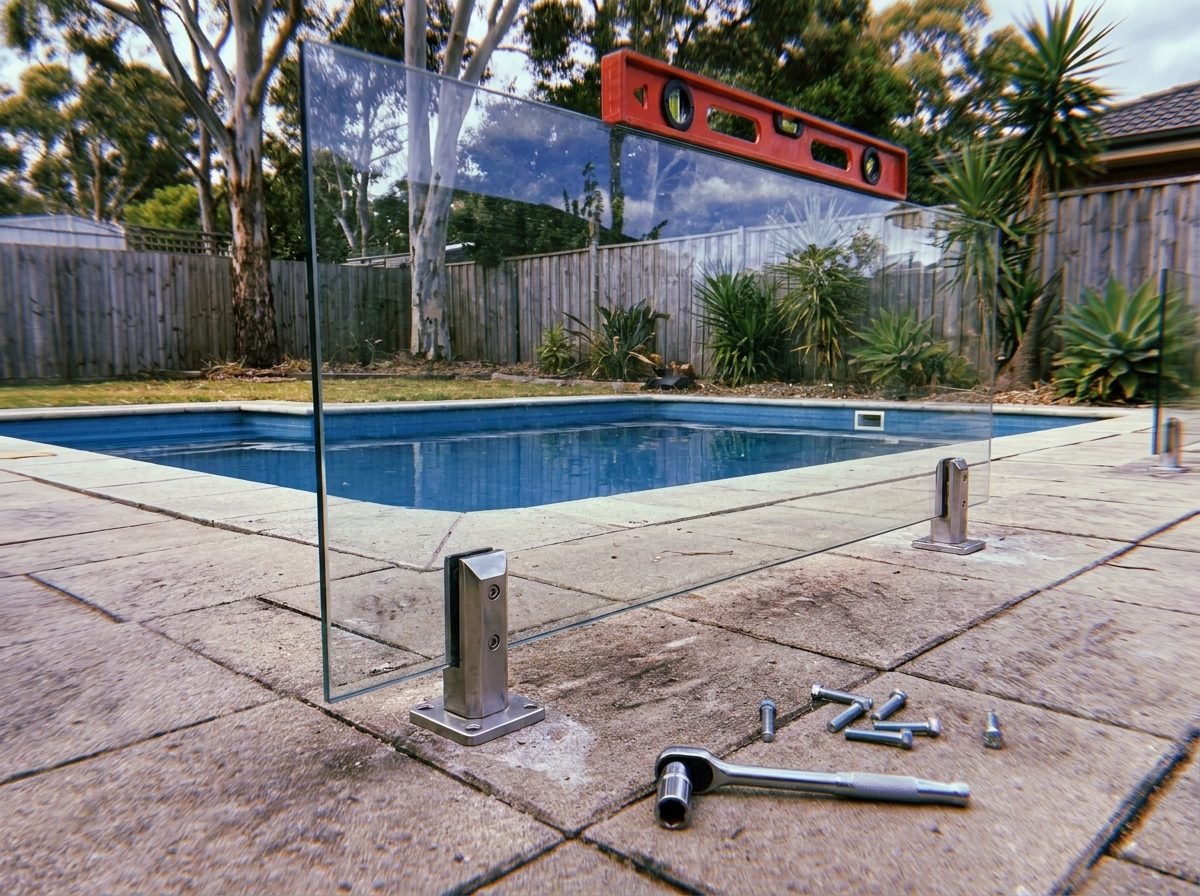
Key takeaway: No Australian state legally bans you from installing your own glass pool fence. But NSW, Queensland and Victoria all require an independent licensed inspector or certifier to sign off on the finished barrier before the pool can legally hold water, so DIY only saves you labour cost, not the compliance step.
Frameless glass panels are the most popular pool fencing style going into new builds right now, and if you’re handy, it’s tempting to save the installer’s labour cost and put it up yourself. You legally can, in every state. What trips people up isn’t the installation itself, it’s that every state still requires an independent, licensed certifier to inspect and sign off on the finished barrier, regardless of who built it, and glass fencing carries its own engineering considerations that a general DIY aluminium or tubular kit doesn’t.
This guide covers the DIY-specific question. For the full state-by-state barrier rules, gaps, heights and self-closing gate requirements, see our Pool Fencing Laws in Australia hub [INTERNAL LINK OPPORTUNITY, pillar page not currently live]. If you just need the height number, our guide on how high a pool fence needs to be covers that state by state.
A safety note: this is a compliance area with real consequences attached. Royal Life Saving Australia recorded 92 drowning deaths of children aged 0 to 4 in Australian swimming pools over the 2014 to 2024 decade, 91% of them in a backyard pool, and a propped-open or poorly latched gate is a recurring factor. Non-compliant fencing isn’t a paperwork problem, it’s a real safety gap. Always verify your specific requirements with your local council before you build, since council interpretation of the state standard can vary even within the same state.
What the Standard Actually Requires
AS 1926.1:2024 is the current edition of the barrier standard (published August 2024, with Amendment No. 1 in October 2024), replacing a 2012 edition that had been in place for over a decade. It sets the barrier performance rules: minimum height, maximum gaps, non-climbable zones around the fence. What it doesn’t specify is the structural engineering for frameless glass panels themselves, spigot and clamp load calculations for wind and impact are covered separately under AS 1170.1 (structural design actions), which spigot manufacturers reference for their load ratings. The glass itself needs to be toughened safety glass meeting AS 2208 and AS 1288, typically 12mm for a frameless system.
In practice, this means there’s no licence required to physically install a glass pool fence, but getting the spigot engineering right for your local wind exposure, especially anywhere coastal or exposed, is a genuine technical calculation, not a guess. That’s the gap a general “can I DIY my pool fence” article tends to skip.
State by State: Who Has to Sign Off
| State | Can you install it yourself? | Who certifies it | Certificate validity |
| NSW | Yes | A council or a Fair Trading-registered pool safety inspector or certifier | 3 years |
| Queensland | Yes | A QBCC-accredited pool safety inspector; the pool must be on the QBCC Pool Safety Register | Ongoing owner responsibility, checked at point of sale or lease |
| Victoria | Yes | A registered pool inspector, building inspector or building surveyor, lodged with council within 30 days | 4 years |
None of these three states will let you self-certify your own installation, even if you’re confident it meets the standard. The inspection step exists specifically because an owner-builder isn’t considered an independent check. If you’re outside NSW, Queensland or Victoria, the same principle holds everywhere in Australia: check your specific state building or planning department, since certifier titles and renewal periods differ state to state.
Installing It Yourself, Step by Step
- Check your state and council requirements before you buy anything. Confirm panel height, ground clearance and gate swing rules for your specific council, since interpretation of the state standard can vary locally.
- Get a proper spigot layout and wind-load calculation for your site. This is where DIY installs most often fall short, an undersized or incorrectly spaced spigot is an engineering failure waiting to happen, not just a compliance one.
- Confirm your glass meets AS 2208 and AS 1288 before you install it. Toughened safety glass should carry a permanent stamp or etching confirming compliance; don’t take a supplier’s word for it without seeing it on the panel itself.
- Set panels with a maximum 10mm gap between panel and spigot, and check the finished gap under the fence doesn’t exceed 100mm anywhere along its length.
- Fit a self-closing, self-latching gate that opens outward, away from the pool, with the latch release mechanism at least 1.5m above ground level.
- Book your council or licensed inspector before you consider the job finished. The barrier isn’t legally compliant, and the pool isn’t legally allowed to hold water, until it passes that independent inspection.
Where DIY Installs Actually Fail Inspection
- Gaps under panels over 100mm, often from uneven ground that wasn’t accounted for during layout.
- Gates that don’t reliably self-close and self-latch, or a latch mounted below the required height.
- Panel-to-panel spacing wider than the standard allows.
- Glass that isn’t actually toughened to AS 2208, or spigots not engineered for the site’s wind exposure.
When to Call a Professional Instead
If your site is coastal, elevated, or otherwise exposed to higher wind loads, get a structural engineer or licensed installer to size the spigots properly rather than relying on a generic spacing chart. It’s also worth using a licensed installer if this is your first time working with frameless glass at all. A cracked or incorrectly rated panel is an expensive and dangerous mistake to make on a safety barrier.
Frequently Asked Questions
Is it legal to install my own glass pool fence in Australia?
Yes, in every state. But the finished barrier still needs certification from a licensed inspector, which varies by state, before the pool can legally hold water or be used.
Do I need a licensed installer for frameless glass pool fencing?
No licence is required to install it, but spigot and wind-load engineering plus AS 2208 glass compliance make a professional install the lower-risk option, especially in coastal or exposed areas.
What glass thickness is required for a compliant pool fence?
Typically 12mm toughened safety glass for a frameless system, meeting AS 2208 and AS 1288.
Who can issue a pool fence compliance certificate?
A Fair Trading-registered inspector in NSW, a QBCC-accredited pool safety inspector in Queensland, or a registered building or pool inspector in Victoria. Never the homeowner themselves.
What is the most common reason a DIY glass pool fence fails inspection?
Gate self-closing and self-latching hardware, and gaps under panels or between panels exceeding the standard’s limits.
How often does a compliant pool fence need re-certification?
Every 4 years in Victoria. NSW certificates last 3 years. Queensland requires certification at point of sale or lease, with ongoing owner responsibility for compliance in between.
Sources
- Standards Australia, Standards Spotlight: AS 1926.1:2024
- NSW Government, Pool owner obligations
- QBCC, Inspect and certify your pool
- Victorian Building and Plumbing Commission, Swimming pools and spas
- Royal Life Saving Society Australia, Drowning Research
- Spigot Factory Australia, AS 1926.1 compliance for glass pool fence spigots
