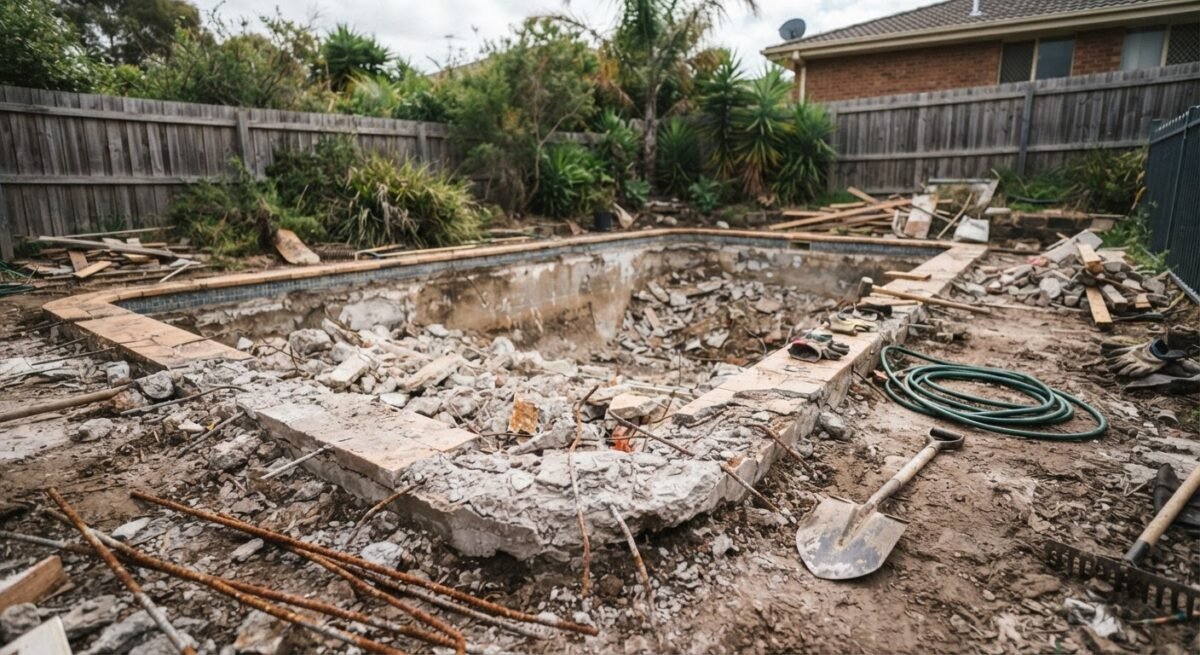
Key takeaway: Removing a pool in Australia costs $3,000 to $20,000 or more, mostly driven by whether it’s a partial fill-in or a full removal, and which state you’re in. Perth quotes typically run $4,000 to $9,500 for a partial concrete removal and $8,500 to $16,000 for a full one, NSW averages $5,000 to $20,000, and an above-ground pool comes out for as little as $1,100 to $3,200.
A professional pool removal service prices the job on the same handful of factors wherever you are in Australia: pool material, whether you’re doing a partial fill-in or a full removal, and how easily their machinery can actually get to your backyard. Our guide to how much it costs to fill in a swimming pool covers the backfilling process itself, including the permit and safety-barrier rules you need to know before you start. This guide focuses on what a removal contractor actually charges, state by state.
| Pool type / job | Typical cost range (AUD) | Region reference |
|---|---|---|
| Above-ground pool removal | $1,100–$3,200 | Perth |
| Fibreglass inground, removal | $3,500–$8,500 | Perth |
| In-ground spa or plunge pool | $2,200–$4,800 | Perth |
| Concrete, partial removal (collapse and fill in place) | $4,000–$9,500 | Perth |
| Concrete, partial removal | $5,000–$10,000 | NSW |
| Concrete, full removal (shell dug out entirely) | $8,500–$16,000 | Perth |
| Concrete, full removal | $10,000–$20,000+ | NSW |
What Actually Drives the Price
- Machine access. Contractors consistently call this the single biggest swing. A pool a mini-excavator can drive straight to costs far less than one behind a narrow side gate, where a surcharge of $1,200 to $3,800 for hand demolition or smaller machinery is common.
- Material. Concrete needs to be broken up with heavier machinery than fibreglass, which adds labour cost on top of a bigger disposal bill if you’re going full removal.
- Partial vs full removal. Partial removal keeps most of the shell in the ground, so it’s cheaper. Full removal digs out and hauls away the entire shell, which costs more but leaves a genuinely clean site if you’re planning to build over the footprint later.
- Crane lifts and backfill volume. A crane lift for equipment or material access typically adds $900 to $2,500, and backfill and compaction runs $50 to $95 per cubic metre, so a bigger pool means proportionally more fill.
Council Permits and the Fencing Catch
Most councils require a permit before a pool removal starts, in NSW this is commonly a Complying Development Certificate or a full Development Application, and expect an inspection of the finished job in most areas. Budget roughly $110 to $250 for permit fees on top of the removal quote itself. The catch that surprises a lot of homeowners: your pool remains a legal “swimming pool” requiring a compliant safety barrier for as long as it can hold water, not just while it’s in use, so removing the fence before the job is genuinely finished and inspected is a real safety and compliance risk. Our full guide to filling in a pool covers this rule in detail.
Is It Worth Removing an Old Pool, or Better to Sell As-Is?
If the pool is tired, non-compliant, or you simply never use it, removal cost is only half the decision. A neglected or non-compliant pool can be a genuine liability at sale time, buyers and their inspectors do ask, and a pool without a current compliance certificate can complicate settlement. But an inground pool in good condition, in the right suburb, can still add real value to your sale price. Before committing to a removal quote, it’s worth reading our guide to whether a pool actually adds value to your house, since in some markets keeping and properly maintaining the pool is the cheaper long-term option.
If removal isn’t the right call and you’re considering a fresh build instead, our breakdown of what it actually costs to build a pool shows what you’d be paying to replace it, on the same block or elsewhere.
Frequently Asked Questions
How much does it cost to remove a concrete pool in Australia?
A partial removal, where the shell is collapsed and backfilled in place, typically costs $4,000 to $10,000. A full removal, where the entire shell is dug out and hauled away, typically costs $8,500 to $20,000 or more, with NSW generally at the higher end of that range.
How much does it cost to remove a fibreglass pool?
Fibreglass pool removal typically costs $3,500 to $8,500, cheaper than concrete because the shell doesn’t need to be broken up with heavy machinery before it can be lifted out.
Is it cheaper to partially fill in a pool or fully remove it?
Partial fill-in is cheaper because it keeps most of the shell in the ground rather than digging it all out and hauling it away. Full removal costs more but leaves a genuinely clean site, which matters if you’re planning to build over the old footprint later.
Do pool removal costs vary a lot by state?
Yes. Perth quotes for a concrete pool typically run $4,000 to $16,000 depending on removal type, while NSW averages run $5,000 to $20,000. Access, local labour rates and council requirements all shift the number regionally.
Do I still need a pool fence while the pool is being removed?
Yes. Your pool remains a legal swimming pool requiring a compliant safety barrier for as long as it can hold water, right up until the removal is complete and, in most councils, inspected. Taking the fence down early is a common and genuinely dangerous mistake.
Is it worth removing an old pool before selling my house?
It depends on the pool’s condition and your suburb. A neglected or non-compliant pool can hurt a sale, but a well-maintained inground pool in a warm-climate, family-friendly area can still add real resale value, so it’s worth checking the value case before booking a removal.
