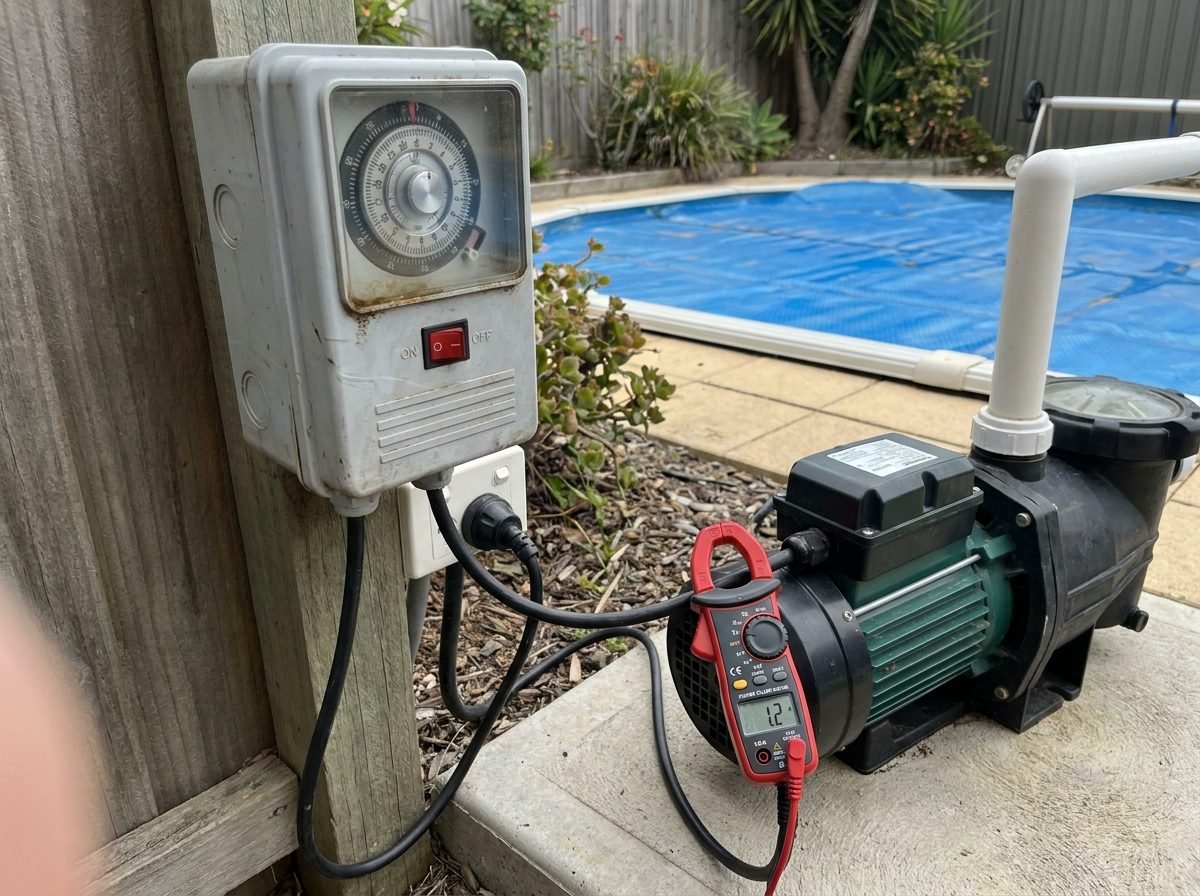
Key takeaway: a typical single-speed pool pump draws 1,500 to 2,500 watts and can use up to 3,000 kWh a year, while a variable-speed pump (VSP) run on its low, everyday setting draws around 300 watts and typically uses 1,000 to 2,400 kWh a year across its whole speed range. At a rough Australian rate of $0.30 per kWh, that’s the difference between roughly $1,300 to $1,800 a year and $300 to $700 a year to run the same pool, before you even factor in an efficient pump’s star rating.
Your pool pump is almost certainly the single biggest electricity user in your backyard, running for hours a day, every day, for months at a time. Working out what it actually costs isn’t guesswork: it comes down to three numbers you can check yourself. For the pump itself, its lifespan and when to replace it, see our guide to how long pool pumps last.
How Much Power Different Pumps Actually Draw
| Pump type | Typical power draw | Typical annual energy use |
|---|---|---|
| Single-speed pump | 1,500 to 2,500 watts | Up to around 3,000 kWh/year |
| Variable-speed pump (VSP), low/eco setting | Around 300 watts | 1,000 to 2,400 kWh/year across its full speed range |
A single-speed pump only has one setting, full power, whenever it’s on, which is why its energy use tracks almost entirely with how many hours a day it runs. A VSP can run most of the day on a low flow setting for routine filtering and only ramp up to full speed for shorter jobs like vacuuming or a chlorinator boost, which is where most of its saving actually comes from, not any difference in how efficiently it moves the same volume of water at full speed.
Working Out Your Own Running Cost
The formula is the same regardless of pump type: (watts ÷ 1,000) × hours run per day × your electricity rate ($/kWh) × 365. Check your pump’s rating plate for its actual wattage and your electricity bill for your actual rate, since both vary and this is where a generic online estimate usually goes wrong.
Worked example, a common single-speed setup: a 2,000-watt pump run 8 hours a day at $0.30 per kWh. That’s 2 kW × 8 hours = 16 kWh a day, × $0.30 = $4.80 a day, × 365 = roughly $1,752 a year. The same pool on a VSP’s 300-watt low setting for the same 8 hours works out to 2.4 kWh a day, $0.72 a day, or roughly $263 a year, though in practice a VSP is often run for more total hours a day at that low setting, which is still normally far cheaper overall than the equivalent single-speed run time. Use the actual figures for your own pump and tariff rather than either example number.
Check the Energy Rating Label Before You Buy
Since 1 October 2022, every pool pump sold or supplied in Australia must display a mandatory Energy Rating star label and meet minimum energy performance standards under the GEMS Act 2012, the same regulator behind the star ratings on fridges and air conditioners. It’s a genuinely useful, standardised way to compare pumps side by side rather than trusting a brand’s own efficiency claims, and the gap is real: a 6-star pump uses roughly 563 kWh a year against about 1,319 kWh for a 1-star model doing the same job.
Common Mistakes
- Comparing pumps on purchase price alone and ignoring the Energy Rating label, which is designed for exactly this comparison
- Using a generic overseas electricity rate instead of checking your own bill, when rates vary significantly by state, retailer and time of use
- Assuming a VSP is automatically cheap regardless of how long it’s run; it’s cheap per hour on a low setting, not free to run all day
- Not checking whether you’re on a time-of-use or solar feed-in tariff, where shifting pump run time to off-peak hours or the middle of the day can matter as much as the pump’s wattage itself
More on Pool Equipment
For how many hours a day to actually run your pump, see how long a pool pump should run each day. For signs your current pump is on its way out, see how long pool pumps last, and for the filter side of your system, see our pool filters guide.
Frequently Asked Questions
How many watts does a pool pump use?
How much does it cost to run a pool pump per day?
Do pool pumps need an energy rating label in Australia?
How much can a variable-speed pump actually save on electricity?
Does running my pool pump at night save money?
Sources
- Energy Rating (Australian Government) – New Mandatory Standards and Labelling Requirements for Swimming Pool Pumps
- Zodiac Australia – Choosing an Energy-Efficient Pool Pump
- AstralPool Australia – How Much Can You Actually Save With a Variable Speed Pump?
- Canstar Blue – Pool Pump Power Consumption & Running Costs
