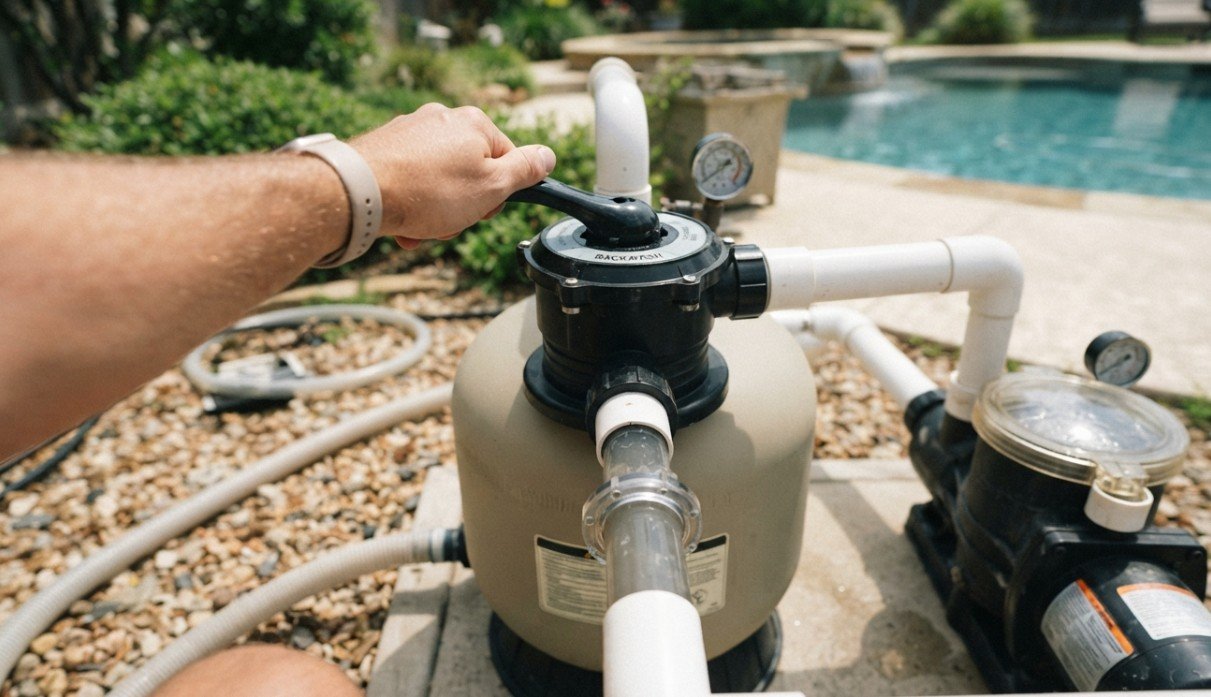
Key takeaway: Backwash a sand or DE filter when the pressure gauge reads 55 to 70 kPa (8 to 10 psi) above its clean, just-backwashed baseline, not on a fixed calendar. Turn the pump off before you touch the valve, backwash for 2 to 3 minutes until the sight glass runs clear, then rinse for 30 to 60 seconds before switching back to Filter. A DE filter also needs a fresh slurry of powder, roughly 0.5kg per square metre of filter area, added back through the skimmer before you restart. And the waste water itself needs to go down your sewer connection, not onto the lawn or into a stormwater drain.
Backwashing is running water backwards through your sand or DE filter to flush out the dirt it has trapped, and it is the one piece of pool maintenance most owners either forget entirely or do on a fixed two-week schedule whether the filter needs it or not. Neither is right. The filter itself tells you when, through the pressure gauge on the lid, and sand and DE filters are backwashed the same basic way but need different finishing steps afterwards.
Sand vs DE Filter Backwashing at a Glance
| Aspect | Sand Filter | DE Filter |
|---|---|---|
| Backwash trigger | 55 to 70 kPa above clean baseline | 55 to 70 kPa above clean baseline |
| Backwash duration | 2 to 3 minutes, until sight glass runs clear | 1 to 2 minutes, repeated with rinses (see below) |
| Rinse cycle needed? | Yes, 30 to 60 seconds, once | Yes, 30 seconds, up to 3 times |
| Recharge needed? | No, sand stays in the tank | Yes, fresh DE powder every time |
| Typical interval | Every 2 to 4 weeks in summer | Every 4 to 6 weeks, plus a full strip-down twice a year |
How to Backwash a Sand Filter
- Turn off the pump at the switch. Never move the multiport or slide valve while the pump is running, it can shear the valve spider or blow a gasket.
- Roll out and connect the backwash hose to the waste port before you touch the valve, so you are not chasing water once it starts flowing.
- Move the valve handle to Backwash and lock it in position.
- Turn the pump back on. Let it run for 2 to 3 minutes, watching the sight glass on the valve, until the water runs clear rather than cloudy or brown.
- Turn the pump off again and move the valve to Rinse, locking it in position.
- Run the pump for 30 to 60 seconds on Rinse. This resettles the sand bed in the right direction and flushes any debris the backwash loosened but did not clear.
- Turn the pump off, move the valve back to Filter, lock it in position, and restart the pump. Check the pressure gauge has dropped back to close to your clean baseline reading.
How to Backwash and Recharge a DE Filter
A DE filter uses the same valve and the same basic backwash motion as a sand filter, but the diatomaceous earth powder that does the actual filtering washes out with the dirt every time, so it has to go back in before you switch back to filtering.
- Turn off the pump and move the valve to Backwash, locked in position.
- Run the pump for 1 to 2 minutes, then turn it off and switch to Rinse for 30 seconds. Repeat this backwash-then-rinse pair up to three times, until the sight glass runs clear each time. One pass rarely clears a DE tank properly.
- Turn the valve to Filter and prime the pump: open the strainer basket lid, top it up with water, and start the pump so it is running before you add powder.
- Mix your DE powder with water in a bucket until it is a pourable slurry, not a dry powder and not a liquid. As a working figure, use roughly 0.5kg of DE powder per square metre of your filter’s rated area, check your filter’s nameplate for its exact area since tank sizes vary.
- With the pump running, pour the slurry slowly into the skimmer basket so it draws through to the filter rather than sitting in the basket.
- Let the pump run for at least 30 minutes so the DE coats the grids evenly before you leave it to filter normally.
Health note: DE powder is respirable crystalline silica, which is a genuine lung hazard if you breathe the dry powder in over time, not just an irritant. Mix it with water outdoors rather than indoors, avoid creating dust, and wear a properly rated dust mask while you are handling the dry powder. Safe Work Australia sets the national workplace exposure standard for respirable crystalline silica at 0.05 mg/m³ over an eight-hour day, the same substance, the same caution applies at home.
How Do You Know It’s Actually Time?
Show your working: note your pressure gauge reading straight after a backwash, that is your clean baseline, say 55 kPa. Check it again each week. If it climbs to 115 to 125 kPa, 60 to 70 kPa above baseline, it is time to backwash, regardless of whether that happens after five days or five weeks. A pool that gets heavy leaf litter or a run of hot, high-swim days will hit that number faster than a quiet winter month, which is exactly why a fixed fortnightly schedule either wastes water on a clean filter or leaves a genuinely clogged one running too long.
Where Does the Backwash Water Go?
Backwash water is chlorinated pool water, and most Australian water utilities require it to be discharged to your sewer connection, not run onto the garden or into a stormwater drain or gutter. Sydney Water, for example, is explicit that pool water must not enter the stormwater system because it needs treatment, and should instead be discharged to the wastewater system via the backwash hose or by siphoning. Rules and the exact connection point are set by your local water utility or council, not nationally, so check with yours before you run a hose to a garden bed or the street.
Common Mistakes
- Moving the valve with the pump running: this is the single most common way to break a multiport valve, always switch off first.
- Skipping the rinse cycle on a sand filter: without it, loosened sand and debris get pushed straight back to the pool the moment you switch to Filter, leaving cloudy water for the first few minutes.
- Forgetting to recharge a DE filter: running a DE filter without powder after a backwash does nothing to filter the water and can push fine debris straight through to the pool.
- Backwashing on a fixed schedule instead of the gauge: either wastes hundreds of litres of water on a filter that did not need it, or leaves a genuinely clogged filter running past the point it is doing much filtering at all.
- Running backwash water onto the lawn or a stormwater drain: chlorinated water is meant for the sewer connection in most areas, check with your local water utility.
When to Call a Pro
Get a pool technician out if the pressure climbs back up within a day or two of backwashing, that usually points to a cracked lateral, a torn grid, or degraded sand rather than a normal debris load. The same goes for sand or DE powder appearing in the pool itself after you have backwashed correctly, that is a filter internals problem, not something another backwash will fix.
Frequently Asked Questions
How often should I backwash my pool filter?
There is no universal number, go by the pressure gauge, not the calendar. Most sand filters need it every 2 to 4 weeks over summer, and DE filters every 4 to 6 weeks, but a pool with heavy leaf litter or constant heavy use will need it more often. Backwash when the gauge reads 55 to 70 kPa above its clean baseline, whenever that happens to fall.
Can you backwash a pool filter too much?
Yes. Backwashing before the filter actually needs it wastes hundreds of litres of water and, on a sand filter, can loosen the sand bed unnecessarily. If your gauge is still close to its clean baseline reading, leave it alone rather than backwashing on a fixed schedule.
Do you backwash a cartridge filter the same way?
No. Cartridge filters are not backwashed at all, there is no valve to switch. Instead you turn off the pump, open the filter housing, remove the cartridge, and hose it down (or soak it in filter cleaner) before putting it back in.
How much DE powder do I need to recharge my filter?
As a working figure, roughly 0.5kg of DE powder per square metre of your filter’s rated area, mixed into a slurry with water. Check your specific filter’s nameplate for its exact rated area, since tank sizes vary between models.
Is it safe to breathe in DE filter powder?
No, avoid it. DE powder is respirable crystalline silica, a genuine lung hazard with repeated exposure, not just a nuisance dust. Mix the slurry outdoors, avoid creating a dust cloud when you pour it, and wear a properly rated dust mask while handling the dry powder.
Where should backwash water go?
To your sewer connection, in most Australian areas, not onto the garden or into a stormwater drain. Chlorinated pool water needs treatment before release, which is why water utilities like Sydney Water require it to go to the wastewater system. Check your own local water utility for the exact rule and connection point.
