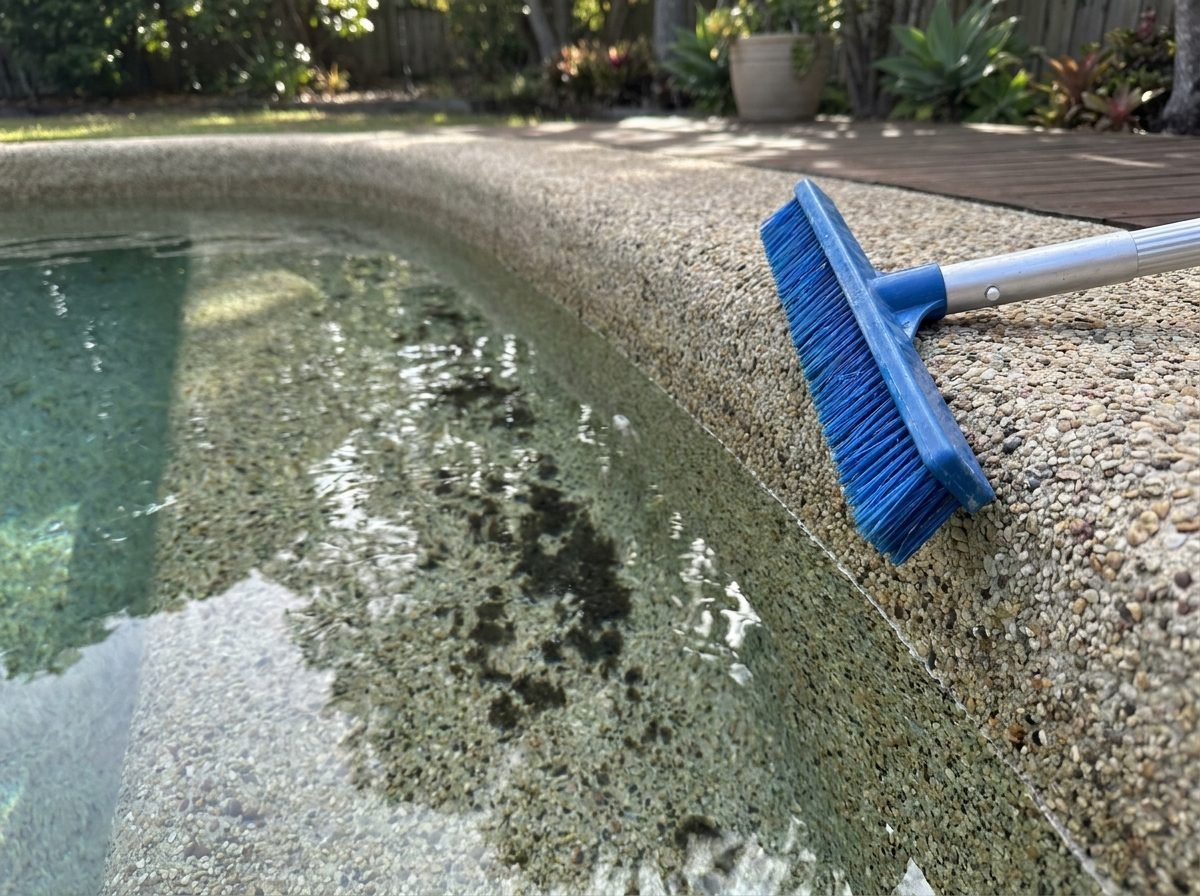
Key takeaway: Black spot algae won’t clear at normal chlorine levels. It grows a protective outer layer that shields it from your usual 1 to 3 ppm sanitiser, so it needs a stainless-steel brush to break that layer open, plus a sustained shock of roughly 20 to 30 ppm free chlorine, repeated daily for 3 to 5 days before it’s actually gone.
Those small black or blue-black dots on your pool’s walls or floor aren’t dirt, and they won’t budge no matter how much you vacuum. That’s black spot algae, and it survives at chlorine levels that would easily kill the green, floating kind. Clearing it takes three things working together: hard brushing with a stainless-steel brush, a much heavier chlorine shock than a normal green-algae treatment, and repeating both for several days in a row, not once.
This guide is part of our Pool Water Chemistry 101 hub. If your pool has actually gone green rather than black-spotted, our guide on why your pool turns green covers that fix, and this one assumes you’ve already got a current pH and chlorine reading using the same process in how to shock a pool.
A safety note before you start: granular calcium hypochlorite pool shock is a hazardous oxidising chemical. It causes serious skin and eye burns on contact and reacts dangerously if it touches pool acid, chlorine tablets or anything organic, so store it separately and never mix products. Always add chemicals to water, never water to chemicals, and wear gloves and eye protection while dosing. For any chemical exposure, call the Australian Poisons Information Centre on 13 11 26, available 24 hours a day.
What You’ll Need
- A stainless-steel pool brush, not a nylon one. Nylon can’t break through the protective layer or reach into rough, pitted surfaces where black spot embeds.
- Granular calcium hypochlorite pool shock, at least 65 to 70% available chlorine.
- A current pH and free chlorine test kit or test strips.
- A pool vacuum, manual or robotic, for the dead algae that comes loose.
- Optional: a copper-based algaecide rated for pool use.
- Your pool’s volume in litres. See our guide to swimming pool sizes, dimensions and litres if you don’t already know it.
Why Normal Chlorine Levels Don’t Touch It
Green algae floats freely in the water, so a normal 1 to 3 ppm free chlorine level and decent circulation is usually enough to keep it from taking hold. Black spot algae is different on both counts. It secretes a waxy, protective outer layer and roots itself into rough or pitted concrete, grout and pebblecrete, physically anchoring below the surface your chlorine actually touches. Your test kit can read a perfectly normal chlorine level and the black spots simply won’t care, because the sanitiser never reaches the organism underneath its own shield.
Shock Dose by Coverage
For comparison, a standard green-algae or after-heavy-use shock using granular chlorine is typically dosed around 100 to 170g per 10,000 litres, per Hy-Clor’s own label guidance. Black spot needs roughly double that, sustained for longer, because the dose has to punch through the protective layer, not just sanitise the surrounding water:
| Coverage | Granular chlorine (min. 700g/kg strength) | Free chlorine target |
| Light, isolated patches | Around 1kg per pool | 20 to 30 ppm |
| Moderate coverage | 2 to 4kg per pool | 20 to 30 ppm |
| Widespread or heavy coverage | Up to 10kg per pool | 20 to 30 ppm |
After the initial shock, most Australian guidance has you step the free chlorine target down over the following week: roughly 10 to 15 ppm through week one, then back to a normal 3 to 5 ppm once the patches have visibly lifted. Dissolve granular chlorine in a bucket of water first, never pour it in dry, and add it at dusk or after dark so UV doesn’t burn off the dose before it can work.
How to Get Rid of Black Algae, Step by Step
- Correct pH and alkalinity first. Get pH into 7.2 to 7.6 and total alkalinity into roughly 80 to 150 ppm before you shock. Chlorine barely sanitises above pH 7.8, so shocking a high-pH pool wastes most of the dose.
- Brush every visible patch hard, before you shock. This is the step that actually matters most. A stainless-steel brush needs to physically break open the protective layer so the chlorine that follows can reach the organism underneath, not just the water around it.
- Shock to 20 to 30 ppm free chlorine using the coverage table above as your starting dose.
- Decide on the pump. Sources genuinely disagree here: some recommend switching the pump off for 24 to 36 hours so the chlorine sits directly on the affected surfaces, others recommend running it to circulate the shock through the whole pool. Either approach works. What actually clears black spot is the brushing and the repeat treatment below, not which one you pick.
- Add a copper-based algaecide if patches don’t lift after the first shock. Keep copper under roughly 0.8 ppm, below the general 1 ppm ceiling used in Australia, since copper itself can stain a pool surface at higher levels.
- Brush and top up the shock daily for 3 to 5 days. Black spot rarely clears from a single treatment. Expect to repeat the brush-and-shock cycle for several days running before the patches are actually gone, not faded.
- Once it’s clear, keep brushing twice a week for a month. Spores can survive in surface pores even after visible algae is gone, and this is what stops it coming straight back.
- Retest before anyone swims. Wait until free chlorine has dropped back to a normal 1 to 3 ppm and pH is balanced.
Common Mistakes
- Using a nylon brush. It glides over the protective layer instead of breaking it.
- Shocking before brushing. The chlorine treats the water, not the algae anchored below the surface.
- Treating it once and stopping. A single shock rarely finishes the job; the repeat days are not optional.
- Mistaking it for green algae and under-dosing. A normal green-algae shock is roughly half the strength black spot actually needs.
- Letting anyone swim before chlorine and pH are back in range.
When to Call a Pro
Get a pool professional involved if the patches keep returning within weeks despite repeat treatment, since that can point to a pitted or damaged surface that needs acid washing or resurfacing rather than more chlorine. The same goes for vinyl-liner or fibreglass pools, where aggressive stainless-steel brushing risks scratching the surface. A professional can recommend a removal method that won’t damage the liner or gelcoat.
Frequently Asked Questions
What kills black algae in a pool fast?
Nothing is truly fast. Stainless-steel brushing to break the protective layer, followed by shock chlorination to 20 to 30 ppm and a copper-based algaecide, gives the quickest realistic results, days rather than one treatment.
Why will not normal chlorine levels kill black spot algae?
It secretes a protective sheath and roots into pitted concrete or grout, shielding it from a standard 1 to 3 ppm sanitiser level.
Do I need a stainless-steel brush, or will nylon work?
Stainless steel. Nylon brushes cannot penetrate the protective layer or the rough pool surfaces where black spot embeds.
Is algaecide necessary for black spot algae?
Usually yes. Unlike green algae, a copper-based algaecide is generally needed alongside chlorine to help break down the protective coating. Keep copper under roughly 0.8 to 1 ppm.
How long does black spot algae treatment take?
Typically several days of daily brushing plus shock treatment, with continued brushing twice a week for a month afterward to stop it coming back.
Can I swim during black spot algae treatment?
No. Wait until free chlorine is back in the normal 1 to 3 ppm range and pH is balanced before anyone swims.
