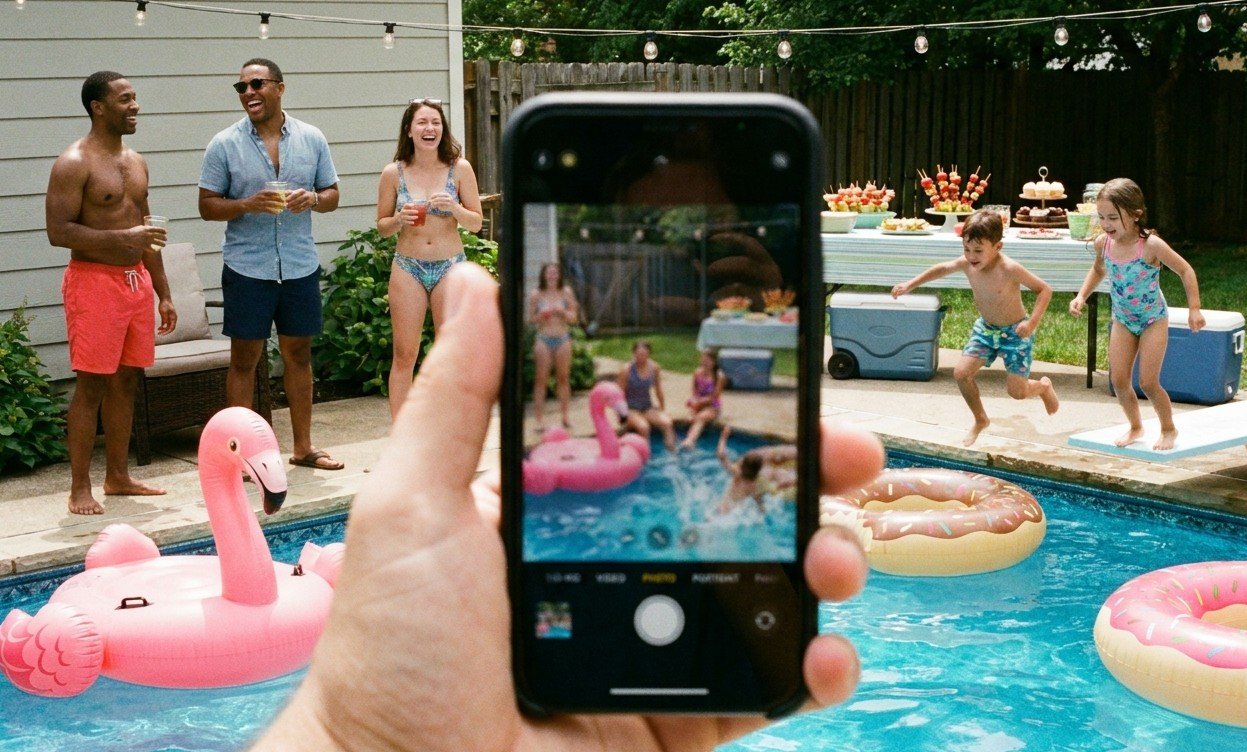
Key takeaway: A pool party runs on five things, not fifty: one named adult watching the water who isn’t also hosting or drinking, food that comes off ice inside the 2-hour/4-hour window, a gate that still self-closes and self-latches even with guests walking through it all afternoon, sunscreen reapplied roughly every two hours, and games matched to your weakest swimmer, not your loudest one. Theme, playlist and decorations are all layered on top of that.
Pool party searches in Australia swing hard with the seasons, up to six times an average month around the December school-holiday peak, and most hosts start planning two to three weeks out, not months in advance. This guide covers the full brief: picking a theme that doesn’t eat your whole weekend, matching games to the actual age group in your pool, timing food and drinks safely in the heat, and the supervision and compliance details that most ‘fun ideas’ round-ups skip because they’re not fun to write about.
Safety note: a pool party is exactly the situation Royal Life Saving Society Australia warns about most: a group of children, several adults who each assume someone else is watching, and a lot of ordinary distractions (a doorbell, a drink refill, a phone call) that a lone supervisor can’t out-multitask. Its Keep Watch program’s core rule for a party is to name one adult as the supervisor out loud, keep non-swimmers and weak swimmers within arm’s reach, and hand off supervision explicitly to another adult if that person needs to step away. Never leave the pool unwatched by default, and that supervisor shouldn’t be drinking or also cooking and hosting. Pool gates matter here too: under AS 1926.1, every pool gate must self-close and self-latch from any open position. Propping it open so guests can walk in and out is the single most common way a compliant fence gets defeated at a party. Fencing rules are state-based, so check your current state building or planning department’s requirements rather than assuming a national standard, and see our full guide to pool fencing laws in Australia for the state-by-state detail. If your party involves inflatables or novelty pool toys bought recently, check the label: a new ACCC mandatory standard for aquatic toys commenced 26 June 2026 (two-year transition to 25 June 2028), and requires the wording “Warning! This is not a life-saving device. Only to be used in water in which the child is within its depth and under adult supervision”. A toy without it, or marketed as making a non-swimmer safe unsupervised, is exactly what the standard exists to stop.
Which Kind of Pool Party Are You Planning?
The right setup changes more with who’s in the water than with any theme you pick. Use this as your starting checklist before you plan a single game.
| Party type | Supervision needs | Best games | Food & drink style |
|---|---|---|---|
| Kids-only (under 12) | One dedicated adult supervisor per Royal Life Saving guidance, not doing double duty as host or cook. A second if the group is large or ages are mixed. | Marco Polo, sharks and minnows, dive-for-treasure, floatie parade, water balloon dodgeball | Small, bite-sized snacks (fruit, cheese, crackers) kids can grab between swims. No alcohol on site to fog the supervision line. |
| Mixed-age family | Split supervision by age group. A non-swimming toddler needs arm’s-reach watching even while older kids play unsupervised games nearby. | Watermelon toss and pool volleyball for older kids and adults; shallow-end floatie games for the youngest | Barbecue plus a kids’ table of finger food. Keep the youngest group’s food separate from anything spicy or choking-hazard sized. |
| Teens & adults-only | Lower hands-on supervision, but assign someone sober to keep an eye on the pool if drinking is involved. Drowning risk doesn’t disappear once everyone can swim. | Pool basketball, cannonball contests, pool poker, trivia for non-swimmers, a DIY cocktail or mocktail station | Finger food that survives being eaten one-handed poolside. Ice buckets for drinks reduce how long anything sits in the danger zone. |
Pick a Theme That Doesn’t Take Over Your Week
A theme only needs to touch two or three things to read as a theme: an invite, one signature snack or drink, and one decor element. Trying to theme every single detail is what burns a whole weekend and a chunk of the budget on things nobody remembers by Monday. Popular, low-effort options for Australian pool parties:
- Tropical or Hawaiian: leis, a fruit punch station, and a couple of paper lanterns do most of the work
- Under the sea or mermaid: works especially well for younger kids’ parties
- Superhero splash: cheap capes plus a water-gun “training course” covers both decor and a game
- Movie or pop-culture themed: pick whatever the birthday kid is currently obsessed with
- Retro or decades party: good fit for an adults-only night, pairs well with string lights and a playlist
- Australia Day or Aussie backyard: meat pies, a barbecue, and green-and-gold bunting for a patriotic twist
For lighting after dark, floating pool lights, solar garden lights and fairy lights strung overhead go a long way for very little setup time or cost, and none of them need mains power near the water.
Games That Actually Match Your Group
Most pool party round-ups list games without saying who they suit, which is how a “fun obstacle course” ends up in the deep end with a group of six-year-olds who can’t touch the bottom. Match the game to the group first, the theme second.
- Ages 3 to 6: dive-for-treasure with sinking toys in the shallow end, a floatie parade, or a poolside bubble-foam dance session. Low water-confidence games that don’t need swimming ability.
- Ages 7 to 12: Marco Polo, sharks and minnows, water balloon dodgeball, watermelon toss (teams push a floating watermelon to the far ledge), and pool noodle jousting on a pool float. All classics that let kids join or drop out mid-round.
- Teens and adults: pool basketball or volleyball, a cannonball or diving contest, pool poker on floating tables, and a swim-friendly obstacle course (swim across, glide through a tube, float on your back for a count) for a bit of friendly competition.
Whatever you pick, the game changes for a weak swimmer in the group, not the group for the game. Move deep-end games to the shallow end, or add a floatie, rather than assuming everyone will speak up if they’re out of their depth.
Food and Drinks: Get the Timing Right
Australian food safety guidance, the NSW Food Authority’s 2-hour/4-hour rule, sets out how long food can safely sit in the “danger zone” between 5 and 60°C, the range where food-poisoning bacteria multiply fastest. The clock is cumulative across prep, transport and serving, not just however long a platter has been sitting on the table.
Show your working: sausages come off the barbecue at 12:30pm and go straight onto a serving platter in the sun. By 2:30pm, two hours in the danger zone, they can still be eaten but can’t go back in the fridge for leftovers. By 4:30pm, four hours in, they need to be thrown out, even if they still look and smell fine. On a hot Australian afternoon that clock runs the same whether the platter is in direct sun or not, so reset it by keeping mayo-based salads, dips and anything with dairy or egg on ice, not just on the table.
A few other practical calls: use plastic cups and plates, not glass, near the water. It’s both a cut-foot hazard and, on a fibreglass or gel-coat pool, a surface-damage risk if something breaks in the water. And if alcohol is part of an adults’ party, keep it separate from whoever is on supervision duty for any children present. Royal Life Saving’s own review of home-pool drowning cases keeps turning up the same pattern: the person meant to be watching was distracted by something completely ordinary.
How Many Guests Can Your Pool Actually Handle?
There’s no official Australian guest-to-pool-size ratio published by any pool safety authority, and a guide that hands you one is making it up. What actually matters is whether one supervisor can see every child’s face at once. As a working rule: if the group is spread across the pool, the yard and the shade at the same time, or is large or mixed-age enough that you can’t do a full visual sweep in a couple of seconds, you need a second dedicated supervisor, not a bigger pool. Deck space matters too. Leave enough clear, dry space around the edge for people to move without crowding the coping, since a slippery, crowded pool edge is a fall risk independent of anything happening in the water.
Setting Up on the Day
- Test and balance your water a day or two beforehand, not the morning of. See our full guide to pool water chemistry if you haven’t checked it in a while.
- Check every pool gate closes and latches on its own from a fully-open position. Do this before guests arrive, not after someone props it open.
- Clear the deck of trip and slip hazards, and mark the deep end clearly if young or new swimmers are coming
- Keep a first aid kit poolside and make sure your phone (for Triple Zero, 000) is within reach, not inside on the charger
- Decide your games and age groupings in advance so you’re not scrambling, and briefly agree with any other supervising adults who’s watching the water and when
Packing Down After the Party
A big pool party is exactly the kind of “anything unusual” event worth a full water re-test afterwards. A full afternoon of extra bathers, sunscreen, and possibly dropped food or drink shifts your pool’s chemistry more than a normal day’s use, so check pH and chlorine again in the day or two after.
Rinse and dry inflatables and floats before folding them away. Trapped pool water is what breeds mould inside a float, not the material itself, so give each one a once-over for slow leaks while it’s still inflated, since a hole is far easier to find with the float under pressure than after it’s already flat. Store everything out of direct sun where you can; UV is what actually breaks down PVC and vinyl over a season, more than the water ever does.
Frequently Asked Questions
What should I wear to a pool party?
Bring swimwear plus a change of dry clothes for afterwards, and pack a cover-up, hat and sunglasses for whenever you’re out of the water rather than in it. Whether it’s a kids’ or adults’ party, the same rule applies: you’ll spend more time out of the pool than in it, so dress for that part too.
What should I bring to a pool party?
A towel, a change of clothes, and your own sunscreen are the essentials most hosts don’t supply for every guest. If you’re asked to bring food, check the 2-hour/4-hour rule above before you leave it in a hot car on the way over. That clock starts during transport, not just once it’s on the table.
How do I host a pool party?
Start with the four things that actually make a party work: a named supervisor for the water, games matched to your guests’ ages, food timed to Australia’s food-safety danger zone, and a gate and fence you’ve checked on the day. Theme and decorations are worth doing, but they’re the last 10% of the planning, not the first.
What do you actually do at a pool party besides swim?
Most pool parties run on a rotation of swimming, games, and food breaks rather than continuous swimming. Kids in particular tend to burn out on pure swimming within 30 to 40 minutes, so a scheduled game or a food break resets everyone’s energy. For adults-only parties, poolside games like trivia or pool poker give non-swimmers something to do without leaving them out.
What are some fun pool games to play?
Marco Polo, sharks and minnows and water balloon dodgeball are the reliable classics for school-age kids, while pool basketball, cannonball contests and pool poker suit teens and adults better. Pick based on the age group in the water, not the theme of the party. See the games breakdown above for a full age-by-age list.
How do I set up a pool game?
Most classic pool games need no more setup than agreeing the boundaries out loud before you start. Marco Polo needs a defined pool area, watermelon toss needs a “goal” ledge marked at each end, and dive-for-treasure just needs a handful of sinking toys tossed into the shallow end. The setup effort is genuinely minimal; the planning effort is picking a game that suits everyone playing.
What is a pool game, exactly?
A pool game is any structured activity played in or around a swimming pool with agreed rules, from tag-style games like Marco Polo to team contests like pool volleyball. Most don’t need equipment beyond what’s already poolside: a few pool noodles, a ball, or sinking toys cover almost every classic option.
Who invented pool party games?
There’s no single inventor on record. Most classic pool games, including Marco Polo, evolved informally from playground tag games adapted for water rather than being designed by any one person or company. A handful of manufactured pool games (branded pool basketball hoops, floating ring-toss sets) do have identifiable makers, but the classics are folk games in the truest sense.
What’s the fastest way to blow up pool floats and inflatables?
An electric air pump is dramatically faster than blowing by mouth for anything bigger than a small ring float, and most also deflate on the reverse setting, which makes pack-down faster too. If you’re inflating by mouth, do the main chamber first and top up smaller air chambers (arm bands, headrests) last, since they lose air fastest if left half-done.
How do I find a hole in a blow-up pool or float?
Inflate it fully, then either listen and feel closely around every seam for escaping air, or, for a stubborn slow leak, submerge small sections in a bath or wading pool and watch for a stream of bubbles. Check seams and valve stoppers first. That’s where most leaks actually start, not the flat surface of the material.
Where can I buy pool toys and pool noodles?
Big-format retailers (Bunnings, Kmart, Big W), dedicated pool and outdoor stores like Clark Rubber, and supermarkets in summer all stock pool toys and noodles in Australia, with online marketplaces filling in whatever’s sold out locally in peak season. Whatever the source, check for the ACCC’s required aquatic-toy warning label before buying anything meant to support a child’s weight in the water.
How do I store pool floats and toys after the party?
Rinse off chlorine and sunscreen residue, let everything dry completely, and fold or roll it loosely before storing out of direct sunlight. Trapped moisture breeds mould inside a float, and UV exposure is what actually degrades vinyl and PVC over time. A lidded storage tub or a shaded shed shelf both work; a pool float left inflated and in the sun all winter is the fastest way to end up buying a new one every season.
Sources
Sources
- Royal Life Saving Society Australia, Keep Watch
- Royal Life Saving Society Australia, Children’s Pool Party (home pool supervision)
- ACCC Product Safety, Aquatic Toys Mandatory Standard (Consumer Goods (Aquatic Toys) Safety Standard 2026)
- NSW Food Authority, The 2-hour/4-hour rule
- Cancer Council Australia, Slip, Slop, Slap, Seek, Slide
- SPASA, Australian Pool Fencing Rules (AS 1926.1)
