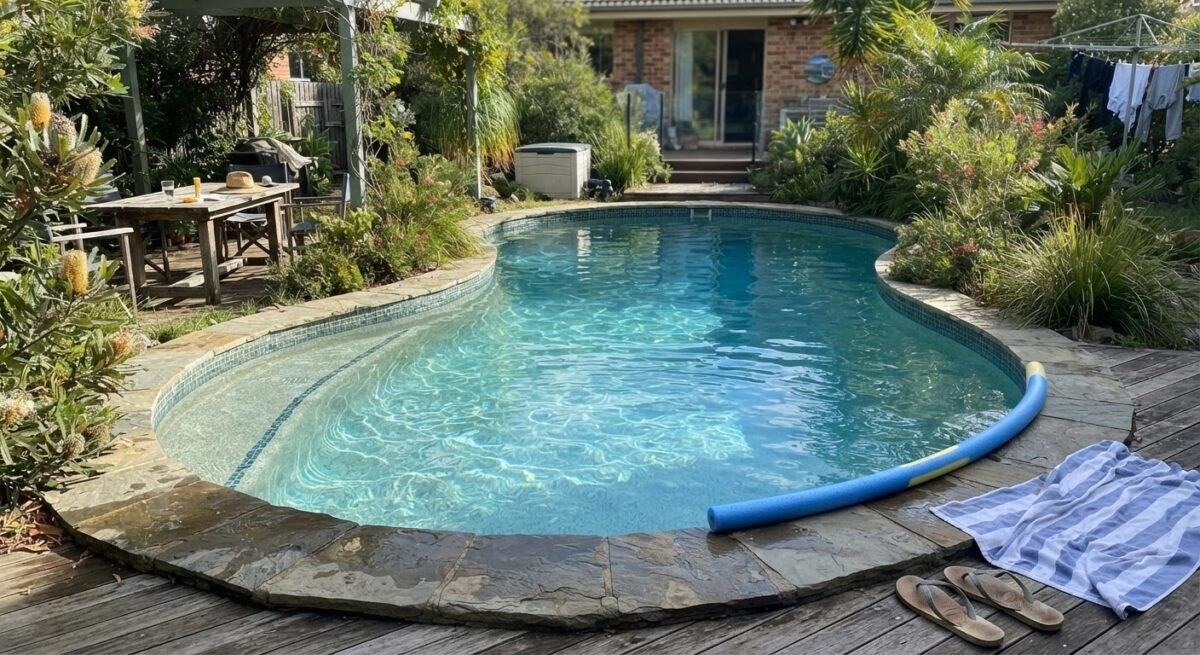
Key takeaway: A mineral pool uses a blend of magnesium chloride and potassium chloride instead of plain salt or manual chlorine dosing. The minerals are converted to a low, steady dose of chlorine through electrolysis, producing water that feels noticeably softer and requires around 40% less chlorine than a standard saltwater pool. Converting an existing pool costs $2,500 to $4,000, while a new mineral system adds $700 to $2,500 on top of a standard pool build.
Mineral pools have become one of the fastest-growing pool trends in Australia, driven by brands like MagnaPool and Mineral Swim appearing on renovation shows and in new pool builds. But the name “mineral pool” can be confusing because the water still uses chlorine for sanitisation.
This guide explains what a mineral pool actually is, how it compares to saltwater and chlorine pools, what it costs, and whether it is worth converting your existing pool.
How a Mineral Pool Works
A mineral pool dissolves a blend of minerals (typically magnesium chloride and potassium chloride) into the pool water at a concentration of roughly 3,000 ppm. The water passes through an electrolytic cell in the chlorinator, which splits the minerals to produce a low, steady level of chlorine (hypochlorous acid) that sanitises the water.
In MagnaPool systems, the electrolysis also produces magnesium hydroxide, which acts as a natural flocculant. It binds to fine particles in the water and helps the filter catch them, improving water clarity without additional chemicals.
Some systems, such as Mineral Swim by Maytronics, add an ozone generator that does the majority of the sanitising work. Ozone is roughly 3,000 times more effective at killing bacteria than chlorine, which reduces chlorine demand by up to 80%.
Mineral Pool vs Saltwater vs Chlorine
| Mineral Pool | Saltwater Pool | Chlorine Pool | |
|---|---|---|---|
| Sanitiser | Low-level chlorine from mineral electrolysis | Chlorine from salt electrolysis | Manually dosed liquid or tablet chlorine |
| Chlorine level | 0.5 to 1.0 ppm | 2.0 to 3.0 ppm | 2.0 to 3.0 ppm (spikes after dosing) |
| Salt/mineral level | ~3,000 ppm | 4,000 to 6,000 ppm | N/A |
| Water feel | Soft and silky | Slightly salty, can feel sticky | Can dry skin and hair |
| Smell | Minimal to none | Mild | Strong chlorine smell after dosing |
| Equipment corrosion | Lower (less salt content) | Moderate (salt corrodes metal) | Low |
| Annual chemical cost | $200 to $500 | $150 to $300 | $300 to $600 |
| Equipment cost | $700 to $3,500 | $800 to $2,500 | $200 to $500 |
The most important difference is the chlorine level. Mineral pools produce roughly half the chlorine of a saltwater or traditional chlorine pool. This is why the water feels softer and is less likely to irritate sensitive skin, eyes or hair.
What Minerals Are Used
Most mineral pool systems use a combination of:
- Magnesium chloride – produces the soft water feel, generates chlorine through electrolysis, and creates magnesium hydroxide (a natural flocculant for water clarity). Magnesium is absorbed through the skin and may help with muscle recovery and relaxation.
- Potassium chloride – supports the electrolysis process and acts as a natural moisturiser. Helps prevent the dry-skin feeling that chlorine pools are known for.
- Sodium chloride – included in some blends but not all. MagnaPool is completely sodium-free (70% potassium chloride, 30% magnesium chloride). Other systems use a mix that includes roughly 30% sodium chloride.
Mineral Pool Systems Available in Australia
| System | Made By | How It Works | System Cost (approx.) |
|---|---|---|---|
| MagnaPool | Zodiac | Magnesium + potassium chloride (sodium-free), Hydroxinator cell, glass media filtration | $2,000 to $3,500 |
| Mineral Swim | Maytronics | Dead Sea minerals + ozone purification, low chlorine output | $2,500 to $4,000 |
| Theralux | International Quadratics | Magnesium-enriched minerals + photocatalytic oxidiser | $1,500 to $3,000 |
| Nature2 | Zodiac | Silver, copper and zinc cartridge (mineral ionisation, not electrolysis) | $200 to $400 |
MagnaPool and Mineral Swim are the most common systems installed in Australian pools. Nature2 works differently. It uses a passive cartridge that releases metal ions into the water rather than dissolving mineral salts, and it does not require a compatible chlorinator.
Cost to Convert an Existing Pool
| Component | Cost |
|---|---|
| Mineral-compatible chlorinator (e.g. Hydroxinator) | $1,500 to $3,500 |
| Initial mineral supply (for a 40,000 L pool) | $200 to $400 |
| Glass filter media (if replacing sand) | $300 to $600 |
| Installation and plumbing check | $300 to $500 |
| Total conversion cost | $2,500 to $4,000 |
The biggest cost is the chlorinator. Not all salt chlorinators are compatible with mineral blends, so you may need a new unit. If your existing filter uses sand, switching to glass media is recommended but not always required.
Ongoing Running Costs
| Expense | Mineral Pool | Saltwater Pool |
|---|---|---|
| Mineral/salt top-up | $100 to $250/year | $30 to $60/year |
| Chemicals (pH, alkalinity) | $100 to $250/year | $100 to $250/year |
| Electricity (pump + chlorinator) | $600 to $1,200/year | $600 to $1,200/year |
| Cell replacement (every 4 to 7 years) | $500 to $1,200 | $400 to $1,000 |
| Total annual running cost | $800 to $1,700 | $730 to $1,500 |
Mineral pools cost slightly more to run than saltwater pools because the mineral blends are more expensive than plain salt. The difference is roughly $100 to $200 per year. However, mineral pools use fewer additional chemicals (such as clarifiers and algaecides) because the magnesium hydroxide does some of that work naturally.
Can You Convert Any Pool to Mineral?
- Fibreglass pools – fully compatible. No shell modifications needed.
- Concrete pools – compatible, but calcium hardness must be maintained between 200 to 400 ppm to prevent the water from leaching calcium from the surface.
- Vinyl liner pools – the liner is compatible, but metal components (wall panels, fittings) should be checked for corrosion resistance.
The main requirement is a mineral-compatible chlorinator. You do not need a new pump, filter housing or any structural changes to the pool itself.
Pros and Cons
Pros:
- Softer, silkier water that is gentler on skin, eyes and hair
- Lower chlorine levels (roughly half that of saltwater)
- Less corrosive to pool equipment and surrounds than standard salt
- Fewer additional chemicals needed (clarifiers, algaecides)
- Improved water clarity through magnesium hydroxide flocculation
Cons:
- Higher upfront cost ($2,500 to $4,000 to convert vs $800 to $2,500 for standard saltwater)
- Mineral blends cost more than plain salt ($100 to $250/year vs $30 to $60/year)
- Fewer compatible chlorinators available, which can limit replacement options
- Still uses chlorine (not chlorine-free despite marketing claims)
- Health benefits of transdermal magnesium absorption are not conclusively proven
Frequently Asked Questions
What is a mineral pool?
A mineral pool is a swimming pool that uses a blend of magnesium chloride and potassium chloride instead of plain salt or manually dosed chlorine. The minerals are dissolved in the water and converted to a low dose of chlorine through electrolysis. The result is softer-feeling water with roughly half the chlorine level of a standard saltwater pool.
Do mineral pools still use chlorine?
Yes. Mineral pools still produce chlorine through electrolysis, but at lower levels (typically 0.5 to 1.0 ppm compared with 2.0 to 3.0 ppm in saltwater or chlorine pools). The water is not chlorine-free, but the reduced chlorine level is why it feels softer and causes less skin and eye irritation.
Is a mineral pool better than a saltwater pool?
For swimmers with sensitive skin, eczema or allergies, a mineral pool’s lower chlorine level and softer water can be a noticeable improvement. For most other pool owners, a saltwater pool provides a similar experience at a lower cost. The main trade-off is softer water and less chlorine versus higher upfront and ongoing costs.
How much does it cost to convert to a mineral pool?
Converting an existing pool to mineral costs $2,500 to $4,000 in Australia. The largest expense is the mineral-compatible chlorinator ($1,500 to $3,500). You also need the initial mineral supply ($200 to $400) and possibly glass filter media ($300 to $600). No structural changes to the pool shell are needed.
What is the difference between MagnaPool and Mineral Swim?
MagnaPool (by Zodiac) uses a sodium-free blend of magnesium and potassium chloride with a Hydroxinator cell and glass media filtration. Mineral Swim (by Maytronics) uses Dead Sea minerals combined with ozone purification. Both produce low-chlorine mineral water, but the technology and mineral blends are different. MagnaPool focuses on the flocculant benefit of magnesium hydroxide, while Mineral Swim uses ozone to further reduce chlorine demand.
Are mineral pools worth it?
If you value softer water, less chemical smell and gentler swimming for sensitive skin, a mineral pool is worth the extra $100 to $200 per year in running costs. The conversion cost of $2,500 to $4,000 is relatively modest compared with the cost of the pool itself. For pool owners who are happy with their current saltwater setup, the improvement may not justify the expense.
- Zodiac Australia, What Is a Mineral Pool System?
- Mineral Swim, Chlorine, Salt or Mineral Pools: What Is the Difference?
- Barrier Reef Pools, Mineral Pools vs Saltwater: What Is the Difference?
- Maytronics, The Cost of Switching to a Mineral Pool
- Mr Pool Man, MagnaPool Mineral Pool System: Hype or Hope?
- Theralux, How It Works
- Cyberpools, Convert Your Existing Pool to a Mineral Pool
