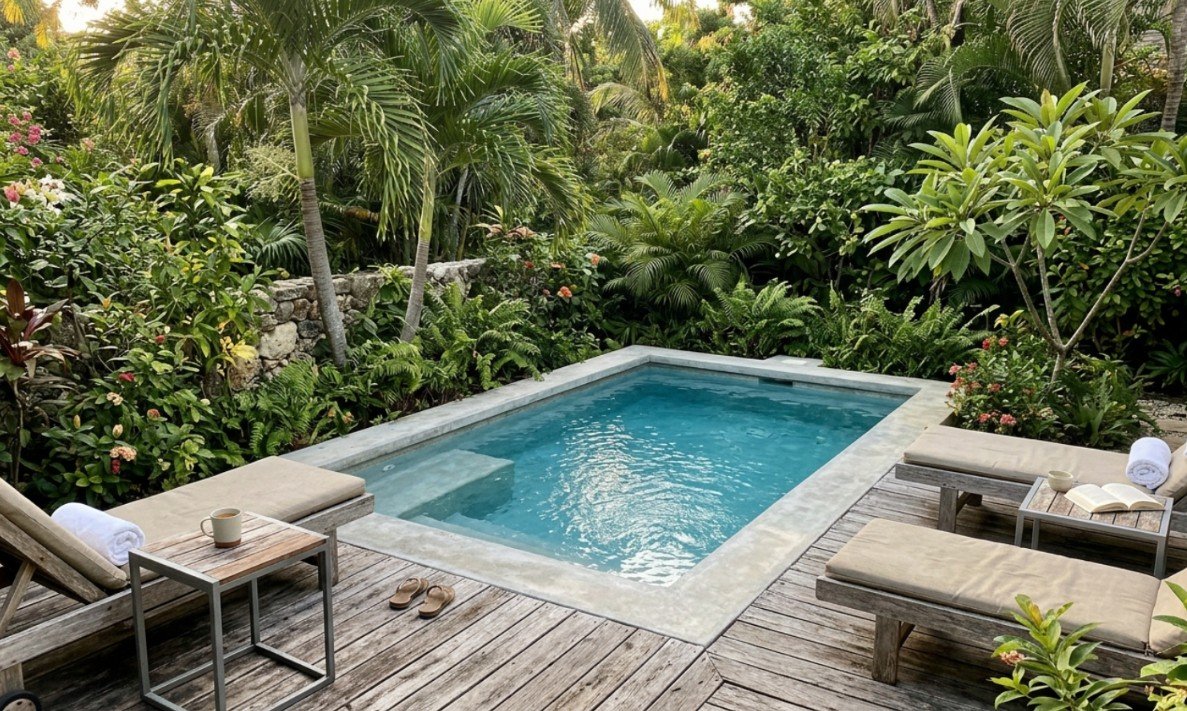
Key takeaway: A plunge pool is a small, compact pool, typically 3m to 4.5m long and 1.2m to 1.7m deep, built for cooling off and soaking rather than swimming laps. Installed cost in Australia typically runs $20,000 to $50,000, and it holds roughly 7,000 to 15,000 litres depending on size, a fraction of a standard pool’s volume.
A plunge pool is a small-footprint pool designed for standing, floating and cooling off rather than swimming any real distance. Most are 2m to 4m wide and 3m to 6m long, with a depth of 1.2m to 1.7m, deep enough to fully immerse an adult, shallow and short enough to fit where a lap-length pool never would.
Typical Plunge Pool Sizes, Depth and Cost
| Size | Typical dimensions | Approx. volume | Installed cost (AUD) |
| Compact | 3m x 2m, 1.2m deep | ~7,000L | $20,000–$30,000 |
| Standard | 4.5m x 2.5m, 1.4m deep | ~12,000L | $30,000–$45,000 |
| Large | 3.4m diameter (round), 1.7m deep | ~15,000L | $40,000–$50,000+ |
For comparison, a standard 7m x 3m fibreglass lap-style pool holds roughly 45,000 to 50,000 litres, so even a large plunge pool is typically less than a third of the volume. See our full pool cost guide for how plunge pools compare with fibreglass and concrete inground builds.
What a Plunge Pool Is Actually For
A plunge pool isn’t a smaller version of a lap pool, it’s a different kind of pool entirely. It suits:
- Small backyards, courtyards and narrow side spaces where a full-size pool physically won’t fit
- Cooling off on a hot day without the space, cost or upkeep of a full pool
- A hydrotherapy-style soak, some are fitted with jets or heating specifically for this
- Renovations and units or townhouses with limited outdoor footprint
It doesn’t suit anyone wanting to do laps or host a backyard full of kids playing pool games, there simply isn’t the length or width for either.
Running Costs: Why Smaller Is Genuinely Cheaper
Because a plunge pool holds a fraction of the water of a standard pool, everything volume-dependent scales down with it: less chemical to dose, a smaller pump and filter, and far less energy to heat if you add heating at all. A compact plunge pool can often be heated to a comfortable temperature faster and cheaper than a full-size pool would ever manage, which is part of why plunge pools are increasingly fitted with heat pumps as standard rather than as an expensive extra.
Plunge Pool vs Full-Size Pool: Being Honest About the Trade-Off
A plunge pool is not a cut-price way to get “a pool” if what you actually want is somewhere to swim laps or host a crowd, it’s a genuinely different product for a genuinely different use case. What you gain is a much smaller footprint, lower running costs, and often a faster build. What you give up is swimming distance and the ability to fit more than a few people in the water at once. Neither is the “better” pool, it depends entirely on what the space is for.
Plunge Pool vs Spa: Not the Same Thing
The two get confused constantly. A spa is small, shallow (often under 1m) and typically heated to 37°C-plus for soaking, usually with jets built in as standard. A plunge pool is deeper, unheated by default (though heating can be added), and sized for standing or floating rather than a hot soak. Some manufacturers now sell hybrid units that do both, cool for a summer dip, heated for a winter soak, but a standard plunge pool on its own is closer to a small pool than a hot tub.
Do You Still Need Council Approval and Fencing?
Yes. In every Australian state, a plunge pool that holds water deep enough to submerge a small child is legally a swimming pool, not an exempt feature, which means it still needs development or building approval and compliant pool fencing under the same rules as any other pool. Being small doesn’t exempt it, this catches people who assume a “plunge pool” is somehow a lesser structure in the eyes of the regulator.
Frequently Asked Questions
How deep is a plunge pool?
Most plunge pools are 1.2m to 1.7m deep, deep enough for an adult to fully immerse standing up, though some premium builds go to 2.1m.
How big is a plunge pool?
Plunge pools typically range from 2m to 4m wide and 3m to 6m long. A common compact size is 3m x 2m, while larger builds reach around 4.5m x 2.5m or a 3.4m diameter if round.
How much does a plunge pool cost in Australia?
A plunge pool typically costs $20,000 to $50,000 installed, depending on size, material (fibreglass or precast concrete) and whether heating is included.
Can you swim laps in a plunge pool?
Not really. Plunge pools are built for standing, floating and cooling off, not for swimming distance. If lap swimming matters to you, you’ll want a longer, purpose-built lap pool instead.
Do plunge pools need heating?
Not necessarily, but many are fitted with a heat pump because their small volume heats quickly and cheaply compared with a full-size pool, making year-round use realistic in a way it often isn’t for a bigger pool.
