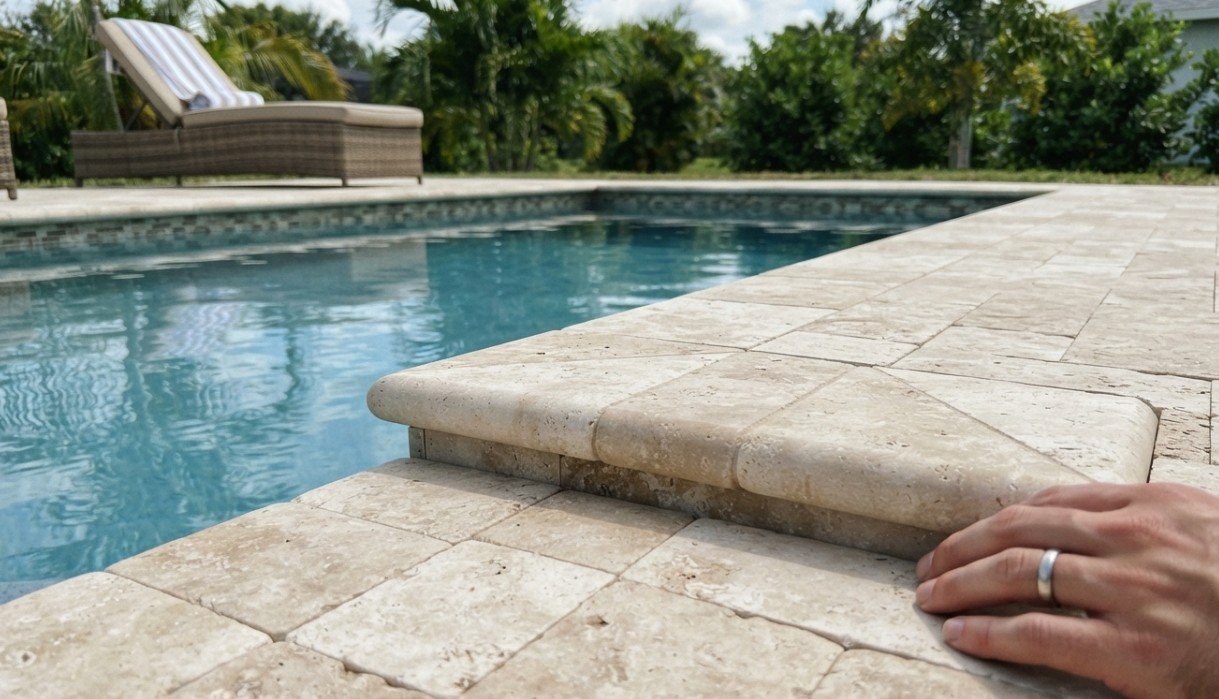
Key takeaway: pool coping is the capping edge around the top of a pool shell. It costs roughly $45 to $90 per square metre supplied and laid for concrete pavers, up to $160 to $220 per square metre for natural stone like travertine, depending on material and profile.
Pool coping is the row of pavers or tiles that caps the top edge of your pool shell, covering the raw edge of the pool wall and giving swimmers a rounded, safe surface to grip or walk on. It’s priced and installed separately from your pool build and from the surrounding pool deck, and the material you choose changes both the look and the cost of your finished pool by thousands of dollars.
Pool Coping Materials and Costs
| Material | Supplied & laid (per m²) | Typical profile | Notes |
|---|---|---|---|
| Concrete pavers | $45 – $90 | Bullnose or drop face | Cheapest option, wide colour range, needs periodic resealing |
| Limestone / sandstone | $90 – $150 | Bullnose | Softer natural stone, more porous, needs resealing most often |
| Bluestone | $130 – $180 | Bullnose or drop face | Dense and low-porosity, holds up well to pool chemicals, gets hot in direct sun |
| Travertine | $160 – $220 | Bullnose or French pattern | Naturally slip-resistant tumbled finish, stays cooler underfoot, needs sealing every 2-3 years |
Add roughly $20 to $40 per square metre on top of these figures for a fully finished result once site prep, edge cutting and initial sealing are included. Expect the top end of each range for a rounded bullnose profile over a plain square edge, since rounding the edge means more cutting and less usable stone per slab.
Worked Example: Coping a 10m x 4m Pool
Take a typical rectangular pool measuring 10m by 4m. The coping runs around the full perimeter, so: 2 x (10m + 4m) = 28 linear metres. At a standard coping width of 500mm, that’s roughly 14 square metres of coping (28m x 0.5m).
At $45 to $90 per square metre for concrete pavers, that 14m² job costs roughly $630 to $1,260 supplied and laid. Switch to travertine at $160 to $220 per square metre and the identical job becomes $2,240 to $3,080, a difference of well over $1,500 for the same pool, purely from the material choice.
What Actually Drives the Price
- Corners and curves: a freeform or kidney-shaped pool wastes more stone in cutting than a straight rectangle, which pushes the per-metre price up.
- Profile choice: bullnose costs more than a plain square edge because rounding the face uses more of each slab.
- Resealing over time: natural stone needs resealing every 2 to 3 years, an ongoing cost a one-off quote won’t include.
- Matching your deck: colour-matching coping to an existing deck or pavers can limit you to pricier supply options.
Whatever material you choose, ask your landscaper or pool builder to confirm it’s rated to AS 4586, ideally P4 or, better, P5 for a barefoot, wet pool surround. A standard pool fencing inspection doesn’t check this, so it’s easy for a builder to quietly substitute a cheaper, lower-rated paver unless you ask for the rating in writing.
Coping is one of the cost differences that gets overlooked when people compare pool types. If you’re still deciding what kind of pool to build in the first place, see our guide to inground vs above ground pools, since above ground pools generally skip stone coping altogether. The pool shell material matters too – see our comparison of fibreglass, concrete and vinyl liner pools, since concrete pools are typically finished with a wider coping band than fibreglass shells.
Frequently Asked Questions
What is pool coping used for?
Pool coping caps and seals the raw top edge of the pool shell, giving swimmers a rounded, safe surface to grip, sit on or walk around, and it also directs splash-back water away from the pool wall instead of behind it.
Is pool coping the same as a pool deck?
No. Coping is the narrow capping band directly on the pool edge, usually 300-600mm wide, while the deck or paving is the larger surrounding area you walk and sit on. They are often matched in colour but priced and installed as separate items.
How wide should pool coping be?
Most Australian pools use a coping width of 300mm to 600mm, wide enough to sit on and to keep the pool edge structurally sound. Wider coping costs more but gives a more generous, resort-style edge.
Do I need to reseal pool coping?
Natural stone coping like travertine, limestone or sandstone generally needs resealing every 2 to 3 years to stop chlorine, sunscreen and pool salts staining or eroding the surface. Concrete pavers need it less often, and dense stones like bluestone hold up longest between reseals.
Which pool coping material is best for hot Australian summers?
Lighter-coloured stone like travertine or limestone stays noticeably cooler underfoot than dark bluestone or dark-tinted concrete pavers in direct sun, which matters more in Australia than in cooler climates. If bare feet on a 40-degree day is a real concern, choose a lighter finish even if it costs a little more.
Sources
Editorial Notes (remove before publishing)
Gaps filled vs competitors: real supplied-and-laid $/m² figures (not per-piece material-only prices), a full worked example showing the maths on a real pool size, and the AS 4586 slip-rating gap most coping retailer pages never mention. Category: Pool Design, Decking & Landscaping (/pool-design/). Internal links: pillar “Pool Landscaping Ideas: Decking, Coping, Planting & Lighting” not yet published [INTERNAL LINK OPPORTUNITY]; sibling “Fibreglass vs Concrete vs Vinyl Liner Pools Compared” is now live and hyperlinked for real (it links back here already). Live link used: Inground vs Above Ground Pools (this session, id 670). This is a Type B reference-fact post (table-led). LLMO: Key Takeaway with real numbers, cost table near the top, worked formula shown openly, FAQ built as rank-math/faq-block. Needs a coping close-up photo before publishing, none inserted here as no real photography was available.
