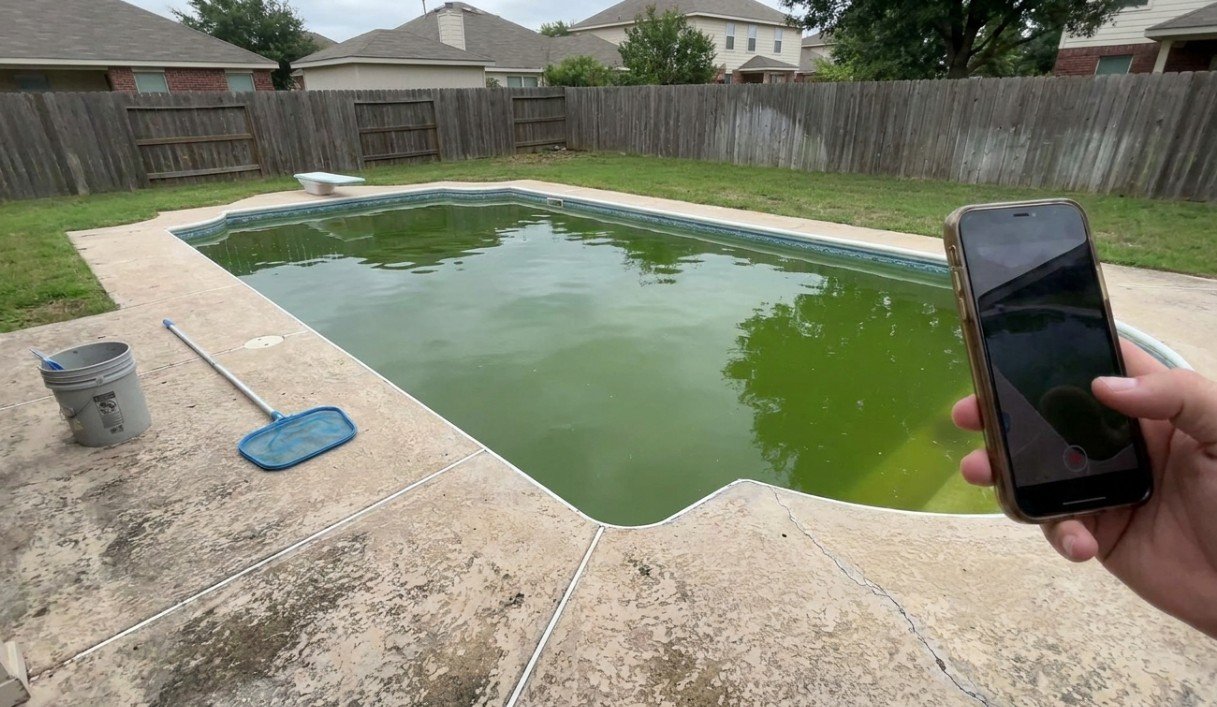
Key takeaway: a green pool means your sanitiser lost the fight against algae — almost always low chlorine, high pH, or both, with poor circulation piling on. Fix pH first (into 7.2–7.6), then shock with roughly 900g–1,350g of granular calcium hypochlorite per 10,000L (double to triple a normal 450g maintenance dose), brush hard, and run the filter continuously. Most green pools clear in 2–5 days, not overnight.
Your pool was fine three days ago; now it’s swamp-green and nobody’s swimming. A green pool is algae — and algae only takes over when your sanitiser has stopped keeping up, almost always because free chlorine dropped too low, pH climbed too high, or both at once. Poor circulation (a weak pump, a blocked skimmer, a shaded corner) usually isn’t the root cause, but it’s why the algae took hold in one spot first. Fixing it is mostly patience and the right order of operations, not any single magic product.
This guide is part of our Pool Water Chemistry 101 hub — see it for the wider basics of keeping pool water balanced. If your acid or alkalinity is the actual root cause, our What Is Pool Acid? guide covers dosing and safety in full.
Safety: don’t swim in a green pool — algae and the bacteria it shelters aren’t sanitised, and you’ll also be handling concentrated shock chemicals. Add chemicals to water, never water to chemicals, wear gloves and eye protection, and keep pool shock away from chlorine tablets and pool acid in storage — mixing incompatible chlorine products can react dangerously. For any chemical exposure, call the Australian Poisons Information Centre on 13 11 26, available 24 hours a day.
What You’ll Need
- A current pH and free chlorine reading — test strips or a liquid kit, not a guess
- Granular calcium hypochlorite pool shock (or another chlorine-based shock product)
- A pool brush (a stainless-steel brush if you suspect black algae) and a vacuum, manual or robotic
- Your pool’s volume in litres — use our Pool Volume Calculator if you don’t already know it
- Optional: algaecide and a clarifier for the tail end of the clean-up
How to Fix a Green Pool
- Test pH and free chlorine first. Correct pH into the 7.2–7.6 range before you shock — chlorine barely sanitises above pH 7.8, so shocking a high-pH pool mostly wastes the dose. See our full Pool Water Chemistry 101 guide for the pH-then-alkalinity order.
- Brush every surface where algae is visible. Do this before you shock, so chlorine can actually reach the algae instead of just the water around it. Green algae floats freely and is the easiest to clear; black algae (“black spot”) burrows into rough concrete or grout and needs a stainless-steel brush and repeat treatment; mustard/yellow algae clings to shaded walls and resists normal chlorine levels. See our guide on how to get rid of black algae in a pool if that’s what you’re dealing with.
- Shock at dusk or after dark. UV burns off unstabilised chlorine fast in daylight, so shocking in full sun wastes a large share of the dose. A typical Australian maintenance dose is roughly 450g of granular calcium hypochlorite (about 65–70% available chlorine) per 10,000L; for a green pool, most Australian guides suggest doubling to tripling that — roughly 900g–1,350g per 10,000L — depending on how dark the water is. This is an industry rule of thumb, not an Australian Standard figure, so use it as a starting point and retest rather than a guaranteed number. Scale it to your exact volume with our Chlorine Dosing Calculator rather than eyeballing a chart built for a different-sized pool.
- Run the filter continuously. AstralPool Australia’s rule of thumb for normal use is at least one hour of filtration per 5.5°C of air temperature each day (so roughly 5–6 hours on a 30°C day) — during a green-pool recovery, treat that as the floor, not the target, and run the filter 24 hours a day until the water clears.
- Retest free chlorine every 4–6 hours for the first day or two and re-dose if it falls before the water has cleared. A green pool consumes chlorine far faster than a balanced one, and a single shock dose rarely holds.
- Vacuum out dead algae once it settles. Expect a cloudy grey-white stage between “green” and “clear” as dead algae drops out of suspension — that’s a normal part of the process, not a sign the shock failed. Check your local water restrictions before backwashing to waste.
- Once clear, retest and rebalance everything — pH, alkalinity, free chlorine and cyanuric acid — to confirm the shock hasn’t pushed anything out of range, and consider a maintenance algaecide dose to make a fast repeat bloom less likely while the rest of your chemistry re-stabilises.
Common Mistakes
- Shocking before correcting pH — wastes chlorine that never gets the chance to work
- Shocking in full sun — UV can burn off a large share of unstabilised chlorine within hours
- One shock dose and no retesting — a genuinely green pool usually needs 2 to 3 rounds over several days
- Ignoring low cyanuric acid — without enough stabiliser, sunlight burns off chlorine even faster, so the same dose does less
- Assuming it’s “clean” once it looks clear — it’s not swimmable again until chlorine and pH are both back in their normal ranges, not just when the colour looks right
When to Call a Pro
If the pool is still green after two full shock-and-brush cycles over 3–4 days, or you can’t get free chlorine to hold above 1 ppm for more than a few hours between doses, something bigger is usually going on — a failing pump or filter, a badly out-of-range cyanuric acid level, or algae established deep in a rough or damaged surface. A pool shop water test (often free) can diagnose in minutes what several more days of guessing won’t.
Frequently Asked Questions
How long does it take to clear a green pool?
Most green pools clear in 2 to 5 days with continuous filtration and 1–3 shock treatments; very dark green or long-neglected pools can take a week or more.
Can I swim in a green pool if I add enough chlorine?
No — wait until the water is visibly clear and free chlorine and pH have both retested back into their normal ranges (1–3 ppm and 7.2–7.6), not just after adding shock.
Why does my pool keep going green even after I shock it?
Usually one of three things: pH climbed straight back up before the chlorine could work, cyanuric acid is too low or too high for the dose to hold, or a weak pump or blocked filter means large parts of the pool barely circulate.
What’s the difference between green algae and black algae?
Green algae floats freely in the water and is the easiest to clear; black algae (“black spot”) burrows into rough concrete or grout and needs hard brushing with a stainless-steel brush plus repeat, heavier shock treatments to fully remove.
Do I need algaecide as well as chlorine shock?
Chlorine shock is what actually kills the bloom; algaecide is mainly a prevention tool afterwards, used at a normal maintenance dose to make a repeat bloom less likely while the rest of your chemistry re-stabilises.
- AstralPool Australia – Why Is My Pool Green? (filtration run-time guidance)
- Better Health Channel (Victorian Government) – Swimming pools: water quality
- SPASA Victoria – Fact Sheet 5: Water Balance
- Mind Your Pool – How Much Shock Should You Add to Your Pool?
- Australian Government – Poisons Information Centre

1 thought on “Why Is My Pool Green? Step-by-Step Fix for Algae Blooms”