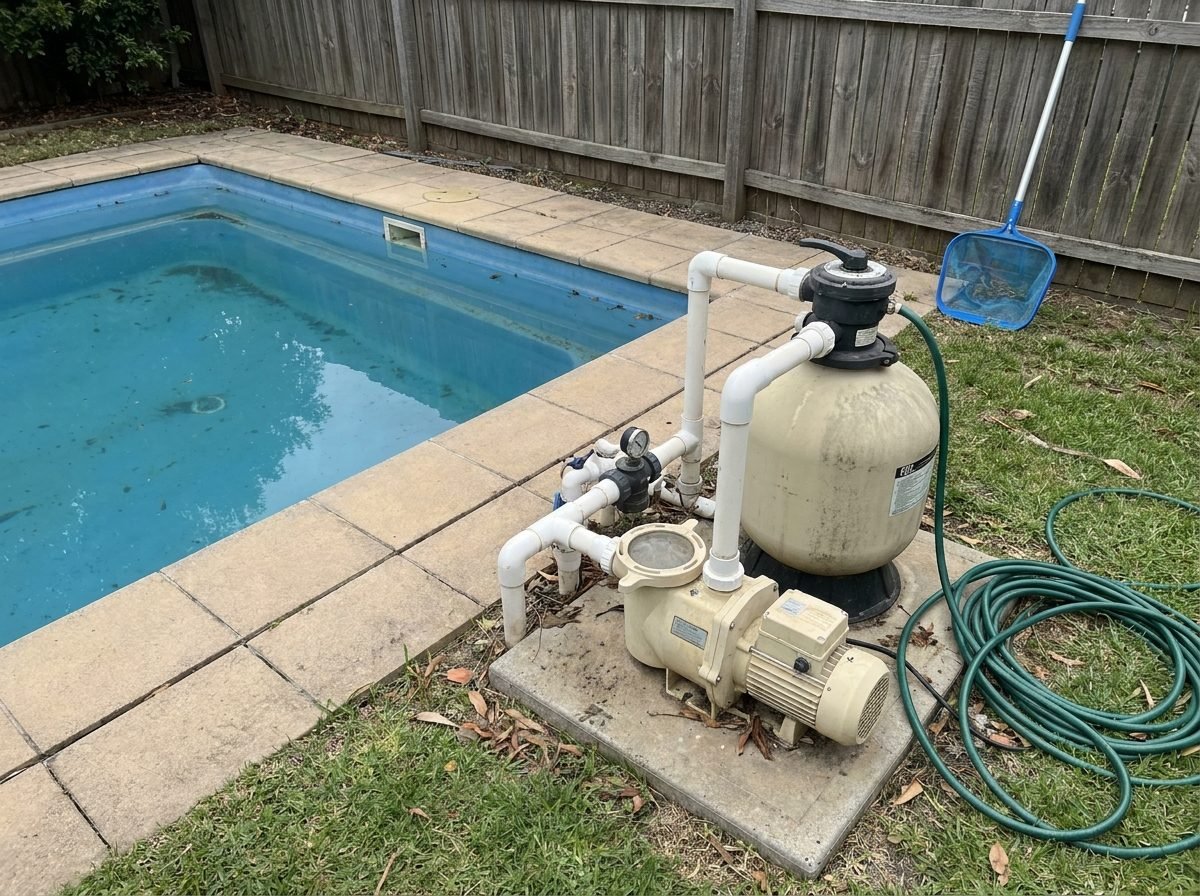
Key takeaway: most Australian backyard pools need one full turnover of their water volume every 4 to 6 hours, which works out to roughly 6 to 8 hours of pump run time a day for an average pool, more like 7 to 9 hours in Western Australia’s long hot summers and 8 to 10 hours in Queensland’s humidity and algae risk. Winter needs far less, often just 4 to 6 hours, since colder water slows algae growth and most pools see less use.
“Just run it all day” and “a couple of hours is fine” are both wrong for most pools, and the right answer actually depends on two numbers you can look up yourself: how much water your pool holds, and how fast your pump moves it. For what that pump actually costs to run, see our guide to how much power a pool pump uses.
The Turnover Rule: Work It Out Properly
A “turnover” is one complete cycle of your entire pool volume through the filter. Residential pools should get at least one turnover every 4 to 6 hours. To work out your own run time: divide your pool’s volume in litres by your pump’s flow rate in litres per minute, which gives you the minutes needed for one turnover, then convert to hours. A 50,000 litre pool on a pump moving 500 litres a minute needs 100 minutes, under 2 hours, for one turnover, so running it for 6 to 8 hours gives 3 to 4 turnovers a day, well within the recommended range rather than the bare minimum.
Typical Run Times by Season and Region
| Situation | Typical daily run time |
|---|---|
| Average AU pool, summer | 6 to 8 hours |
| Western Australia (long hot summers, wind-driven debris) | 7 to 9 hours |
| Queensland (humidity, frequent rain, higher algae risk) | 8 to 10 hours |
| Average AU pool, winter | 4 to 6 hours |
These are starting points, not fixed rules: a pool under heavy tree cover, hosting a lot of swimmers, or showing early signs of algae needs more circulation than these ranges suggest, regardless of season.
Split Run Time Instead of One Long Block
Running your total hours as two or three shorter blocks spread across the day, rather than one long overnight run, keeps water moving and chlorine circulating during the hours people actually use the pool and algae actually grows, which is during daylight, not at 3am. If you have solar panels, running at least one block through the middle of the day also uses your own generation instead of grid power.
Common Mistakes
- Running the pump 24 hours a day out of habit or “just in case,” which wastes electricity without actually cleaning the water any better past a couple of turnovers
- Cutting run time right back in summer to save on electricity, which is exactly when algae risk and swimmer load are both highest
- Never adjusting the timer between seasons, leaving a winter setting running through summer or vice versa
- Working out run time from a generic “8 hours for everyone” rule instead of your own pool’s volume and pump flow rate
- Running a variable-speed pump on its lowest setting for the same short hours as a single-speed pump, rather than the longer, low-flow schedule a VSP is actually designed for
More on Pool Equipment
For what all those hours actually cost, see how much power a pool pump uses and running costs explained. If your pump is ageing or showing warning signs, see how long pool pumps last, and for the filter it’s feeding, see our pool filters guide.
