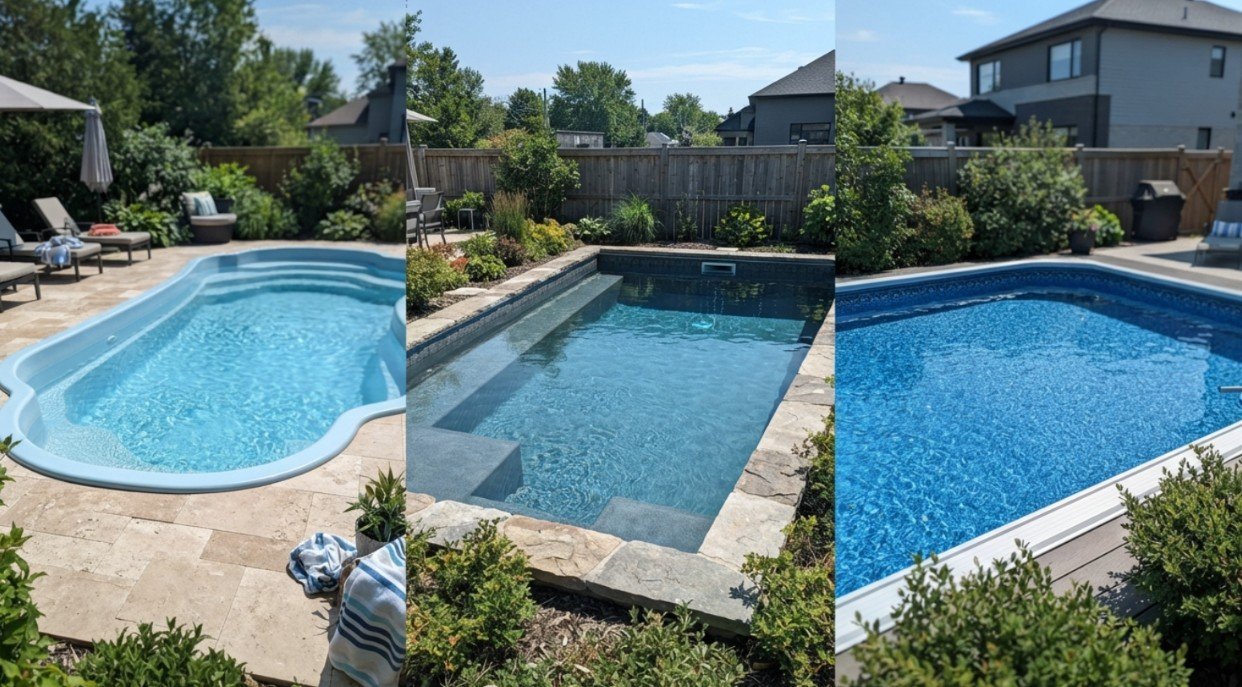
Key takeaway: fibreglass pools cost $35,000 to $80,000 installed and last 25-30 years with the least maintenance. Concrete pools cost $50,000 to $120,000, last 50+ years but need resurfacing every 10-15 years at $5,000-$20,000 a time. Vinyl liner pools are cheapest to build at $40,000-$70,000 but are rare in Australia and need a new liner every 7-10 years.
Fibreglass, concrete and vinyl liner are the three inground pool shell types sold in Australia, and they’re genuinely different products, not just different price points on the same pool. Fibreglass is a pre-made shell craned into your yard, concrete is poured and shaped on site, and vinyl liner is a steel or polymer wall with a flexible liner inside. Each trades off upfront cost against lifespan, maintenance and how much you can customise the shape. This comparison assumes you’ve already decided on an inground pool – if you haven’t, see our guide to inground vs above ground pools first.
At a Glance
| Factor | Fibreglass | Concrete | Vinyl Liner |
|---|---|---|---|
| Installed cost (AUD) | $35,000 – $80,000 | $50,000 – $120,000 | $40,000 – $70,000 |
| Structural lifespan | 25-30 years | 50+ years | 20-25 years |
| Surface upkeep | Rarely needs attention | Resurface every 10-15 years ($5,000-$20,000) | New liner every 7-10 years ($3,500-$6,000) |
| Build time | 1-3 weeks | 8-12+ weeks | 4-8 weeks |
| Chemical & algae maintenance | Lowest, smooth non-porous gelcoat | Highest, porous surface prone to black algae | Moderate, smooth liner but seams collect dirt |
| How common in Australia | Most popular choice | Popular for custom or larger pools | Rare – built for freeze-thaw climates AU mostly doesn’t have |
Fibreglass Pools
A fibreglass pool is manufactured off-site as a single shell, then craned into an excavated hole in your yard, which is why it can go from empty block to swimming in 1 to 3 weeks once the hole is dug. That speed, combined with a smooth, non-porous gelcoat surface that resists algae far better than concrete, is why fibreglass has become the most popular inground pool type in Australia. The trade-off is shape: you’re choosing from the manufacturer’s existing range of shell shapes and sizes, not designing your own.
Concrete Pools
Concrete pools are built and shaped on site, so they’re the only one of the three that can be genuinely custom: any shape, size, depth profile or feature like an infinity edge is possible. That flexibility and a structural lifespan of 50 years or more come at a cost, both a higher build price and a porous surface that needs resurfacing every 10 to 15 years at $5,000 to $20,000 a time, plus more chlorine and more scrubbing in between to keep black algae from taking hold. Coping and edge finishes also tend to be wider and more elaborate on concrete pools than on fibreglass shells – see our guide to pool coping materials and costs if you’re pricing this in.
Vinyl Liner Pools
Vinyl liner pools use a steel or polymer wall structure lined with a flexible vinyl sheet, and they’re the cheapest of the three to build, typically $40,000 to $70,000. They’re also genuinely rare in Australia, and there’s a real reason why: vinyl liners were designed to flex with the ground movement caused by winter freeze-thaw cycles, an advantage that matters in the US and Canada but barely applies in most Australian capital cities, where the ground simply doesn’t freeze. What you’re left with here is mainly the lower price, offset by a liner that needs replacing every 7 to 10 years at $3,500 to $6,000 each time.
Which Should You Choose?
- Want the lowest ongoing maintenance and fastest build: fibreglass, as long as one of the manufacturer’s shell shapes suits your yard.
- Want a custom shape, infinity edge, or the longest structural lifespan: concrete, and budget for resurfacing every 10-15 years.
- Want the lowest upfront cost and don’t mind replacing a liner: vinyl liner, though check local installers actually stock and service it before committing.
- Not sure which pool category suits your budget at all: start with [INTERNAL LINK OPPORTUNITY: our guide to how much a pool costs in Australia] before choosing a shell type.
Common Mistakes
- Comparing only the sticker price and ignoring resurfacing or liner-replacement costs over the pool’s life.
- Assuming a vinyl liner pool will be as easy to find installers and parts for in Australia as it is in the US.
- Choosing a concrete pool for a custom shape without budgeting for the extra chemical and cleaning time a porous surface needs.
When to Call a Pro
All three pool types need a licensed pool builder for excavation, structure and plumbing, but get quotes from builders who specialise in the specific shell type you want. A fibreglass specialist and a concrete specialist are usually different businesses with different equipment, and an installer who mainly does one type will rarely give you an unbiased steer toward the other. For a realistic build timeline once you’ve picked a type, see our guide to how long it takes to build a pool in Australia.
Frequently Asked Questions
Which pool type lasts the longest?
Concrete pools last the longest structurally, often 50 years or more, but that figure assumes you keep up with resurfacing every 10 to 15 years. Fibreglass pools last 25 to 30 years with very little maintenance in between, which is why many buyers see fibreglass as the better lifetime value even though concrete outlasts it on paper.
Why are vinyl liner pools rare in Australia?
Vinyl liner pools were designed to flex with ground movement caused by winter freeze-thaw cycles, which is why they dominate the US market. Most Australian capital cities don’t get cold enough for the ground to freeze, so that key advantage doesn’t apply here, and fibreglass or concrete tend to win out instead.
Do fibreglass pools really need less chemical maintenance?
Yes. A fibreglass shell’s gelcoat surface is smooth and non-porous, so algae and bacteria have far less to grip onto than on a porous concrete surface, which translates into less chlorine and fewer scrubbing sessions over the pool’s life.
How much does it cost to resurface a concrete pool?
Resurfacing a concrete pool typically costs $5,000 to $20,000 depending on the size of the pool and the finish you choose, and it’s generally needed every 10 to 15 years to stop the surface degrading and harbouring algae.
Can I get a custom shape with a fibreglass pool?
Only within the manufacturer’s existing shell range, since fibreglass pools are pre-fabricated off-site and craned in as one piece. If you want a genuinely custom shape, an infinity edge, or an unusual depth profile, a concrete pool is the only one of the three built specifically to your design.
