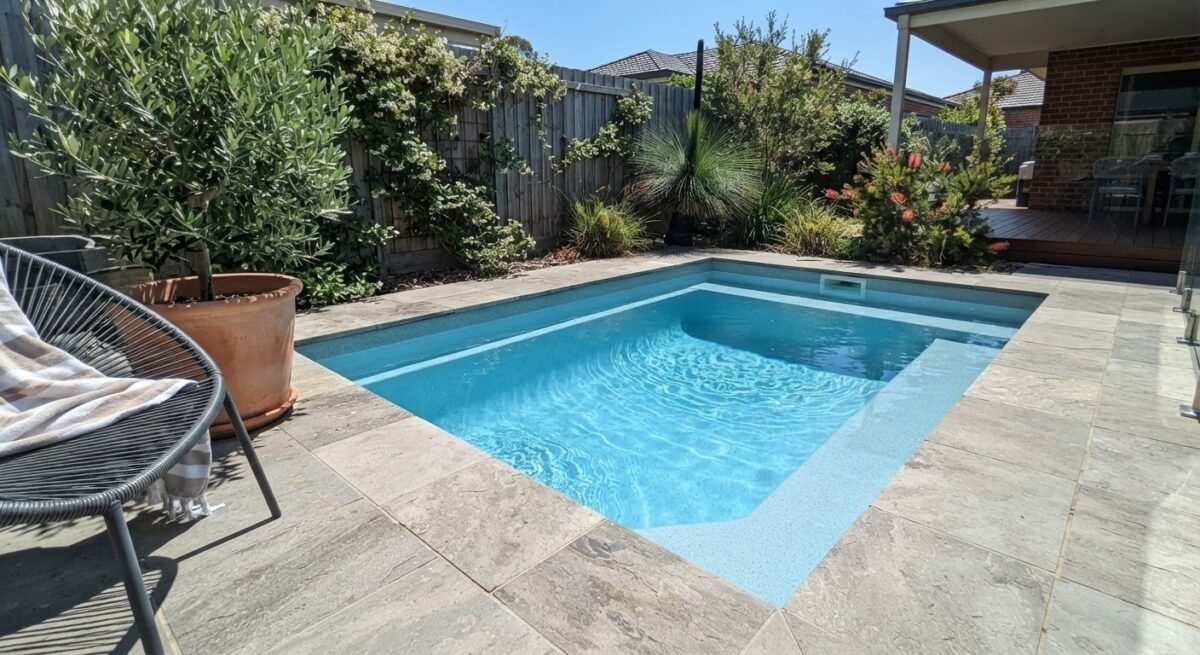
Key takeaway: A plunge pool in Australia costs $25,000 to $55,000 fully installed for fibreglass, $37,000 to $68,000 for precast concrete (such as Plungie), and $50,000 to $85,000+ for custom concrete. The shell price is only part of the picture: fencing, excavation, council approval, electrical and landscaping typically add 40% to 60% on top.
Plunge pools have become one of the fastest-growing pool categories in Australia, especially for compact backyards and inner-city blocks where a full-size pool will not fit. But the cost varies widely depending on what type you choose, how your site is set up and where you live.
This guide breaks down the real cost of every plunge pool type available in Australia, from stock tank DIY builds to custom concrete, with the installation extras that most quotes leave out.
Plunge Pool Cost by Type
| Pool Type | Installed Cost (AUD) | Install Time | Best For |
|---|---|---|---|
| Fibreglass (prefab shell) | $25,000 to $55,000 | 1 to 3 weeks | Most backyards, lowest maintenance |
| Precast concrete (Plungie, Precast Pools) | $37,000 to $68,000 | 1 to 2 weeks | Design flexibility with fast install |
| Custom concrete (shotcrete) | $50,000 to $85,000+ | 6 to 12 weeks | Unusual shapes or sloped sites |
| Above-ground | $15,000 to $40,000 | 1 to 5 days | Renters, flat sites, tight budgets |
| Stock tank or container | $4,000 to $15,000 | 1 to 3 days (DIY) | Budget builds, temporary setups |
| Swim spa (alternative) | $19,000 to $55,000 | Delivery + plumbing | Year-round heated use, small spaces |
These are total project costs for standard suburban sites with good access. Difficult sites (rock, slope, restricted access) can add $5,000 to $20,000 or more.
What Is Included in the Price (and What Is Not)
Most advertised plunge pool prices cover the shell and basic installation only. The extras add up quickly:
| Component | Typical Cost |
|---|---|
| Pool shell (fibreglass or precast) | $12,000 to $30,000 |
| Excavation and site preparation | $5,000 to $15,000 |
| Crane hire | $3,000 to $14,000 |
| Pool equipment (pump, filter, chlorinator) | $3,000 to $5,000 |
| Plumbing and equipment install | $1,000 to $3,000 |
| Electrical and earthing | $1,500 to $5,000 |
| Fencing (AS 1926.1 compliant) | $2,000 to $12,000 |
| Council approval and certification | $1,500 to $4,000 |
| Landscaping and surrounds | $5,000 to $30,000 |
| Freight and delivery | $1,100 to $6,600 |
A $15,000 shell price often becomes $45,000 to $60,000 once every line item is included. Always ask for a fully itemised quote that covers fencing, electrical, council fees and landscaping separately.
Plunge Pool Cost by Size
| Size | Installed Cost | Typical Use |
|---|---|---|
| 2 to 3 m | $25,000 to $35,000 | Cold plunge, small courtyard |
| 3 to 4 m | $35,000 to $45,000 | Small family, relaxation |
| 4 to 5 m | $40,000 to $55,000 | Family use, light exercise |
| 5 to 6 m | $50,000 to $80,000+ | Lap swimming with jets, entertaining |
Each additional metre of length adds roughly $3,000 to $5,000 to a concrete build. Fibreglass and precast shells come in fixed sizes, so the price jumps between models rather than scaling per metre.
Plungie: Australia’s Most Popular Precast Plunge Pool
Plungie is the largest precast concrete plunge pool brand in Australia. Their shells are factory-made and craned into position in a single day.
| Model | Size | Shell Price (approx.) | Installed From |
|---|---|---|---|
| Quad | 2.2 x 2.2 m | From $15,000 | ~$37,000 |
| Arena | 3.5 m round | From $12,000 | ~$34,000 |
| Studio | 3.6 x 2.2 m | From $13,000 | ~$37,000 |
| Original | 4.6 x 2.5 m | From $15,000 | ~$42,000 |
| Max | 6.0 x 3.0 m | From $20,000 | ~$45,000+ |
Shell prices are approximate and based on publicly available installer data. Plungie directs buyers to a sales consultation for current pricing, which varies by finish and location. The installed costs above assume a standard suburban site with good access.
Cost by City
| City | Typical Installed Range | Key Cost Factor |
|---|---|---|
| Sydney | $50,000 to $80,000+ | Sandstone rock adds $5,000 to $15,000 to excavation |
| Melbourne | $45,000 to $65,000 | Heating almost always added ($3,000 to $5,000) |
| Brisbane | $42,000 to $55,000 | Most affordable east-coast capital; sandy soil helps |
| Perth | $40,000 to $60,000 | Sandy soil saves $5,000 to $12,000 on excavation |
| Adelaide | $40,000 to $55,000 | Similar to Brisbane; less competition among builders |
Regional and rural areas are typically 5% to 10% cheaper on labour, but freight can add $1,000 to $6,600 depending on distance from the manufacturer.
Fencing Costs
Under AS 1926.1, every plunge pool in Australia must have a compliant safety barrier if it holds water deeper than 300 mm. There is no exemption for small pools.
| Fence Type | Cost per Metre | Typical Total (15 m perimeter) |
|---|---|---|
| Aluminium tubular | $80 to $400 | $1,200 to $6,000 |
| Semi-frameless glass | $200 to $600 | $3,000 to $9,000 |
| Frameless glass | $350 to $700 | $5,250 to $10,500 |
A plunge pool’s smaller footprint means a shorter fence perimeter, which is one of its cost advantages over a full-size pool. For a detailed breakdown of fencing rules by state, see our guide to pool fence height requirements.
Council Approval
Every state treats a plunge pool the same as a full-size pool for approval purposes. Any pool holding water deeper than 300 mm requires building or development approval.
- NSW: Complying Development Certificate (CDC) for standard sites (2 to 6 weeks, $1,500 to $3,500). Full DA required for heritage zones or steep sites (2 to 4 months).
- VIC: Building permit required. Pool must be registered with local council. Barrier compliance re-certified every 4 years.
- QLD: Building approval from a QBCC-registered certifier. Pool must be registered on the QBCC Pool Safety Register.
- WA, SA, TAS, NT, ACT: Building permit or development approval required. The 300 mm depth trigger applies universally.
Budget $1,500 to $4,000 for the full approval process, including certifier fees and any engineering reports. For a complete state-by-state guide, see our post on how to build a pool in Australia.
Running Costs
One of the biggest advantages of a plunge pool is lower running costs compared to a full-size pool, thanks to the smaller water volume.
| Expense | Plunge Pool (per year) | Full-Size Pool (per year) |
|---|---|---|
| Electricity (pump and filtration) | $150 to $400 | $600 to $1,200 |
| Chemicals | $150 to $400 | $500 to $1,200 |
| Water top-ups | $50 to $150 | $200 to $500 |
| Heating (heat pump) | $400 to $600 | $600 to $1,200 |
| Total (unheated) | $350 to $950 | $1,300 to $2,900 |
| Total (heated) | $750 to $1,550 | $1,900 to $4,100 |
A variable-speed pump can reduce electricity costs by up to 70%. A pool cover halves heating costs and reduces water evaporation. Both pay for themselves within two to three years.
What Increases (and Decreases) the Cost
Costs go up with:
- Rocky ground or reactive clay (adds $2,000 to $15,000 to excavation)
- Restricted or narrow site access (adds $5,000 to $15,000 for crane and machinery)
- Sloped block requiring retaining walls (adds $2,000 to $20,000+)
- Inner-city Sydney or Melbourne locations (higher labour, tighter access)
- Glass fencing instead of aluminium (3 to 5 times more per metre)
- Premium finishes such as full tiling ($20,000 to $30,000 extra on concrete)
Costs go down with:
- Sandy soil (Perth and coastal QLD save $5,000 to $12,000 on excavation)
- Flat site with clear access for a crane
- Fibreglass or precast instead of custom concrete ($15,000 to $25,000 less)
- Aluminium fencing instead of glass
- Installing during autumn or winter (builders often discount $3,000 to $6,000 in the off-season)
- Building the pool during a new home construction (avoids re-excavation and landscaping repair)
Frequently Asked Questions
How much does a plunge pool cost in Australia?
A fibreglass plunge pool costs $25,000 to $55,000 fully installed. Precast concrete (such as Plungie) costs $37,000 to $68,000 installed. Custom concrete plunge pools start from $50,000 and can exceed $85,000 depending on the site and finishes.
What is the cheapest type of plunge pool?
Stock tank and container pools are the cheapest at $4,000 to $15,000 including basic filtration. For a permanent in-ground pool, fibreglass is the most affordable option at $25,000 to $55,000 installed.
Do you need council approval for a plunge pool?
Yes. Every state in Australia requires building or development approval for any pool holding water deeper than 300 mm. The approval process and costs are the same as for a full-size pool.
Do plunge pools need a fence?
Yes. Under AS 1926.1, any pool capable of holding water deeper than 300 mm must have a compliant safety barrier. There is no exemption based on pool size. The fence must be at least 1,200 mm high with a self-closing, self-latching gate.
How much does it cost to run a plunge pool per year?
An unheated plunge pool costs roughly $350 to $950 per year for electricity, chemicals and water. With a heat pump, annual costs rise to $750 to $1,550. This is significantly less than a full-size pool, which typically costs $1,300 to $4,100 per year.
Is a plunge pool worth it?
For small to medium backyards, a plunge pool offers most of the benefits of a full-size pool (cooling off, relaxation, property value) at roughly half the upfront and running cost. Research suggests a pool can add up to 7% to a property’s value, though the actual return depends on your suburb and market conditions.
- Plungie, How Much Does a Plunge Pool Cost in 2026?
- What’s The Damage, Swimming Pool Cost Australia 2026
- Integrity Swimming Pools, Plunge Pool Cost NSW 2025
- Plunge Pools Direct, Plunge Pool Running Costs
- Coast Life Pools, Plunge Pool Cost Pricing and Design Guide
- Standards Australia, AS 1926.1-2024: Safety Barriers for Swimming Pools
- QBCC, Build a Pool
- Precast Pools Australia
