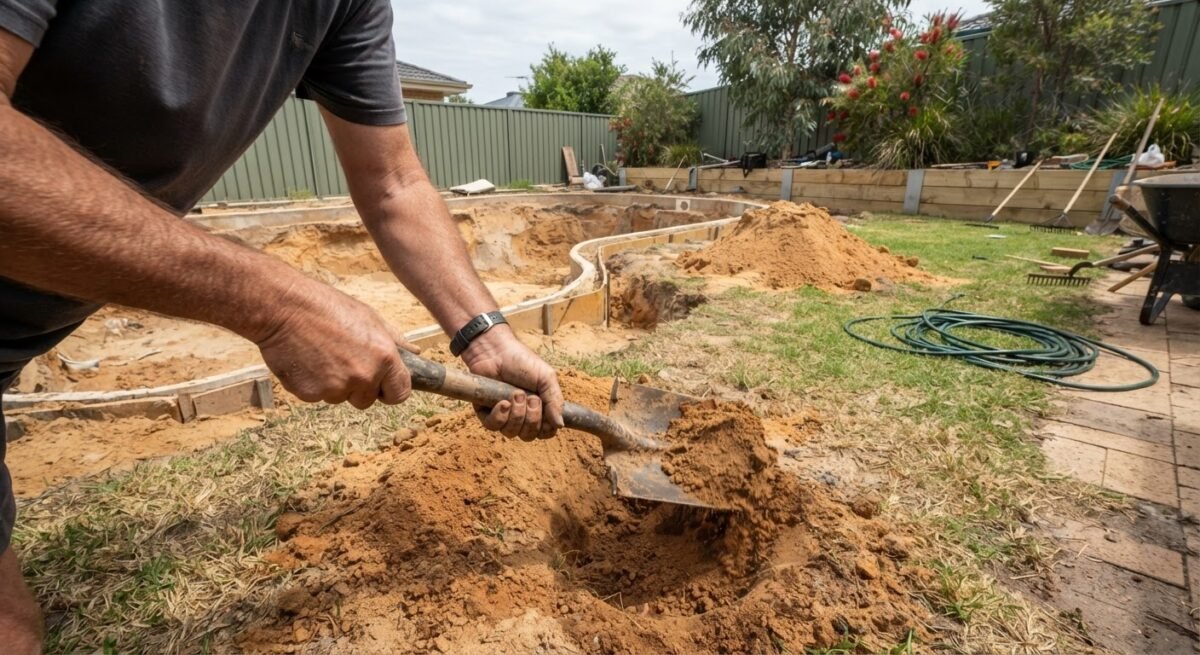
Key takeaway: Building a pool in Australia typically takes 12 to 20 weeks from council approval to your first swim, with costs ranging from $25,000 to $40,000 for fibreglass and $50,000 to $100,000+ for concrete. Every state requires council or building approval before excavation begins, and a compliant safety barrier under AS 1926.1 must be in place before you fill the pool.
Building a pool is one of the biggest upgrades you can make to an Australian home, and one of the easiest to get wrong if you skip the paperwork or rush the process. Council approvals, soil conditions, fencing compliance and the choice between fibreglass, concrete or vinyl liner all shape the timeline and the final bill.
This guide walks you through the full process, from your first council enquiry to balancing the water for your first swim, with the real costs, timelines and regulatory requirements at each stage.
At a Glance: Pool Types, Costs and Timelines
| Pool Type | Typical Cost (AUD) | Install Timeline | Lifespan |
|---|---|---|---|
| Fibreglass (prefabricated shell) | $25,000 to $40,000 | 3 to 6 weeks | 25+ years |
| Concrete (shotcrete/gunite) | $50,000 to $100,000+ | 12 to 16 weeks | 30+ years (resurfacing every 10 to 15 years) |
| Vinyl liner | $20,000 to $35,000 | 4 to 8 weeks | Liner replacement every 7 to 12 years |
| Above-ground | $3,000 to $15,000 | 1 to 3 days (DIY possible) | 10 to 15 years |
Costs are for the pool shell and basic installation. Add $5,000 to $15,000 for fencing, $3,000 to $8,000 for landscaping and decking, and $2,000 to $5,000 for a heating system. Soil conditions (rock, reactive clay, high water table) can add $5,000 to $20,000 or more to excavation alone.
1. Set Your Budget and Choose a Pool Type
Start with the total project budget, not just the shell price. A $35,000 fibreglass pool often becomes $55,000 to $65,000 once you add fencing, decking, landscaping, equipment (pump, filter, chlorinator) and council fees.
Fibreglass is the most popular choice in Australia for backyards under 10 metres. The shell arrives pre-made and drops into the excavated hole, which keeps the build timeline short. Major Australian manufacturers include Compass Pools, Leisure Pools, Narellan Pools and Barrier Reef Pools.
Concrete gives you full control over shape and depth, which is why it dominates larger, custom or commercial builds. It takes longer and costs more, but a well-built concrete pool lasts decades with periodic resurfacing.
Vinyl liner is the budget option for standard rectangular shapes. The upfront cost is lower, but liner replacements every 7 to 12 years add up.
Above-ground pools are the only type where genuine DIY installation is realistic for most homeowners. They still require council notification and fencing in most states.
2. Check Council and Building Approval Requirements
Every state in Australia requires some form of approval before you build a pool. The process varies:
- NSW: Development Application (DA) or Complying Development Certificate (CDC) via a licensed certifier. All pools must be registered on the NSW Swimming Pool Register.
- QLD: Building approval from a private building certifier, registered with QBCC. A Pool Safety Certificate (Form 23) is required for sale or lease.
- VIC: Building permit from a registered building surveyor. All pools must be registered with the local council, with barrier compliance re-certified every 4 years.
- WA: Building permit required in most cases. The builder must submit a BA7 Notice of Completion within 7 days.
- SA: Development Approval via the SA Planning Portal. A barrier is required for any pool holding 30 cm or more of water.
- TAS: A building permit is required for the safety barrier itself, even where the pool may be exempt.
- NT: Compliance certificate from the Swimming Pool Safety Authority within 7 days of completion. Properties under 1.8 hectares must have mandatory fencing.
- ACT: Under 2024 reforms, all residential pools must have compliant barriers by 1 May 2028. Compliance certificates are valid for 5 years.
Expect council approval to take 2 to 6 weeks. A Complying Development Certificate (where available) is faster than a full DA.
Before lodging, call Dial Before You Dig (1100) to locate underground services. It is free and legally required before excavation.
3. Hire a Licensed Pool Builder
In every state, anyone building a pool above a certain contract value must hold a current building licence. Get at least three written quotes that itemise the shell, excavation, fencing, equipment, electrical, landscaping and council fees separately. A single lump-sum quote makes it impossible to compare like for like.
Ask every builder for proof of public liability insurance and home warranty insurance (mandatory for contracts above $20,000 in NSW and WA, $16,000 in VIC, $12,000 in SA, ACT and NT).
4. Site Assessment and Design
Your builder will assess:
- Soil type: Reactive clay, rock or sandy soil all change the excavation method and cost. A geotechnical report ($500 to $1,500) is often required for concrete pools or sloped sites.
- Access: Can a crane or excavator reach the backyard? Restricted access can add $3,000 to $10,000.
- Slope and drainage: A sloped block may need retaining walls, which adds cost and engineering.
- Underground services: Gas, water, sewer, electrical and telecommunications lines must be located and avoided.
5. Excavation
For a standard backyard fibreglass pool, excavation takes 1 to 3 days with a 5 to 8 tonne excavator. Concrete pools may need longer, especially if rock breaking is involved.
Expect to remove 30 to 60 cubic metres of soil for a typical 7 m x 3 m pool. Spoil removal costs $50 to $80 per cubic metre, so budget $1,500 to $4,800 for cartage.
6. Shell Installation or Construction
Fibreglass: The pre-made shell is craned into the excavated hole and levelled on a sand or gravel base. This usually takes one day.
Concrete: Steel reinforcement (rebar) is tied to form the pool shape, plumbing pipes are laid, and shotcrete or gunite is sprayed over the steel cage. The shell then cures for 7 to 28 days before the interior finish (pebblecrete, quartzon or tiles) is applied. This phase alone takes 4 to 8 weeks for a standard concrete pool.
7. Plumbing, Electrical and Equipment
A licensed plumber installs the filtration pipework, skimmer box, returns and any water features. A licensed electrician connects the pump, chlorinator, lighting and any heating system.
This is the stage to decide on your filtration system. For a comparison of sand, cartridge and DE filters, see our guide to pool filters. If you are considering a heater, our pool heater comparison covers solar, heat pump and gas options with running costs.
8. Install Pool Fencing
Under AS 1926.1, every pool in Australia must have a safety barrier that meets these minimum requirements:
- Height: 1,200 mm minimum from finished ground level
- Gate: Self-closing and self-latching from any position, swinging away from the pool, with the latch release at least 1,500 mm above ground
- Non-climbable zone (NCZ): 900 mm clear zone on the outside of the fence, free of furniture, pot plants, trees or anything climbable
- Gaps: Maximum 100 mm at the base and between vertical members
- CPR sign: Mandatory in every state, weather-resistant, legible from 3 m
Fencing must be inspected and certified before you fill the pool. For a full breakdown of height rules by state, see our guide to pool fence height requirements. If you are considering glass panels, our DIY glass pool fencing guide covers the process and costs.
9. Fill, Balance and Commission
Once fencing passes inspection, fill the pool. A standard 40,000 to 50,000 litre pool takes 12 to 24 hours to fill from a garden hose, or 2 to 4 hours with a water delivery tanker ($200 to $400).
Before anyone swims, balance the water chemistry:
- pH: 7.2 to 7.6
- Free chlorine: 1 to 3 ppm
- Total alkalinity: 80 to 120 ppm
- Calcium hardness: 200 to 400 ppm (concrete pools) or 175 to 225 ppm (fibreglass)
Run the pump continuously for the first 48 to 72 hours, then transition to your normal daily run time. For a complete guide to getting your water right, see Pool Water Chemistry 101.
Common Mistakes
- Not checking soil conditions before signing a contract. Rock or reactive clay can add $10,000 to $20,000 to excavation. Get a geotech report before you commit to a fixed-price contract, or ensure the contract has a clear variation clause for unexpected ground conditions.
- Choosing the cheapest quote without comparing scope. A $30,000 quote that excludes fencing, electrical and landscaping will cost more than a $42,000 quote that includes them.
- Skipping the Dial Before You Dig call. Hitting a gas or sewer line during excavation is dangerous and expensive. The service is free.
- Assuming fencing rules are national. They are not. Each state sets its own approval process, inspection cycle and penalty regime. What is compliant in Queensland may not be compliant in Victoria.
- Not budgeting for ongoing costs. A pool costs $1,200 to $3,500 per year to run (chemicals, electricity, water top-ups, equipment servicing). Factor this into your decision before building.
When to Call a Pro
Pool construction is not a DIY project for in-ground pools. Licensed plumbers, electricians and (in most states) a licensed builder are legally required. The only realistic DIY pool is an above-ground kit installed on flat, stable ground with compliant fencing.
If you are considering the owner-builder route for an in-ground pool, check your state’s owner-builder licence requirements. In NSW, an owner-builder permit is needed for work over $10,000, and you lose the statutory home warranty insurance protection that a licensed builder provides.
Frequently Asked Questions
Do you need council approval to build a pool in Australia?
Yes. Every state requires some form of building or development approval before pool construction starts. The type of approval (DA, CDC, building permit) and the approving body (council, private certifier, registered building surveyor) vary by state.
How long does it take to build a pool?
A fibreglass pool typically takes 3 to 6 weeks from excavation to first swim. A concrete pool takes 12 to 20 weeks including curing time. Add 2 to 6 weeks for council approval before construction begins.
How much does it cost to build a pool in Australia?
Fibreglass pools range from $25,000 to $40,000 for the shell and basic installation. Concrete pools range from $50,000 to $100,000+. Total project cost (including fencing, landscaping, equipment and council fees) is typically 40% to 60% more than the shell price alone.
Can you build your own pool in Australia?
Above-ground pools can be installed DIY. For in-ground pools, licensed tradespeople (plumber, electrician) are legally required in every state, and most states require a licensed builder for contracts above $10,000 to $20,000. An owner-builder permit may be available but comes with significant insurance and liability trade-offs.
What pool type is best for Australian backyards?
Fibreglass is the most popular for standard residential backyards (under 10 m length) because of its shorter install time, lower maintenance and smooth non-porous surface. Concrete is better for custom shapes, large pools or commercial projects.
Do you need a pool fence before filling the pool?
Yes. In every state, a compliant safety barrier under AS 1926.1 must be installed and inspected before the pool is filled with water. Fines for non-compliance range from $2,356 (QLD) to $5,500 (NSW) or more.
- Standards Australia, AS 1926.1-2024: Safety Barriers for Swimming Pools
- Standards Australia, AS 2783-2025: Use of Reinforced Concrete for Small Swimming Pools
- QBCC, Build a Pool
- NSW Government, Swimming Pool Owner Obligations
- SPASA Australia, Pool Fencing Rules: An Overview
- VBA Victoria, Swimming Pool Installation Process
- WA Government, Swimming Pool and Spa Safety Barrier Requirements
- ACT Government, Home Swimming Pool Safety Reforms
- NT Government, Install a Pool or Spa
- Royal Life Saving Society Australia
- Dial Before You Dig
