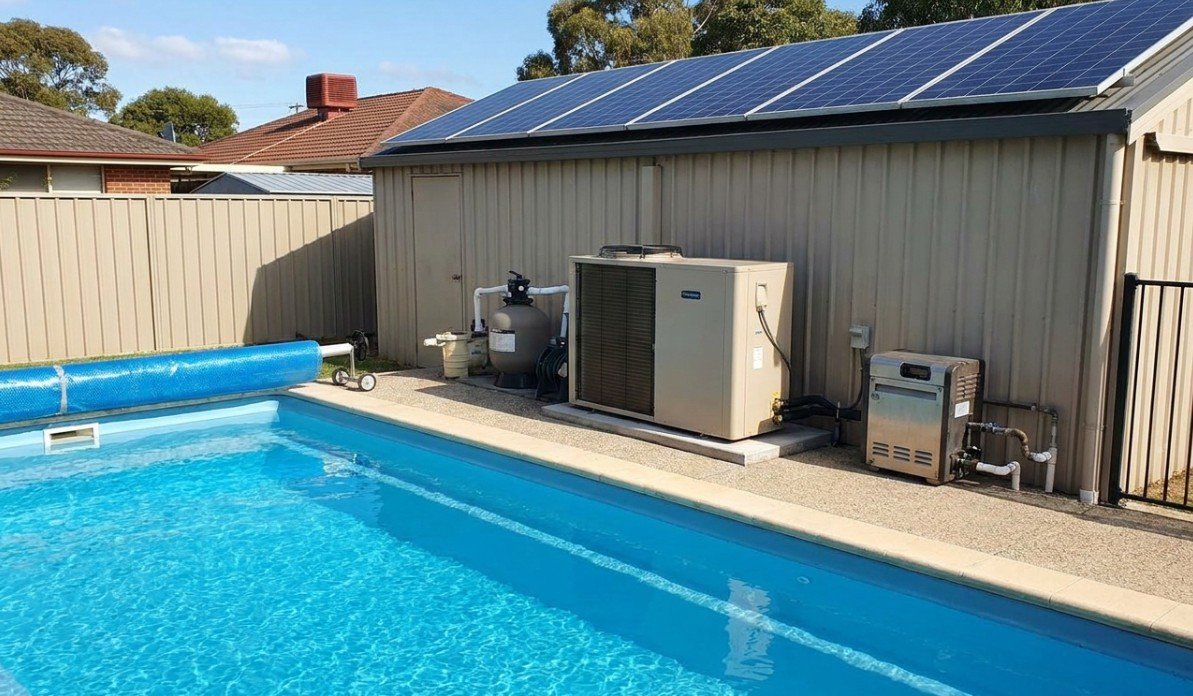
Key takeaway: Solar heating is the cheapest to run, roughly $50–$400 a year depending on whether it needs a dedicated booster pump, but only works when there’s sun and doesn’t qualify for the small-scale technology certificate (STC) rebate that home solar hot water gets. A heat pump costs $500–$1,200 a year to run and works day or night regardless of weather, which is why it’s the most common choice for Australian pools. Gas heats fastest in any conditions but costs $2,000–$4,000 or more a year to run continuously, so it suits occasional or fast top-up heating better than season-long use.
Every pool heating quote eventually comes down to the same three options, and the marketing for each one tends to undersell what it actually costs to run. This guide compares solar, heat pump and gas heating on real running costs, upfront costs and genuine climate limitations, not brand names, so you can pick the method that suits your pool and how you actually use it. For how each method physically works and how long it takes to heat a pool, see our guides to how to heat a pool, how solar pool heating works and how long it takes to heat a pool.
At a Glance: Solar vs Heat Pump vs Gas
| Typical upfront cost | Running cost per year | Works in cool or cloudy weather? | |
|---|---|---|---|
| Solar | $2,500 – $4,500 | $50 – $400 | No, needs direct sun |
| Heat pump | $3,000 – $8,000+ | $500 – $1,200 | Yes, day or night |
| Gas | $2,000 – $5,000+ | $2,000 – $4,000+ | Yes, any conditions |
A Safety Note
A gas pool heater must be connected, commissioned and pressure-tested by a licensed gas fitter under AS/NZS 5601, the national gas installations standard; this isn’t optional DIY territory, and flue placement and ventilation rules are enforced for genuine carbon monoxide safety reasons. A heat pump or any electric heating element falls under the same pool-zone electrical rules as a pump or chlorinator: a 30mA RCD on the circuit and equipotential bonding of nearby conductive parts, installed by a licensed electrician. Solar heating is the lowest-risk option electrically and requires no gas connection, though the circulation pump feeding it still sits on the same RCD-protected circuit as the rest of the equipment pad.
Solar Heating: Free Heat, But Only When the Sun Cooperates
Solar heating runs pool water through roof-mounted collectors and relies entirely on direct sun, so it heats well through the warmer months but does little on a run of cloudy days or through a genuine cold snap. Running costs are the lowest of the three methods, roughly $50 to $100 a year if the existing filtration pump can push water through the collectors, rising to $150–$400 a year if the system needs its own dedicated booster pump running longer hours. One thing worth debunking directly: pool solar heating does not qualify for small-scale technology certificates (STCs), the rebate scheme that applies to solar hot water and heat pump water heaters for domestic use. Don’t budget for an STC rebate on a pool solar system, since that’s a different scheme covering a different kind of solar heating entirely.
Heat Pump: The Middle Ground Most Australian Pools Land On
A heat pump extracts heat from the surrounding air and transfers it into the pool water, which is why it works day or night and in cooler weather, just less efficiently as the air temperature drops. Its efficiency is rated by coefficient of performance (COP): a COP of 5 means 1 unit of electricity produces roughly 5 units of heat, a genuinely open, checkable figure rather than a vague efficiency claim. Standard units typically run a COP of 4 to 6 in mild conditions, dropping to 2.5–3.5 in cold winter air, while premium modern inverter units can reach a COP above 10 in ideal conditions. That range in typical running costs, $500 to $1,200 a year, largely comes down to unit size versus pool size and how many months a year you’re actually heating, not brand alone.
Gas Heating: Fastest, But the Most Expensive to Run Continuously
A gas heater burns natural gas or LPG to heat water directly, and it’s genuinely the fastest of the three methods and the only one unaffected by air temperature or sunlight at all. That speed and reliability comes at a real running cost: $2,000 to $4,000 a year or more if run continuously through a full season, which is why gas suits occasional or fast top-up heating (an event, a cold snap, a short window before guests arrive) far better than heating a pool continuously for months. Over a 10-year comparison, solar’s total cost of ownership sits around $4,250 against $21,000 or more for gas run the same way, which is the real gap most quotes don’t put side by side.
Climate and a Pool Cover Matter More Than the Brand
Whatever heating method you choose, a pool cover cuts heat loss to evaporation dramatically, often reported at up to 80% of total heat loss on an uncovered pool, which changes the running-cost maths for every heating method more than switching between two brands of the same technology ever will. A heat pump paired with a cover can out-perform an uncovered gas heater on both cost and comfort, and a solar system paired with a cover holds heat gained during the day much further into the evening. Don’t treat the heater and the cover as separate purchases; the combination is what actually determines your real running cost and how warm the pool feels after sundown.
Buying Checklist
- Match the method to how you actually use the pool: season-long heating favours solar or a heat pump, occasional fast heating favours gas.
- Ask for the heat pump’s COP rating at both mild and cold conditions, not just a single best-case figure.
- Don’t budget for an STC rebate on pool solar heating; that scheme applies to domestic solar hot water, not pool heating.
- Budget for a pool cover alongside any heater; it changes the running-cost outcome more than the heater brand does.
- Confirm gas installation is by a licensed gas fitter under AS/NZS 5601, and electric heating circuits have a 30mA RCD.
When to Call a Pool Professional
Comparing running costs and picking a method is something you can reasonably do yourself with your pool’s size and how many months a year you want to heat it in hand. A licensed gas fitter must handle any gas heater installation or connection, and a licensed electrician must handle the wiring for a heat pump or electric heater. A pool professional is also worth involving for sizing a heat pump or solar collector area correctly to your pool’s actual surface area, since an undersized unit of any type will run constantly and still underperform.
Frequently Asked Questions
Which is cheaper to run: solar, heat pump or gas pool heating?
Solar is cheapest to run, roughly $50–$400 a year, followed by a heat pump at $500–$1,200 a year, with gas the most expensive at $2,000–$4,000 or more a year if run continuously. Gas heats fastest, so it can still make sense for occasional or fast top-up heating rather than season-long use.
Does solar pool heating qualify for a government rebate in Australia?
No. Small-scale technology certificates (STCs) apply to domestic solar hot water and heat pump water heaters, not pool solar heating. Don’t factor an STC rebate into a pool solar heating quote; it’s a different scheme covering a different kind of system.
What does COP mean for a pool heat pump?
Coefficient of performance: a COP of 5 means 1 unit of electricity in produces roughly 5 units of heat out. Standard units typically run a COP of 4 to 6 in mild weather, dropping to 2.5–3.5 in cold air, while premium inverter units can exceed a COP of 10 in ideal conditions.
Does a pool cover actually make a difference to heating costs?
Yes, often more than the choice of heater itself. Evaporation is typically the largest source of heat loss from an uncovered pool, commonly cited at up to 80%, so a cover paired with any heating method noticeably cuts running costs and helps the pool hold heat later into the evening.
Can I install a pool heater myself?
A gas heater must be connected and commissioned by a licensed gas fitter under AS/NZS 5601; this is a legal requirement, not just best practice. A heat pump or electric heater’s wiring must be done by a licensed electrician with a 30mA RCD on the circuit. Positioning and plumbing connections are more DIY-friendly, but the gas or electrical connection itself is not.
