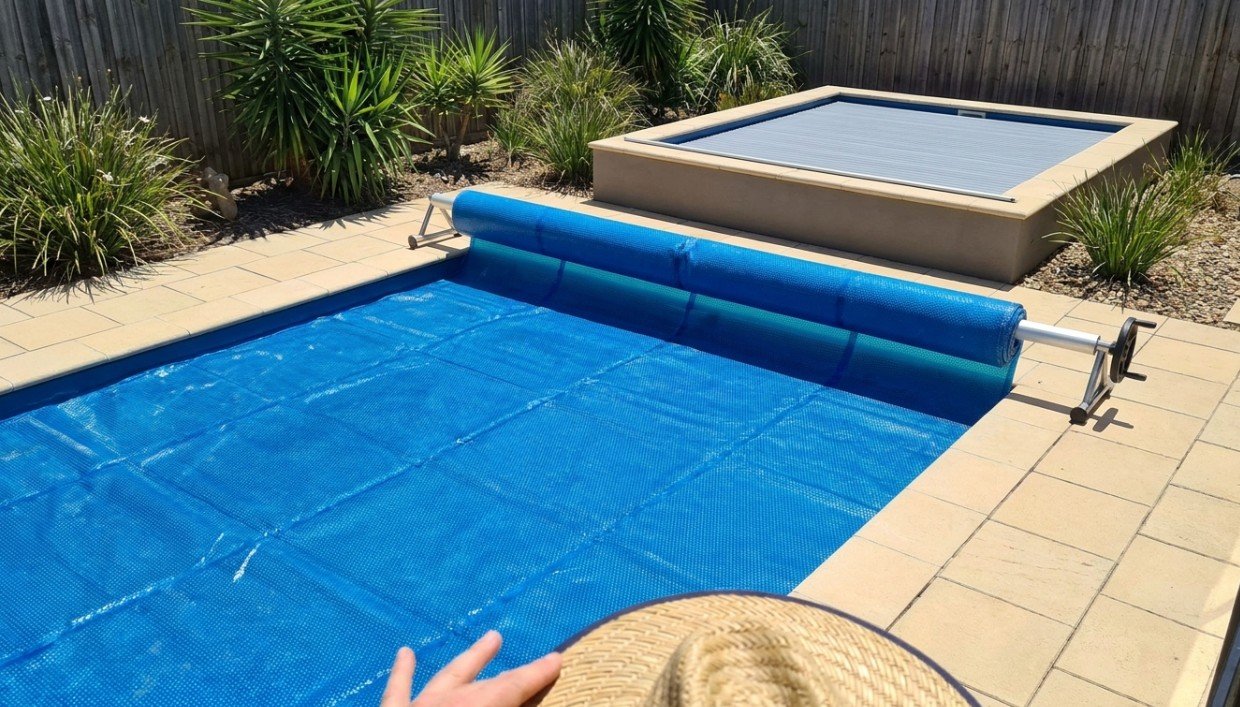
Key takeaway: A rectangular or lap pool suits a roller cover cheaply, from around $1,500 for a manual system, because the straight-line geometry rolls up cleanly. A freeform or kidney-shaped pool needs a custom-cut cover instead, typically $4,000–$5,000 for solar or safety fabric and well into five figures for a custom automatic system, since the curves and “humps” that make the shape attractive are exactly what blocks a standard roller from working properly.
Pool cover shopping usually starts with solar versus thermal versus safety, but the question that actually determines your options and your budget is simpler: what shape is your pool? A rectangular lap pool and a freeform kidney pool are not buying the same product, even if both are described as a “pool cover” on the same website. This guide matches cover type to pool type, so you’re comparing the right options for your actual pool rather than a generic bestseller. For the full explainer on solar, thermal, safety and automatic cover types, see our pool covers guide, and for whether a cover is worth it at all, see are pool covers worth it.
At a Glance: Cover by Pool Type
| Pool type | Best cover option | Typical AU cost |
|---|---|---|
| Rectangular / lap pool | Roller system, manual or automatic | $1,500–$4,000 manual, $8,000–$20,000+ automatic |
| Freeform / kidney | Custom-cut solar or safety cover | $4,000–$5,000+ cut fabric, $30,000–$40,000+ custom automatic |
| Above-ground | Tie-down tarp or bungee-edge solar cover | $150–$600 |
| Spa / plunge pool | Insulated thermal cover, usually manual | $200–$800 |
A Safety Note
A pool cover, of any type, cannot legally replace a compliant pool fence in Australia. Every state requires a pool or spa deeper than 300mm to have a compliant safety barrier, and a floating or automatic cover doesn’t meet that requirement on its own. There’s a narrow exception in some states for a lockable, child-resistant spa cover used strictly in place of a spa’s own barrier, but it doesn’t extend to a backyard swimming pool, and the rules differ by state, so check with your local council or building authority rather than assuming a cover satisfies your fencing obligation. See our full guide to pool fencing requirements for the barrier rules themselves.
Rectangular and Lap Pools: Roller Systems Win
A straight-edged rectangular or lap pool is the easiest shape to cover well, and it’s why roller systems, manual or automatic, are the standard choice here rather than an upsell. The cover rolls up in one straight line with no curves to bunch or twist, so a simple manual reel does the job for a modest budget, while an automatic electric system adds push-button convenience for a lap pool used daily. A long, narrow lap pool in particular suits an automatic cover well: the roller only needs to travel the pool’s width, not navigate an irregular perimeter, which keeps the mechanism simpler and more reliable than on a wider or oddly shaped pool.
Freeform and Kidney Pools: Custom-Cut Is the Real Cost
A kidney or freeform pool’s curves are exactly what a roller system struggles with: the “inside curve” of a kidney shape can cause the cover to shift side to side as it winds onto the roller, and any hump or step in the design can block slats from reaching certain areas altogether. Most suppliers solve this by custom-cutting a solar or safety cover to the pool’s exact shape on a cutting bench rather than trying to force a standard rectangular product to fit, which is why these covers cost noticeably more, roughly $4,000 to $5,000 for a cut solar or safety cover on a mid-size pool, and a custom automatic system can run into the tens of thousands. If your pool is freeform, budget for the custom-cut premium from the outset rather than being surprised by it after getting a quote.
Above-Ground Pools: Tie-Down and Bungee Covers
An above-ground pool has no coping or deck to anchor a roller system to, so covers here work differently: a tie-down tarp cover secures over the top with cables or straps for extended off-season storage, while a lighter bungee-edge solar cover clips or stretches around the pool’s rim for day-to-day heat and evaporation control during the swimming season. Many above-ground pool owners run both: the solar cover in season, the heavier tie-down cover over winter or when the pool is empty. Because above-ground pools are almost always a standard round or oval shape, off-the-shelf sizing is the norm here, and custom-cut costs rarely apply.
Spa and Plunge Pools
A spa or small plunge pool is usually heated, so heat retention matters more than evaporation reduction alone, and a thicker insulated thermal cover typically earns its cost back faster here than on a large unheated pool. Given the small surface area, a manual cover you lift on and off is usually all that’s needed; the running-cost case for an automatic system rarely stacks up at this size. If the spa or plunge pool is being covered specifically to double as a safety barrier rather than just for heat retention, confirm your state’s specific rules first, since the fencing exception for spa covers is narrow and state-dependent.
Buying Checklist
- Measure your pool’s actual shape before comparing quotes; a freeform pool priced against a standard rectangular product will look artificially cheap.
- For a kidney or freeform pool, ask specifically about custom cutting and any roller limitations around curves or humps before ordering.
- For an above-ground pool, check whether the cover attaches by cable and winch or a simple bungee edge, and match it to how you’ll actually use it season to season.
- Never treat any cover as a substitute for a compliant pool fence; check your state’s barrier rules regardless of what cover you buy.
- For a lap pool considering an automatic system, confirm the roller’s rated width matches your pool exactly; automatic systems are far less forgiving of a mismatch than a manual reel.
When to Call a Pool Professional
A standard rectangular or above-ground pool cover is straightforward to measure and order yourself. Get a professional measure and quote for any freeform, kidney or irregularly shaped pool before ordering, since an incorrect custom cut is an expensive mistake to fix, and for any automatic or in-deck roller system, which needs proper mounting into the pool structure or surrounding deck. See our guide to whether you should leave a pool cover on over winter for how usage patterns change across the seasons.
Frequently Asked Questions
Can a kidney-shaped pool have a roller cover?
It’s possible but limited: the inside curve of a kidney shape can make the cover shift side to side as it rolls, and humps in the design can block certain areas from being covered at all. Most suppliers recommend a custom-cut solar or safety cover instead of forcing a standard roller to fit.
How much does a custom pool cover cost for a freeform pool?
Typically $4,000–$5,000 for a custom-cut solar or safety cover on a mid-size freeform or kidney pool, and well into five figures for a custom automatic roller system, since both need to be cut and fitted to the pool’s exact irregular shape rather than a standard size.
What cover works best for an above-ground pool?
A tie-down tarp cover with cables or straps for extended storage, or a lighter bungee-edge solar cover for day-to-day use during the season. Many above-ground pool owners use both, since above-ground pools are almost always a standard round or oval shape suited to off-the-shelf sizing.
Can a pool cover replace a pool fence in Australia?
No, not for a standard swimming pool. Every Australian state requires a compliant safety barrier for a pool or spa deeper than 300mm, and a cover doesn’t meet that requirement on its own. A narrow, state-dependent exception exists for some lockable spa covers, but not for pools generally.
Is an automatic pool cover worth it for a lap pool?
Often, yes. A lap pool’s narrow, straight-edged shape suits an automatic roller particularly well, since the mechanism only travels the pool’s width rather than navigating an irregular perimeter, making it more reliable than on a wider or freeform pool, and the daily-use convenience matters more on a pool used every day.
