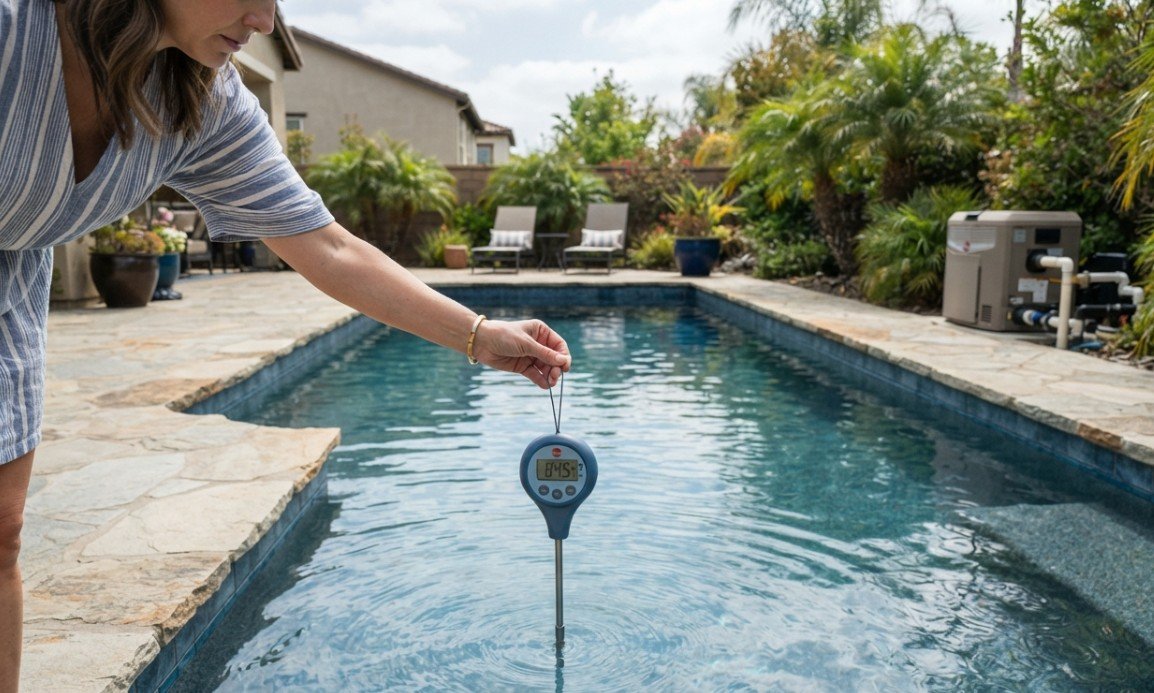
Key takeaway: Heating a typical 50,000 litre Australian pool by 10°C takes roughly 13 to 18 hours of continuous running on a standard residential gas heater, 2 to 3 days on a heat pump, and anywhere from several days to a couple of weeks on solar heating, depending on sun and season. The time comes down to one formula: energy needed equals pool volume × 4.186kJ/kg°C × temperature rise, divided by your heater’s real kW output.
Heater brochures like to quote their kW or BTU rating and leave it there, but that number alone doesn’t tell you how long you’ll actually wait for a swimmable pool. Heating time depends on how much water you’re heating, how many degrees you’re asking for, and what the heater actually delivers once it’s ambient temperature and real-world efficiency, not the number on the box. The table below gives typical ranges, then shows the formula so you can work out your own pool.
| Heater type | Typical time to heat a 50,000L pool by 10°C |
|---|---|
| Gas heater (large, ~100kW output) | 6 to 8 hours |
| Gas heater (average residential, ~35 to 44kW output) | 13 to 18 hours |
| Heat pump (~12 to 13kW real output at 15°C ambient) | 2 to 3 days of running time |
| Solar heating (correctly sized collector) | Several days to 2+ weeks, weather dependent |
Show Your Working: The Heating Time Formula
Water takes a fixed, well-established amount of energy to warm up: 4.186 kilojoules to raise 1kg (1 litre) by 1°C. Since a heater’s output is rated in kilowatts, the full calculation is:
- Energy needed (kJ) = pool volume in litres × 4.186 × temperature rise in °C
- Convert to kWh by dividing by 3,600
- Heating time in hours = energy needed (kWh) ÷ heater’s real kW output
Worked Example: 50,000L Pool, 10°C Rise
Take a 50,000 litre pool, roughly the middle of the 40,000 to 60,000L range for a typical Australian inground family pool, and a 10°C temperature rise, a realistic ask going from a cold 15°C into the mid-20s.
- Energy needed: 50,000 × 4.186 × 10 = 2,093,000 kJ
- Convert to kWh: 2,093,000 ÷ 3,600 = 581.4 kWh
- On a heat pump delivering 12.5kW real output at 15°C ambient (a genuine spec figure, not the nameplate rating): 581.4 ÷ 12.5 = 46.5 hours of continuous running, in practice spread over 2 to 3 days since most owners don’t run a heat pump around the clock.
- On a 35kW residential gas heater at realistic efficiency: 581.4 ÷ 35 = 16.6 hours, comfortably inside a day.
Double the pool volume and you double the energy needed and the time, straightforwardly. Ask for a 20°C rise instead of 10°C and you double it again. This is also why heat pump manufacturers publish output at specific ambient temperatures, a heat pump rated 17kW on the box might only deliver 12 to 13kW once it’s actually working in 15°C air, and considerably less again in the middle of winter, which is the real reason heat pumps struggle to heat a pool from scratch in July.
What Actually Changes Your Heating Time
- Pool volume. A 30,000L plunge pool heats in a fraction of the time of an 80,000L family pool on the same heater.
- Temperature rise required. Topping up from 24°C to 28°C is a much smaller job than heating from a winter 15°C.
- Real heater output, not nameplate rating. Heat pumps in particular deliver less as ambient temperature drops, gas heaters are far more consistent regardless of weather.
- A pool cover. Leaving a cover on overnight stops the heat you’ve already paid for evaporating away, which shortens the time to reach and hold your target temperature on the following day.
- Wind and shade. An exposed, windy pool loses heat faster than a sheltered one, extending real-world heating time beyond the formula’s clean numbers.
Get a licensed technician to handle any new gas or electrical connection for a heater, this is genuine gas-fitting and electrical work, not a DIY job, regardless of how straightforward the heater itself is to operate once it’s installed.
If you’re deciding between heater types rather than just timing one you already own, our guide to how solar pool heating works covers what solar can and can’t do, and it’s genuinely worth reading before you commit to a system based on heating speed alone.
Frequently Asked Questions
How long does it take to heat a pool with a gas heater?
A residential gas heater typically heats an average 50,000L pool by 10 degrees Celsius in 13 to 18 hours, and a larger commercial-style gas heater can do it in 6 to 8 hours. Gas heaters deliver consistent output regardless of outside temperature, which is why they stay the fastest option.
How long does a heat pump take to heat a pool?
Around 2 to 3 days of running time for a 50,000L pool and a 10 degree rise, based on a heat pump delivering roughly 12 to 13kW of real output at 15 degrees ambient. Heat pumps deliver less output as the air gets colder, so winter heating from cold takes noticeably longer than the same job in autumn.
Does pool size affect heating time more than heater size?
Both matter equally in the formula, but pool size is the variable most owners underestimate. Doubling your pool volume doubles the energy needed and the heating time on the same heater, which is why an undersized heater on a large pool is a common source of disappointment.
Will a pool cover speed up heating time?
A cover mainly stops you losing the heat you have already paid for overnight, rather than speeding up the initial heat-up. Used consistently, it shortens how long a heater needs to run on subsequent days to hold your target temperature.
Why does my heater not heat as fast as its rated output suggests?
Nameplate ratings, especially on heat pumps, are usually measured at a specific ambient temperature, often warmer than an average Australian pool day. Real output drops as the air cools, so the honest heating time is longer than the box implies, particularly in winter.
