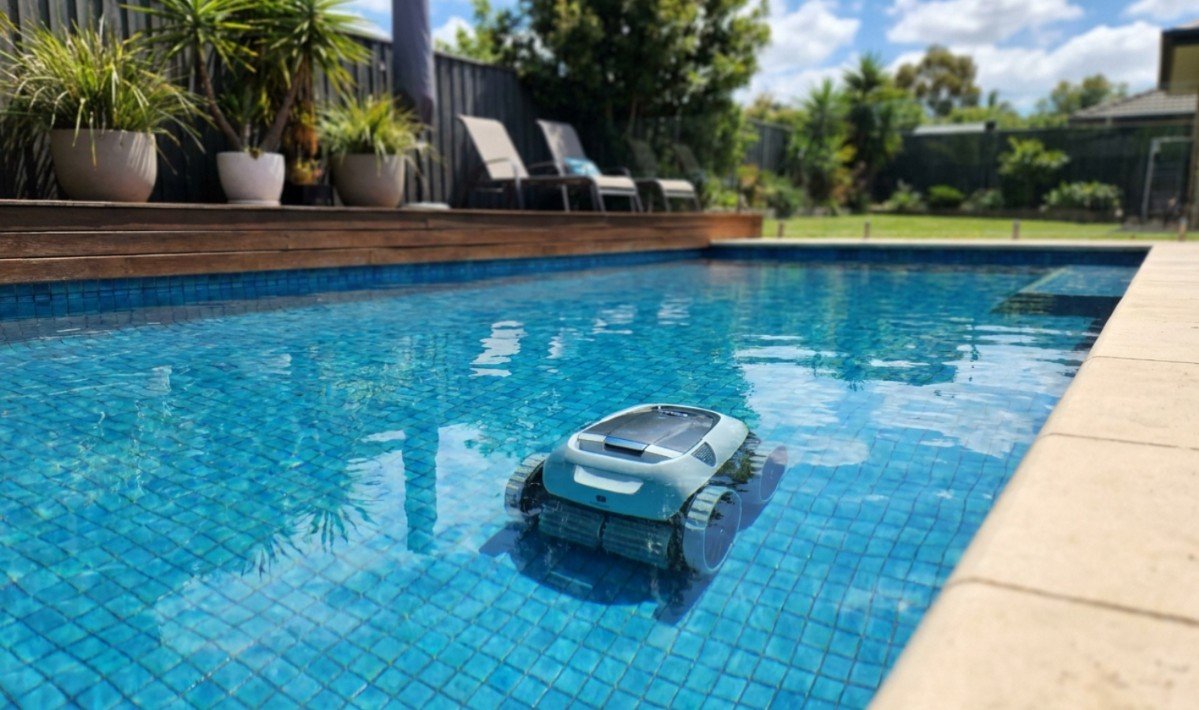
Key takeaway: Corded robotic cleaners ($400–$3,700+) run at full suction for as long as they’re plugged in, while cordless battery models trade some suction and a fixed 1.5–3 hour runtime for no cable to manage. Check the ACCC recalls register before buying a cordless model secondhand or from an overseas listing; several cordless robotic cleaners have been recalled for battery overheating risk.
Gum nuts and jacaranda flowers are a robotic pool cleaner’s real test in most Australian backyards, not the glossy marketing photo of a pristine tiled pool. Buying the wrong robotic cleaner, one with a filter too fine for coarse debris, or too little suction for your pool’s actual floor area, is an easy way to spend $1,000-plus on a cleaner that still leaves you finishing the job by hand. This guide covers what actually separates one robotic cleaner from another, not brand names, so you can specify one properly before you buy. For the wider comparison against suction, pressure and manual cleaners, see our full guide to pool cleaner types.
At a Glance: Corded vs Cordless
| Type | Typical AU price | Runtime | Best for |
|---|---|---|---|
| Corded | $400 – $3,700+ | Full power for as long as it’s plugged in | Larger pools, heavy leaf litter, lowest running cost long-term |
| Cordless (battery) | $500 – $2,500+ | 1.5–3 hrs per charge, then 3–5 hrs to recharge | Pools without a nearby power point, smaller clean-ups, easier handling |
A Safety Note
Robotic pool cleaners run on low-voltage DC power delivered through a transformer that plugs into a standard power point, not mains voltage in the water, which is why they’re generally considered safe equipment around a pool. That said, cordless battery models carry their own risk: the ACCC recalled tens of thousands of Aiper cordless robotic pool cleaners over battery overheating and short-circuit risk, and further cordless models have been recalled since. Check the ACCC Product Safety recalls register before buying any cordless model secondhand, and never charge one unattended overnight regardless of brand. For a corded model, keep the transformer box out of direct sun and off the pool coping, as manufacturers specify, and only ever use the transformer supplied with that exact model.
Corded vs Cordless: What Actually Changes
A corded robotic cleaner draws continuous power through its cable, so it runs at full suction from the first minute to the last. A cordless model runs on battery power instead, and battery-driven suction is genuinely weaker: most cordless robotic cleaners deliver roughly half to a third of the flow rate of a corded unit, and pool professionals generally recommend at least 4,000 gallons per hour of flow for a proper clean. Cordless models also lose power gradually as the battery drains, where a corded cleaner performs the same at minute one and minute ninety. The upside is real too: no cable to detangle on stairs or steps, no transformer sitting in the sun, and the freedom to move the unit between pools. Budget for battery replacement on a cordless model as a real cost, typically 40–50% of the unit’s original price after four to five years of use.
Cycle Time and Cleaning Coverage
Most robotic cleaners run preset cycles of 1.5, 2 or 3 hours depending on the mode selected, and premium models with mapping sensors adjust the cycle automatically based on the pool’s actual size rather than running a fixed timer regardless of how small the pool is. A cycle length that can’t be set below 2 hours is wasted power on a small plunge pool, and one capped at 90 minutes may not finish a genuinely large pool in a single pass. Check the rated pool size range against your own pool’s floor area, not just its litre volume, since cycle coverage is about floor area and wall height, not water volume.
Filter and Debris Handling
Australian pools under trees deal with a genuinely different debris load to a fenced suburban pool with no overhanging trees, and the filter is where that difference shows up. A small, fine-mesh filter basket clogs quickly on gum nuts, leaves and jacaranda flowers, forcing the cycle to stop early with reduced suction. Look for a larger filter canister or basket, and a “turbo” or coarse-debris mode if your pool sits under trees, rather than assuming any robotic cleaner handles heavy leaf litter the same way. A cleaner that’s easy to open and rinse also matters in practice: if emptying the filter is fiddly, it’s the step that gets skipped, and skipped filter cleaning is the most common reason a robotic cleaner’s suction seems to fade over time.
Climbing, Waterline and Coverage Claims
Floor-only cleaning is the baseline; wall-climbing and waterline scrubbing are the features that separate a genuinely full-coverage robotic cleaner from a basic one. Check whether “wall climbing” is rated for your actual pool’s wall angle and surface, tiled walls and vinyl liners can behave differently to fibreglass, and whether waterline scum removal is a real scrubbing pass or just an incidental pass-by. Coverage claims on packaging tend to describe best-case, empty-pool conditions; a pool with steps, a bench seat or an odd shape will always take longer and clean less thoroughly than the same model in a simple rectangular pool.
Running Costs
A robotic cleaner’s own small motor is genuinely the cheapest way to clean a pool day to day, since it doesn’t rely on the main pool pump the way a suction or pressure cleaner does. Running a couple of hours a day on its own low-voltage motor costs a fraction of running a full pool pump cycle, which is where most of a robotic cleaner’s lower running cost actually comes from, not any particular efficiency of the cleaning mechanism itself. Factor the purchase price into that saving over the cleaner’s working life, typically several years for a corded model’s drive system, before assuming the higher upfront cost is automatically worth it for a small, easy-to-maintain pool.
Maintenance and Buying Checklist
- Rinse the filter after every cycle, or every second cycle at minimum; a clogged filter is the most common cause of reduced suction over time.
- Check the manufacturer’s rated pool size (floor area, not litres) against your own pool before buying, not after.
- If your pool sits under trees, prioritise filter basket size and a coarse-debris mode over app features and extra accessories.
- Confirm the warranty length up front; most robotic cleaners in Australia carry a 2–3 year warranty on the unit, with the drive belt, brushes and filter typically excluded as wear parts.
- For a cordless model, check the ACCC recalls register and budget for a battery replacement at roughly 40–50% of the unit’s price after four to five years.
- Don’t buy on wall-climbing or waterline claims alone; check they’re rated for your actual pool’s wall material and shape, not just demonstrated on a simple rectangular pool.
Which Type Suits Your Pool?
- Large pool, heavy leaf litter, or you want the lowest possible running cost: a corded robotic cleaner with a large filter basket and turbo mode.
- No power point near the pool, or you want to move the cleaner between pools: a cordless model, accepting somewhat lower suction and a fixed runtime per charge.
- Small, low-debris pool with a tight budget: an entry-level corded model without app control or mapping is genuinely enough, or see our guide to vacuuming a pool manually if you’d rather skip a robotic cleaner altogether.
- Odd-shaped pool with steps, benches or a spa attached: check wall-climbing and mapping claims carefully rather than assuming any model will navigate it well.
Frequently Asked Questions
Is a corded or cordless robotic pool cleaner better?
Corded models are generally better for cleaning performance: they run at full suction for as long as they’re plugged in, with no battery drain. Cordless models trade some suction and a fixed 1.5‑3 hour runtime for the convenience of no cable, which suits pools without a nearby power point or owners who want to move the cleaner between pools.
How long should a robotic pool cleaner run each cycle?
Most models run preset cycles of 1.5, 2 or 3 hours, and premium models with mapping sensors adjust automatically to the pool’s actual size. A cycle that runs 2 to 3 times a week is generally enough for a well-maintained pool; heavier debris loads or algae-prone periods may need daily cycles.
Are cordless robotic pool cleaners safe?
Generally yes, since they run on low-voltage battery power, but the ACCC has recalled specific cordless models over battery overheating and short-circuit risk. Check the ACCC Product Safety recalls register before buying secondhand or from an overseas listing, and never leave one charging unattended overnight.
How often do robotic pool cleaner filters need cleaning?
Rinse the filter after every cycle, or every second cycle at minimum. A clogged filter is the most common reason a robotic cleaner’s suction seems to fade over time, and it’s the maintenance step most owners skip because it’s fiddly on some models.
Can a robotic pool cleaner fully replace manual vacuuming?
For most pools, yes, a well-matched robotic cleaner handles floor debris, and often walls and the waterline, without any manual vacuuming. A manual vacuum is still useful as a backup for spot-cleaning debris a robotic cleaner’s cycle missed, or for a pool too small to justify the cost of a robotic model.
Sources
- ACCC Product Safety Australia – recalls register (cordless robotic pool cleaner battery recalls)
- Mr Pool Man Australia – The Australian Pool Owner’s Guide to Robotic Pool Cleaners 2026
- Pooltronics Australia – Dolphin Pool Cleaner Warranty & Repairs
- Zodiac Australia – Which Pool Cleaner Is Right For You?
