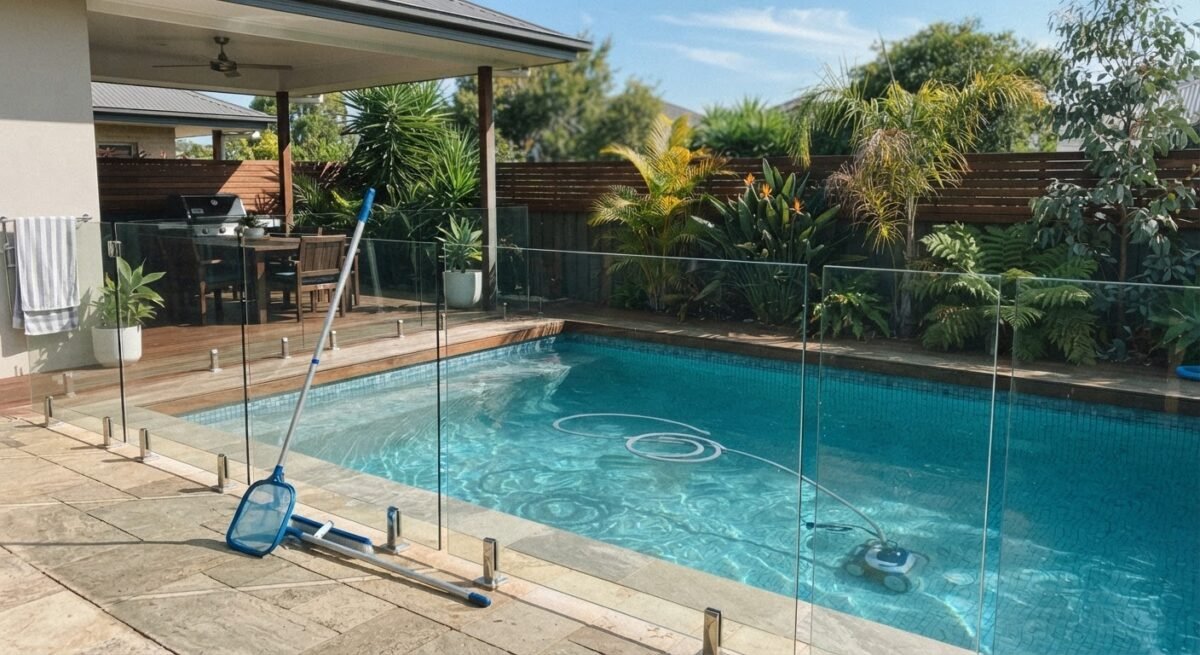
Key takeaway: Glass pool fencing in Australia costs $250 to $600 per linear metre installed for frameless, $150 to $400 for semi-frameless, and $100 to $250 for framed glass panels. A typical 15 to 20 metre pool perimeter comes to $3,000 to $12,000 depending on the style. Frameless glass is the premium option, while semi-frameless offers a similar look at roughly half the price.
Glass pool fencing is one of the most popular choices for Australian homeowners because it meets the safety requirements of AS 1926.1 while keeping sightlines open. But the cost difference between frameless, semi-frameless and framed glass is significant.
This guide breaks down the real cost of glass pool fencing in Australia, including materials, installation, gates and ongoing maintenance.
Glass Pool Fencing Cost per Metre
| Fencing Type | Supply Only (per m) | Installed (per m) | Best For |
|---|---|---|---|
| Frameless glass | $150 to $350 | $250 to $600 | Premium look, uninterrupted views |
| Semi-frameless glass | $80 to $200 | $150 to $400 | Best value for a glass look |
| Framed glass | $60 to $150 | $100 to $250 | Budget glass option |
| Aluminium (comparison) | $50 to $120 | $80 to $250 | Lowest cost compliant fencing |
Frameless glass uses 12 mm toughened safety glass panels fixed with stainless steel spigots drilled into the ground. Semi-frameless uses posts between panels, which lowers the engineering requirements and the price. Framed glass sits inside a full aluminium frame.
Total Cost by Pool Perimeter
| Perimeter | Frameless (installed) | Semi-Frameless (installed) | Framed (installed) |
|---|---|---|---|
| 10 m (small pool) | $2,500 to $6,000 | $1,500 to $4,000 | $1,000 to $2,500 |
| 15 m (medium pool) | $3,750 to $9,000 | $2,250 to $6,000 | $1,500 to $3,750 |
| 20 m (large pool) | $5,000 to $12,000 | $3,000 to $8,000 | $2,000 to $5,000 |
| 30 m (full boundary) | $7,500 to $18,000 | $4,500 to $12,000 | $3,000 to $7,500 |
These prices include a standard self-closing, self-latching gate. Additional gates add $600 to $1,500 each for frameless or $300 to $800 for semi-frameless.
Cost Breakdown
| Component | Typical Cost |
|---|---|
| Glass panels (12 mm toughened) | $100 to $300 per panel |
| Spigots or posts | $30 to $120 each |
| Self-closing gate | $600 to $1,500 (frameless) |
| Installation labour | $50 to $150 per metre |
| Core drilling into concrete | $20 to $50 per hole |
| Compliance inspection | $150 to $350 |
The gate is often the single most expensive component. A frameless glass gate with hydraulic hinges can cost more than 3 metres of fencing panels.
DIY vs Professional Installation
In most states, you can legally install pool fencing yourself as long as it passes a compliance inspection. However, the inspection is mandatory and must be done by a licensed certifier.
| DIY | Professional | |
|---|---|---|
| Materials cost (15 m) | $1,500 to $5,000 | Included in quote |
| Labour cost | $0 (your time) | $750 to $2,500 |
| Compliance inspection | $150 to $350 | Often included |
| Potential savings | 30% to 40% | n/a |
| Risk | Failing inspection, re-work | Installer guarantees compliance |
DIY kits from suppliers like Bunnings and specialist glass fencing retailers include pre-cut panels, spigots and gate hardware. For a step-by-step walkthrough, see our DIY glass pool fencing guide.
Compliance Requirements
All pool fencing in Australia must comply with AS 1926.1-2024. The key requirements for glass fencing are:
- Minimum 1,200 mm height from finished ground level
- Glass must be Grade A safety glass to AS/NZS 2208
- No climbable objects within 900 mm of the non-pool side
- Gaps between panels must not exceed 100 mm
- Gate must be self-closing, self-latching, and open outward (away from the pool)
- Latch must be at least 1,500 mm from ground level (or shielded if lower)
Non-compliant fencing can attract fines of up to $5,500 in NSW and $2,875 in QLD per offence. More importantly, your home insurance may not cover a pool-related incident if the fencing is not compliant. For height rules by state, see our guide on how high a pool fence needs to be.
What Affects the Price
Costs go up with:
- Curved runs or non-standard panel widths (custom cutting adds 20% to 40%)
- Sloped ground requiring stepped panels
- Multiple gates
- Tinted, frosted or low-iron glass
- Marine-grade or black powder-coated hardware
Costs go down with:
- Straight, level runs with standard panel widths
- Semi-frameless instead of frameless (40% to 50% cheaper)
- DIY installation with a pre-cut kit
- Fewer gates (one is the minimum)
- Ordering during winter when demand is lower
Maintenance Costs
Glass pool fencing is low-maintenance, but it does need regular cleaning to look its best:
- Cleaning: $0 to $50 per quarter (DIY with glass cleaner, or hire a window cleaner)
- Hardware check: Inspect spigots, hinges and latches annually for corrosion. Replace as needed ($30 to $120 per spigot).
- Gate adjustment: Self-closers may need adjustment every 1 to 2 years ($0 DIY or $100 to $200 for a technician).
- Re-certification: Required when selling your home in most states. Costs $150 to $350.
In coastal areas, choose 316 marine-grade stainless steel hardware to avoid corrosion. The upfront cost is higher, but it avoids replacing rusted fittings within 3 to 5 years.
Frequently Asked Questions
How much does glass pool fencing cost per metre in Australia?
Frameless glass pool fencing costs $250 to $600 per metre installed. Semi-frameless costs $150 to $400 per metre installed. Framed glass is the cheapest glass option at $100 to $250 per metre installed. Supply-only prices are roughly 40% to 50% lower.
Is frameless or semi-frameless glass fencing better?
Semi-frameless glass gives a very similar look to frameless at roughly half the cost. Frameless fencing provides the cleanest sightlines because there are no posts between panels, but the structural requirements (thicker glass, precision-engineered spigots) make it significantly more expensive. Semi-frameless is the best value for most homeowners.
Can I install glass pool fencing myself?
Yes, in most states you can install pool fencing yourself. DIY kits are available from specialist suppliers and hardware stores. However, the finished fence must pass a compliance inspection by a licensed certifier, and any electrical earthing work must be done by a licensed electrician. DIY can save 30% to 40% on the total cost.
How thick does glass pool fencing need to be?
Frameless glass pool fencing must use 12 mm toughened safety glass to meet AS 1926.1 requirements. Semi-frameless and framed glass can use 8 mm or 10 mm glass because the posts provide additional structural support. All glass must be Grade A safety glass compliant with AS/NZS 2208.
How long does glass pool fencing last?
The glass panels themselves last indefinitely with proper care. The hardware (spigots, hinges, latches) typically lasts 10 to 15 years for standard stainless steel or 20+ years for 316 marine-grade stainless. In coastal areas without marine-grade hardware, corrosion can appear within 3 to 5 years.
Does glass pool fencing need to be earthed?
Metal components of pool fencing within the pool barrier zone may need electrical earthing (bonding) under AS/NZS 3000 to prevent electric shock. This applies to stainless steel spigots and posts. A licensed electrician should assess and complete this work, which typically costs $200 to $500.
