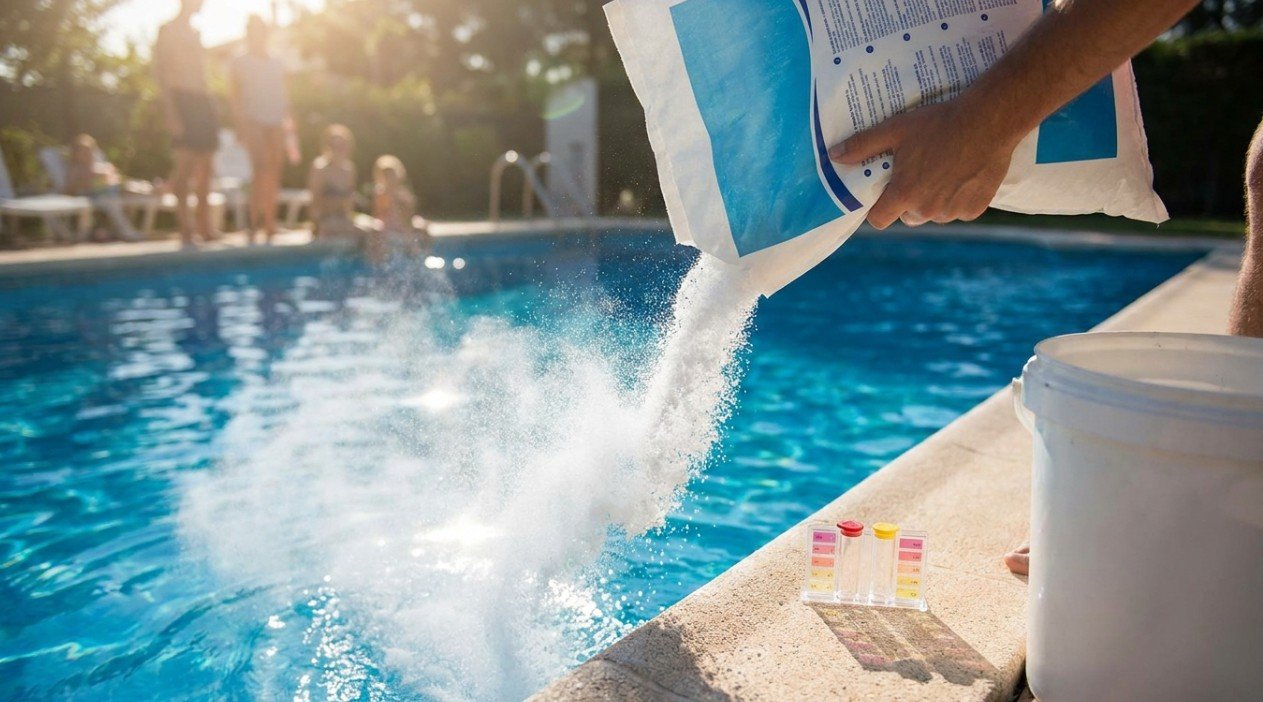
Key takeaway: Raising a pool’s salt level by 1,000 ppm takes 1 kilogram of pool salt per 1,000 litres of water. But the target you’re dosing to depends on your chlorinator: AstralPool and Zodiac, the two most common salt chlorinator brands in Australia, both recommend 4,000 ppm, while some low-salt models are designed to run at 3,000 ppm. Check your own chlorinator’s manual before you dose a large amount, since Australian brands genuinely disagree on this number.
Most online salt calculators land on one fixed number, often around 3,200 ppm, and stop there. That figure comes from an overseas web tool, not an Australian chlorinator manual. AstralPool and Zodiac both recommend 4,000 ppm, some lower-salt models run at 3,000 ppm instead, and the industry body SPASA puts the general working range for salt chlorinators at 3,000 to 7,000 ppm. Since the same pool needs a genuinely different amount of salt depending on what’s bolted to the equipment pad, the tables below show the actual kilograms by pool volume for the targets that matter here, not one borrowed number. For the wider basics of keeping pool water balanced, see our full pool water chemistry guide.
A Safety Note
Pool salt isn’t a hazardous chemical the way chlorine or pool acid is, but it still deserves basic care. Pour it in slowly around the return jets with the pump running, not straight into the skimmer or near the salt cell; undissolved granules sitting against the cell can scale or damage it. A 20kg bag throws up a fair bit of fine dust as you tip it, so keep it away from your eyes and out of your lungs. Most importantly, check your own chlorinator’s manual before dosing a large amount: overshooting salt is far easier to do than to undo, since there’s no filter or chemical that removes it. The only real fix for too much salt is diluting the pool, draining some water and refilling with fresh.
Salt Needed to Raise Your Pool by 1,000 ppm
| Pool volume | Pool salt needed |
|---|---|
| 20,000 L | 20 kg (1 bag) |
| 30,000 L | 30 kg (1.5 bags) |
| 40,000 L | 40 kg (2 bags) |
| 50,000 L | 50 kg (2.5 bags) |
| 70,000 L | 70 kg (3.5 bags) |
Based on standard 20kg bags of pool salt, the size sold at Australian hardware and pool shops.
How the Maths Works
1 ppm equals 1 milligram of salt per litre of water, so raising a pool by a set number of ppm takes that many milligrams per litre, multiplied by the pool’s volume in litres, then converted to kilograms. For a 1,000 ppm rise: 1,000 mg/L × 1 litre = 1,000 mg, or exactly 1 gram, per litre, which is 1 kg for every 1,000 litres. That’s why the table above scales in a straight line: double the pool volume, double the salt.
Worked example: a 40,000 litre pool starting fresh (0 ppm) needs 40kg × 4 to reach AstralPool and Zodiac’s recommended 4,000 ppm, that’s 160kg, or 8 bags of 20kg pool salt. The same pool needs only 120kg (6 bags) to reach a low-salt chlorinator’s 3,000 ppm minimum, a difference of 2 full bags for exactly the same pool. AstralPool’s own product specification confirms this rate directly: reaching its recommended 4,000 ppm from empty needs 4kg of salt per 1,000 litres, which matches the maths exactly.
Salt Needed to Reach Common Chlorinator Targets (From Empty)
| Pool volume | 3,000 ppm (low-salt models) | 4,000 ppm (AstralPool / Zodiac) | 5,000 ppm (higher-salt models) |
|---|---|---|---|
| 20,000 L | 60 kg (3 bags) | 80 kg (4 bags) | 100 kg (5 bags) |
| 30,000 L | 90 kg (4.5 bags) | 120 kg (6 bags) | 150 kg (7.5 bags) |
| 40,000 L | 120 kg (6 bags) | 160 kg (8 bags) | 200 kg (10 bags) |
| 50,000 L | 150 kg (7.5 bags) | 200 kg (10 bags) | 250 kg (12.5 bags) |
| 70,000 L | 210 kg (10.5 bags) | 280 kg (14 bags) | 350 kg (17.5 bags) |
How Often You’ll Actually Need to Top It Up
Salt doesn’t evaporate the way water does, so once a pool reaches its target level, it stays there until water actually leaves the pool. That means salt isn’t topped up on a schedule the way chlorine is; it’s replaced when you backwash the filter, when water splashes out, or when heavy rain dilutes the pool with fresh water. If a salt reading keeps dropping steadily with no obvious water loss, that’s worth checking for a leak rather than just adding more salt and moving on. Use pure granular pool salt, sold in 20kg bags at Australian hardware and pool shops, rather than iodised table salt or agricultural and rock salt, which can carry anti-caking agents or insoluble minerals that cloud the water or scale the cell.
Frequently Asked Questions
How much salt do I add to my pool?
It depends on your chlorinator, not one fixed number. AstralPool and Zodiac, the two most common brands in Australia, both recommend 4,000 ppm; some low-salt models run at 3,000 ppm. Multiply the ppm you’re aiming for by your pool’s volume in litres, then divide by 1,000,000, to get the kilograms of salt needed.
How often do you need to add salt to a pool?
Only when water actually leaves the pool, through backwashing, splash-out, or heavy rain dilution, not on a fixed schedule. Salt doesn’t evaporate or get consumed by the chlorination process, so a topped-up pool holds its salt level until the water itself changes.
Can you put too much salt in a pool?
Yes, and it’s harder to fix than adding too little. Excess salt can’t be filtered or dosed away; the only real fix is draining some pool water and replacing it with fresh water to dilute it back down. Add a little under the calculated amount first, run the pump, then retest before topping up further.
What salt should I use in my pool?
Pure granular pool salt sold in 20kg bags at Australian hardware and pool shops, not iodised table salt or agricultural or rock salt. Non-pool-grade salt can carry anti-caking agents or insoluble minerals that cloud the water or scale the salt cell.
How long after adding salt can I run the chlorinator or swim?
Wait until the salt has fully dissolved and circulated, running the pump continuously for several hours before testing, and don’t run the chlorinator on a batch that hasn’t mixed through yet, since a pocket of undissolved salt sitting near the cell can cause scaling. Swimming is fine once it’s dissolved; there’s no chemical exposure risk the way there is after a chlorine shock.
