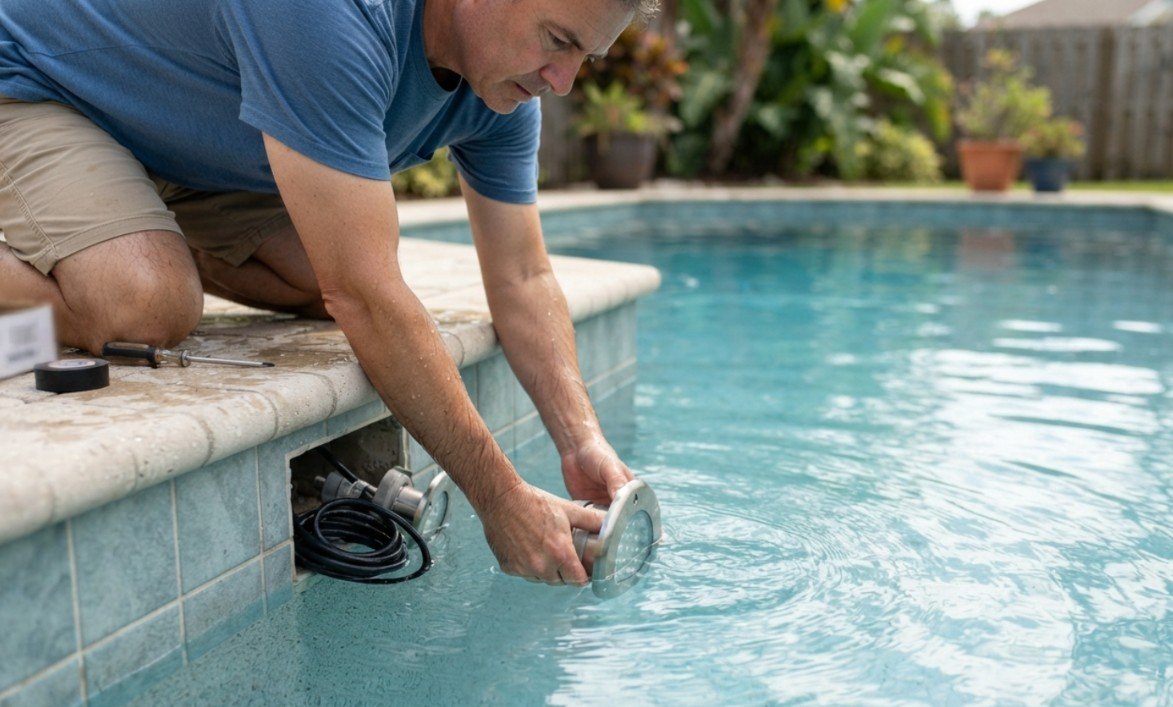
Key takeaway: Changing an existing pool light globe is a homeowner-safe job once the power is isolated at the switchboard, most niche fittings lift out with a single screw and enough cable slack that you never need to drain the pool. Anything beyond that, a new circuit, a damaged transformer, or a mains-voltage fitting, is licensed electrician territory under AS/NZS 3000.
To change a pool light, switch off power to the light circuit at the switchboard, confirm it’s dead with a voltage tester at the niche, undo the single retaining screw, and gently lift the fixture out on its cable, you don’t need to drain the pool. Swap the globe or LED unit, fit a new gasket, test the seal, then reinsert the housing into the niche and restore power. The whole job typically takes 20 to 40 minutes if the fitting itself is in good condition.
What You’ll Need
- A non-contact voltage tester (don’t skip this step)
- A replacement globe or LED unit matched to your existing fitting
- A new lens gasket (O-ring), cheap, and always worth replacing rather than reusing
- A screwdriver matching the niche’s single retaining screw
- A torch, for seeing what you’re doing at dusk or in an enclosed niche
Step-by-Step
- Turn off the power at the switchboard. Isolate the circuit that feeds the pool light, not just a wall switch. Then confirm there’s no current at the niche itself with a voltage tester before you touch anything.
- Remove the retaining screw. Most residential pool light niches hold the fixture in with a single screw at the top of the housing.
- Lift the fixture out gently. Pool light fittings are designed with enough cable slack to bring the whole housing up onto the deck without draining the pool or disconnecting any wiring. Don’t force it, if it won’t come, stop and call an electrician rather than pulling on the cable.
- Replace the globe or LED unit. Match the replacement to your existing fitting’s voltage and fitting type exactly.
- Fit a new gasket. Seat it evenly around the lens before reassembling, this is what keeps water out of the housing.
- Test the seal before reinstalling. Hold the reassembled fixture underwater and check for bubbles escaping from the gasket line. A few is normal; a steady stream means the gasket isn’t seated properly.
- Reinsert the housing into the niche and re-secure the retaining screw.
- Restore power at the switchboard and test the light before you consider the job done.
Common Mistakes
- Skipping the voltage test and assuming the switchboard label is correct, mislabelled circuits happen more often than you’d think
- Reusing the old gasket instead of replacing it, a few dollars now beats a flooded housing later
- Forcing a stuck fixture out of the niche instead of stopping and calling an electrician
- Fitting a globe or LED unit that doesn’t match the housing’s original voltage rating
When to Call a Licensed Electrician Instead
Under Australia’s AS/NZS 3000 wiring rules, underwater pool lighting must run on extra-low voltage (12V) through a safety isolating transformer, and any work on the circuit itself, not just the globe, needs a licensed electrician. Call one if:
- The fixture won’t lift out of the niche without force
- You can see water inside the housing, damaged cable insulation, or a corroded connection
- You’re installing a new light where none existed before, see our full pool landscaping and lighting guide for what that involves
- You’re not certain the existing fitting is genuinely low-voltage rather than a mains-voltage fixture
Types of Pool Light Fittings
Most Australian inground pools use one of two fitting styles, and it’s worth knowing which one you have before you order a replacement:
- Wet-niche fittings sit inside a sealed housing recessed into the pool wall, fully submerged. This is the standard setup on most fibreglass and concrete pools, and it’s what the step-by-step above describes.
- Surface-mounted or above-water fittings sit at or above the waterline, common on above-ground pools and some newer builds. These are usually even simpler to access since there’s no niche to lift out of, but the same switchboard isolation and voltage-testing rules still apply.
Choosing a Replacement Globe or LED Unit
Getting the replacement wrong is the most common reason a “simple” globe swap turns into a return trip to the pool shop. Check these before you buy:
- Voltage. Match it exactly, a 12V LED retrofit into a fitting designed for a 12V halogen globe is straightforward; forcing a mains-voltage globe into a low-voltage housing (or vice versa) isn’t just wrong, it’s unsafe.
- Physical size and thread. Pool light globes and LED units come in specific diameters and base fittings. Take the old unit with you when buying a replacement rather than working from memory.
- Colour-changing vs fixed white. Colour-changing LED units are a straightforward swap for most standard niches, but check the housing has room for the slightly larger driver some colour units include.
- IP rating. Anything going into a wet niche needs a rating built for permanent underwater use, not a generic outdoor-rated fitting meant for splash exposure only.
Frequently Asked Questions
Do I need to drain my pool to change the light?
No. Pool light niches are designed with enough cable slack to lift the entire fixture up out of the water and onto the deck for globe or gasket replacement, without draining any water.
Can I change a pool light myself?
Swapping the globe or LED unit on an existing, working low-voltage fitting is generally a homeowner-safe job once you’ve isolated power at the switchboard. Any work on the wiring, transformer or a fitting that won’t come out cleanly needs a licensed electrician.
How do you change a pool light bulb?
Isolate power at the switchboard, confirm it’s off with a voltage tester, undo the single retaining screw, lift the fixture out, replace the globe and gasket, test the seal underwater, then reinstall the housing and restore power.
Why is my pool light not working after I changed the bulb?
Check that the replacement globe or LED unit matches the fitting’s original voltage rating, that the gasket is seated evenly with no gap, and that power has actually been restored at the switchboard. If it still doesn’t work, the transformer or wiring may have failed, which is an electrician’s job.
How often do pool lights need replacing?
LED pool lights commonly last years longer than older halogen units, but the gasket should be replaced every time the fixture is opened regardless of how long the globe itself has lasted.
