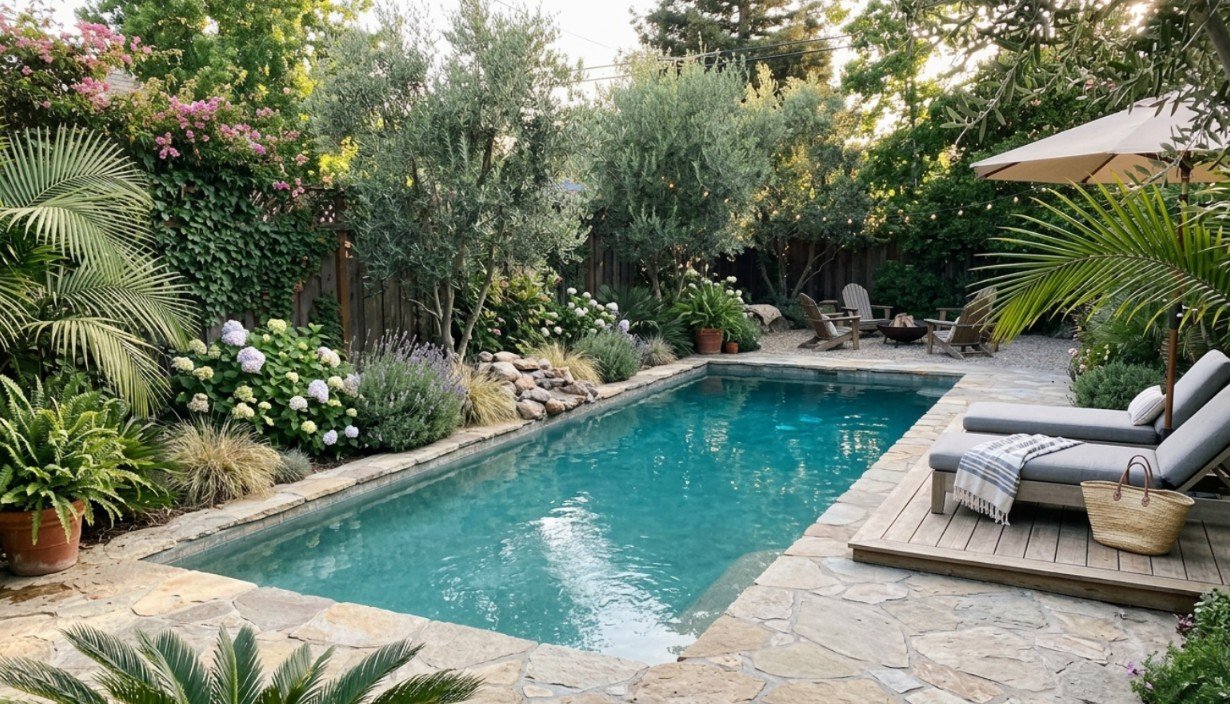
Key takeaway: The four things that actually make a pool area look and work well are the decking (timber, composite or pavers), the coping (bullnose, square edge or cantilever), the planting (chlorine and salt-tolerant species, kept at least a metre back from the water), and the lighting (LED underwater lights typically $400 to $900 each, installed by a licensed electrician). Get the coping and decking right first; everything else sits on top of that decision.
A pool on its own is a hole full of water. What turns it into the part of the house everyone actually wants to be in is what surrounds it: the surface you walk on, the edge the pool itself finishes at, what’s growing nearby, and how it looks after dark. This guide covers all four, decking, coping, planting and lighting, and how they work together rather than as separate decisions.
Four Pool Landscaping Styles to Start From
If you’re staring at a blank backyard, picking a style first makes every other decision on this page easier, the materials, plants and lighting below all follow from it.
- Tropical/Balinese. Timber or timber-look composite decking, dense planting (palms, cordylines, birds of paradise), and warm-toned lighting. Needs the most ongoing garden maintenance of the four.
- Modern minimalist. Square-edge coping, large-format pavers or polished concrete, structural planting (agave, strappy natives) used sparingly, and clean-lined LED lighting rather than warm ambient glow.
- Mediterranean. Travertine or limestone-look paving, olive trees and lavender kept well back from the water, wrought-iron or timber pergola shade.
- Native/coastal. Lomandra, dianella and westringia planting, timber or grey-toned composite decking, and a simple bullnose or cantilever edge that doesn’t compete with the planting.
None of these need to be followed exactly, most real backyards borrow from two styles rather than committing fully to one. What matters is picking a direction before ordering decking, coping and plants separately, mixing tropical planting with stark minimalist paving is the most common regret we hear about after the fact.
Pool Decking and Paving: What to Choose
In Australia, slip resistance around a pool is measured against AS 4586, and anything you put down should sit toward the higher-grip end of that scale, wet feet and smooth stone don’t mix.
| Material | Typical cost | Maintenance | Best for |
| Timber | $150–$300/m² | Oil or stain roughly once a year, or it greys and splits | A natural look, and buyers who don’t mind the upkeep |
| Composite | $250–$450/m² | A wash-down; won’t rot, warp or splinter | Coastal properties and anyone who wants timber’s look without the yearly recoat |
| Concrete/pavers | $80–$200/m² | Occasional sealing depending on finish | The most affordable option, and the most common in budget builds |
| Natural stone (travertine) | $150–$350/m² | Periodic sealing | Staying noticeably cooler underfoot in full sun |
Composite typically costs more upfront than timber, but over 20 years it can save $3,000 to $8,000 in maintenance on an average-sized deck, because there’s no annual recoat. Whether that trade-off is worth it depends on how long you’re planning to stay in the house.
Pool Coping: The Edge That Does the Work
Coping is the capping edge around the pool shell, and it does two jobs: it finishes the pool visually, and it stops water from sheeting back under the decking. Three profiles cover almost every AU pool:
- Bullnose. A smooth, rounded edge. The most widely used profile, and it suits both traditional and contemporary pools.
- Square edge. A sharp, clean line that pairs well with modern, minimalist paving. It’s less forgiving underfoot than bullnose.
- Cantilever. The coping extends slightly over the pool edge itself, giving a seamless look and letting water run straight back into the pool.
Material choice sits on top of the profile: concrete and precast are the budget options, porcelain and travertine cost more but stay noticeably cooler underfoot in direct sun, which matters more than it sounds like on a 40°C day. See our full guide to what pool coping is and what it costs for a deeper breakdown of materials and pricing.
Planting Around a Pool Without the Mess
The plants that work well around an Australian pool share three things: they don’t drop leaves or flowers constantly, they cope with the occasional splash of chlorinated or salt water, and they’re not the kind of root system that goes looking for your pool shell.
- Good choices: agave, yucca, aloe and other waxy or silvery-leafed succulents handle salt splash well. Lomandra, dianella (flax lily) and westringia (coastal rosemary) are hardy Australian natives that cope with full sun and produce very little litter. Bromeliads and society garlic are common low-maintenance poolside picks.
- Avoid: deciduous trees that drop leaves into the water, anything thorny near a barefoot zone, and large trees with invasive root systems planted close to the pool shell or fencing footings.
Plant at least a metre back from the coping. It protects the plant from regular chemical splash and keeps roots away from the shell and any buried lighting or filtration conduit.
Pool Lighting: LED, Solar and Fibre Optic Compared
| Type | Typical cost | Pros | Cons |
| LED underwater | $400–$900 per light, plus install | Most energy-efficient, long life, wide colour range | Higher upfront cost than halogen |
| Halogen | Cheaper to install than LED | Brighter for the price | Runs hot, shorter lifespan |
| Fibre optic | Varies by run length | Light source stays out of the water entirely | Dimmer than LED or halogen |
| Solar | Low cost, no wiring | Adds colour and atmosphere cheaply | Not a permanent or primary lighting system |
A modern 30-watt LED light can put out 1,400+ lumens while an older-style 300-watt incandescent light burns far more power for less light, the efficiency gap is roughly 10x. If you’re replacing an existing light rather than adding a new one, see our guide on how to change a pool light.
A safety note: pool lighting is electrical work done in and around water. Under Australia’s AS/NZS 3000 wiring rules, underwater pool lights must run on extra-low voltage (12V) through a safety isolating transformer, mains-voltage (240V) fittings aren’t permitted underwater, and every circuit in the pool zone (lighting included) needs 30mA RCD (safety switch) protection. Any new pool light circuit, or work on an existing one beyond swapping a globe on an already-compliant low-voltage fitting, must be done by a licensed electrician. This isn’t a DIY job the way changing a deck board is.
How Much Does Landscaping Add to a Pool Build?
Decking, coping upgrades, planting and lighting sit outside most builders’ base pool price, see our full pool cost guide for what’s typically included versus what’s quoted separately. As a rough guide, a mid-size deck (25 to 30m²) alone can add $6,000 to $13,500 depending on material, before coping, planting or lighting are added.
Common Mistakes
- Choosing decking or coping purely on looks without checking its slip rating against AS 4586
- Planting leaf-dropping trees directly beside the pool, then fighting a constant skimmer problem for the life of the tree
- Treating pool lighting as a standard household wiring job instead of a licensed, RCD-protected pool circuit
- Not budgeting decking, coping and lighting as separate line items, then being surprised when the “pool price” doesn’t include any of them
When to Call a Professional
Bring in a landscaper or paver for decking and coping if the site has drainage falls, retaining, or step changes to get right, a badly sloped surround sends water the wrong way for years. Always use a licensed electrician for pool lighting, new circuits and anything involving the switchboard or RCD protection are not DIY territory around a pool.
Shade: Sails, Pergolas and Umbrellas
| Option | Typical cost | Best for |
| Umbrella | From around $50 (basic) up to several hundred for cantilevered styles | Flexible, moveable shade over seating without any ground fixings inside the pool zone |
| Shade sail | From around $300 per sail | Covering irregular pool shapes or large areas cheaply, with posts mounted outside the fence line |
| Pergola | $2,000–$18,000+ | A permanent, architectural solution where the deck is treated as an outdoor room |
Shade sails are the most common choice for pool areas because they’re the cheapest way to cover an irregular shape, and posts can usually sit outside the pool fence rather than inside the non-climbable zone. A pergola costs more but suits a deck that’s meant to function as an outdoor living space year-round, not just pool-side shade in summer.
Where Fencing Fits Into the Landscape
Every decision on this page has to work around one non-negotiable: the pool fence and its 900mm non-climbable zone. That means shade sail posts, garden beds, pot plants, retaining walls and outdoor furniture all need to sit clear of that zone on the outside of the barrier, and decking or steps can’t be built in a way that reduces the fence’s effective height. If you haven’t finalised your fencing yet, read how high your pool fence needs to be before you commit to a decking or planting layout, retrofitting a garden bed that fails inspection is far more annoying than designing around the fence from the start.
Worked Example: Landscaping a Standard Pool
Take a standard 7m x 3m fibreglass pool (see our full pool cost guide for the build price itself). A realistic landscaping budget on top of the pool might look like:
- Compliant fencing: $3,000–$10,000
- Decking or paving (25–30m²): $6,000–$13,500 depending on material
- Coping upgrade from standard concrete to travertine or porcelain: $2,000–$5,000
- Planting: $500–$2,000 depending on scale
- Two to three LED underwater lights, installed: $1,500–$3,500
- A shade sail or two: $600–$1,500
Add it up and a modest landscaping package sits somewhere between $13,600 and $35,500 on top of the pool build itself, which is exactly why the “pool price” you’re quoted and the total cost of a finished, usable pool area are rarely the same number.
Frequently Asked Questions
What is pool coping?
Pool coping is the capping edge that finishes the top of a pool shell where it meets the surrounding deck or paving. It stops water sheeting back underneath the decking and comes in profiles like bullnose, square edge and cantilever.
What’s the best decking material for a pool area?
Composite decking is the lowest-maintenance option, needing just a wash-down and resisting rot and warping, though it costs more upfront than timber. Timber looks natural but needs annual oiling or staining, and concrete or pavers are the most affordable choice.
What plants are safe to grow around a pool?
Waxy or silvery-leafed succulents like agave, yucca and aloe handle salt splash well, and hardy Australian natives such as lomandra, dianella and westringia produce very little leaf litter. Avoid deciduous trees and anything with an invasive root system near the pool shell.
Can I install pool lights myself?
No. Pool lighting circuits fall under AS/NZS 3000 and require a licensed electrician, RCD protection and, for underwater fittings, an extra-low voltage (12V) supply through a safety isolating transformer. Swapping a globe on an already-compliant low-voltage fitting is the only DIY-safe part.
How much does pool decking cost per square metre?
Concrete or pavers typically cost $80 to $200 per square metre, timber $150 to $300, and composite $250 to $450. Composite costs more upfront but can save $3,000 to $8,000 in maintenance over 20 years compared with timber.
What’s the difference between bullnose and square edge coping?
Bullnose has a smooth, rounded edge and suits both traditional and contemporary pools, while square edge gives a sharp, clean line common in modern architectural designs. Bullnose is generally more forgiving underfoot.
Do pool lights need to be low voltage?
Yes, for underwater fittings. Mains-voltage (240V) fixtures aren’t permitted underwater in Australia; underwater lights must run on extra-low voltage (12V) through a safety isolating transformer under the AS/NZS 3000 wiring rules.
How far should plants be from a pool?
At least a metre back from the coping. That distance protects plants from regular chlorine or salt splash and keeps root systems away from the pool shell and any buried lighting or filtration conduit.
Is composite decking better than timber around a pool?
It depends on how long you’re staying. Composite costs more to install but needs only a wash-down and won’t rot, warp or splinter, while timber is cheaper upfront but needs oiling or staining roughly once a year in Australian conditions.
How much does it cost to landscape around a pool?
A mid-size deck (25 to 30 square metres) alone typically adds $6,000 to $13,500 depending on material, before coping upgrades, planting or lighting are added on top.
