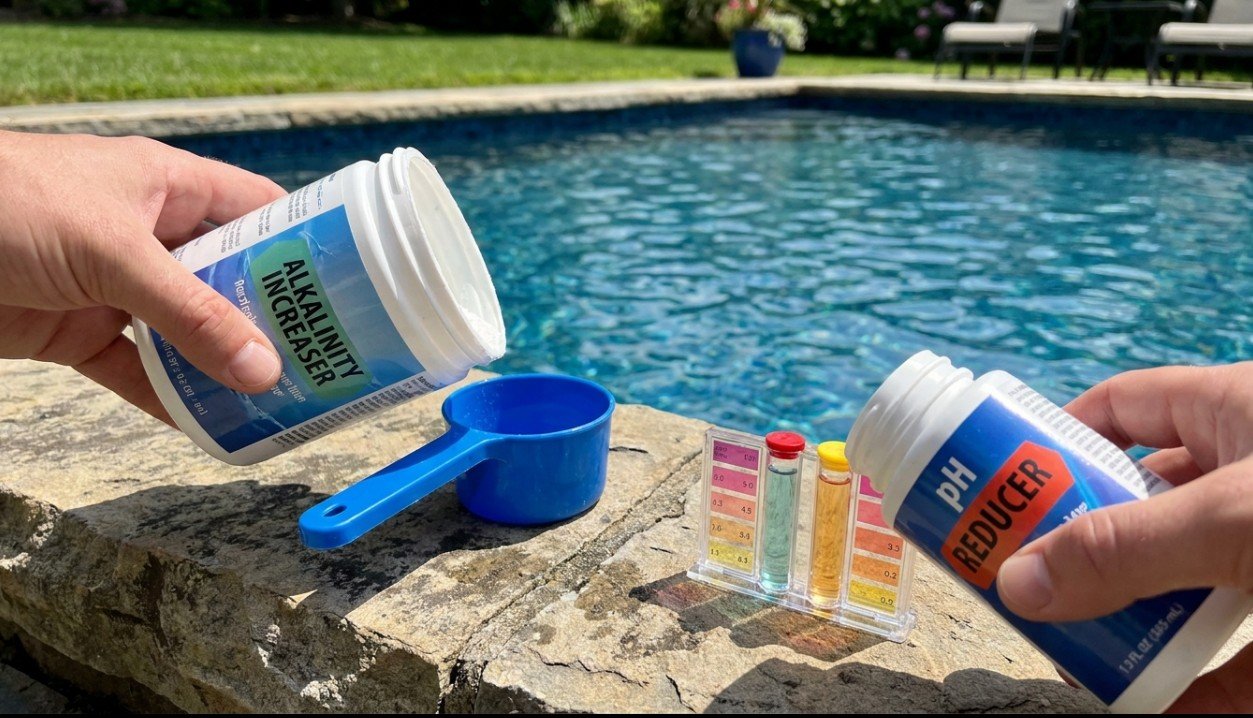
Key takeaway: Total alkalinity should sit between 80 and 120 ppm. To raise it, sodium bicarbonate (sold in Australia as products like Zodiac Alkalinity Up) adds about 10 ppm per 200g per 10,000 litres. To lower it, sodium bisulphate (“dry acid”) removes about 10 ppm per 150g per 10,000 litres. Both directions overshoot the same way: adding the full dose in one go instead of dosing in stages and retesting between each one.
Chlorine that won’t hold steady, pH that swings no matter how carefully you dose it, water that looks cloudy despite good chlorine and clean filters: total alkalinity is the usual suspect behind all three, and it’s the one reading most pool owners skip. Alkalinity is what buffers pH, so when it’s wrong, everything built on top of it gets harder to control. This guide covers raising it, lowering it, and the mistakes that push it too far in either direction. For the wider basics, see our full pool water chemistry guides.
What You’ll Need
- A liquid test kit or test strips for total alkalinity and pH
- Sodium bicarbonate (alkalinity increaser) if raising, or sodium bisulphate (“dry acid”/pH reducer) if lowering, not both
- Your pool’s volume in litres. A pool volume calculator makes this quick (coming soon on this site)
- A clean bucket for pre-dissolving, plus gloves and eye protection
- Patience: dose in stages and retest between each one, rather than one large correction
To Increase Alkalinity
Low alkalinity (under 80 ppm) lets pH swing wildly with every dose of chlorine or every splash of rain, and it can make pool surfaces and metal fittings corrode over time. Sodium bicarbonate, sold in Australia as products like Zodiac Alkalinity Up, raises it back up: that product’s own label calls for 200g per 10,000 litres to raise total alkalinity by 10 ppm. For a 40,000-litre pool that’s 15 ppm low, that’s roughly 200g × 4 × 1.5 = 1.2kg of product.
The label also carries a real overcorrection limit worth taking seriously: no more than 2kg per 50,000 litres in any 6-hour period, because adding too much too fast risks plating dissolved metals onto pool surfaces rather than just overshooting the number. Split a large correction across more than one session rather than chasing it all in a single afternoon, and don’t dose it within 2–4 hours of a calcium hardness increaser, the combination can cause severe cloudiness, one of the less obvious causes behind a pool that clouds up right after a chemical top-up.
To Reduce Alkalinity
High alkalinity (over 120 ppm) buffers pH so heavily that correcting pH barely moves it, and it can leave water cloudy or scaly even when other readings look fine, exactly the trap in our guide to raising pH without overshooting it. Sodium bisulphate, sold as dry acid or pH reducer (Clearchem pH Reducer is one widely sold Australian brand), brings it back down: that product’s label calls for 375g per 25,000 litres to lower total alkalinity by 10 ppm, which scales to 150g per 10,000 litres.
- Pre-dissolve the dose in a bucket of pool water, dry acid products are designed to be mixed this way, not broadcast dry.
- With the pump running, disperse the mixture around the pool perimeter.
- Run the pump for at least 2–4 hours for proper circulation.
- Retest before adding more. As a rule of thumb, don’t try to drop alkalinity by more than about 20 ppm in a single day, large single corrections are far more likely to swing past the target.
Common Mistakes
- Adding a full correction in one dose in either direction instead of splitting it across sessions and retesting
- Confusing alkalinity with pH and dosing a pH product when alkalinity is actually the reading that’s off
- Raising alkalinity and adding a calcium hardness product within the same few hours, risking sudden cloudiness
- Not retesting before adding more, especially when lowering alkalinity, since dry acid needs time to fully circulate
- Ignoring alkalinity entirely and only chasing the pH number, when alkalinity is usually the reading actually driving the problem
When to Call a Pro
If alkalinity keeps drifting back out of range within days of correcting it properly, something else is usually behind it: fresh fill water with a naturally different alkalinity, an auto-chlorinator adding more acid or base than expected, or aerating water features that push pH and alkalinity around constantly. A pool shop water test usually finds the actual driver faster than repeated manual correction.
Safety
Sodium bicarbonate (the increaser) is the same substance as household baking soda and carries a far lower hazard profile than most pool chemicals, though it’s still worth handling with basic care and checking the product’s own safety data sheet. Sodium bisulphate (the reducer) is a different matter: it’s classed under GHS as causing serious eye damage, with a DANGER signal word on its safety data sheet, consistent across every sodium bisulphate pool product checked. Wear gloves and eye protection when handling either, but treat the reducer with the same care as pool acid. If it splashes in the eyes, flush continuously with running water for several minutes and seek medical help. For any exposure concerns, the Australian Poisons Information Centre is available 24 hours a day on 13 11 26.
Frequently Asked Questions
What is total alkalinity in a pool?
Total alkalinity measures the water’s ability to buffer, or resist, changes in pH. Get it right and pH stays stable between tests. Get it wrong and pH swings wildly with every dose of chlorine or every bit of rain, even when you’re dosing pH correctly.
Is high alkalinity in a pool dangerous?
It’s not an immediate health hazard, but high alkalinity buffers pH so heavily that correcting pH barely works, and it can leave water cloudy or cause scaling on tiles and fittings over time. Worth fixing for water quality, not an emergency to drain the pool over.
How much baking soda do I need to raise alkalinity in a pool?
One widely sold Australian product’s label calls for 200g of sodium bicarbonate per 10,000 litres to raise total alkalinity by 10 ppm. Dose in stages rather than all at once, and don’t add more than 2kg per 50,000 litres in any 6-hour period.
Can I raise alkalinity without affecting pH?
Not completely, sodium bicarbonate raises both, just with a much bigger effect on alkalinity than on pH. If pH is already correct and only alkalinity is low, dose in smaller stages and retest pH along the way rather than assuming it won’t move at all.
What causes low alkalinity in a pool?
Heavy rain diluting the water, a recent partial drain and refill, or regular use of certain acidic sanitisers over time can all pull total alkalinity down. It’s also common after correcting a high pH with too much acid at once.
What causes high alkalinity in a pool?
Fresh fill water is often naturally alkaline depending on your area, and some alkalinity increaser or buffer products push it up faster than pH. Bore or tank water in particular can run high in total alkalinity before you’ve added anything at all.
