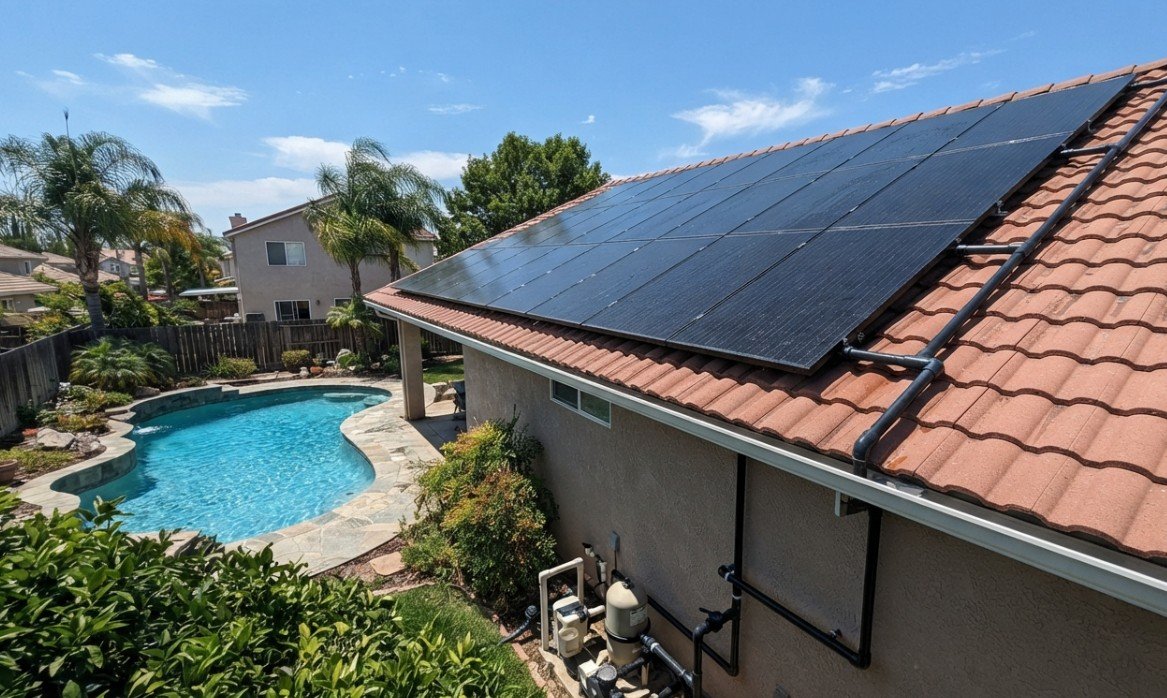
Key takeaway: Solar pool heating pumps your pool water through black collectors, usually mounted on the roof, that absorb the sun’s heat before the water returns to the pool. It typically lifts water temperature by 4°C to 8°C, runs on the pump you already own so there’s close to zero extra running cost, and needs a collector area equal to roughly 60% to 80% of your pool’s surface area depending on your state.
A solar pool heating system doesn’t generate heat the way a gas or electric heater does. It just captures heat that’s already landing on your roof and moves it into your pool. Your existing pump pushes pool water through a set of dark collectors instead of sending it straight back to the pool. The sun warms the water as it passes through, and it returns a few degrees warmer than when it left. There’s no gas bottle to fill and no separate motor running all day, just your pump doing a slightly longer lap.
The 5 Steps: How Solar Pool Heating Works
- Your pump draws water from the pool as normal. Solar heating uses your existing filtration pump and plumbing, it doesn’t need a dedicated pump of its own.
- A diverter valve sends that water to the collector. Instead of returning straight to the pool after the filter, water is redirected up to the roof or ground-mounted collector array.
- The collector absorbs solar radiation and warms the water. Collectors are usually black polypropylene or EPDM rubber panels with narrow internal channels, dark colour and a large surface area to soak up as much sun as possible.
- A controller compares collector and pool temperature. Automatic systems only divert water to the collector when it’s hotter than the pool, so you’re never pumping heat out of the pool on a cold or overcast day.
- Warmed water returns to the pool. The loop repeats for as many hours as your filtration system runs during daylight, gradually raising the average pool temperature over the course of the day.
How Much Warmer Will My Pool Get?
A correctly sized system typically raises pool temperature by 4°C to 8°C above what the pool would sit at unheated, and can extend a comfortable swimming season by six to eight weeks at each end of summer. How much you actually get depends on collector size relative to the pool, hours of direct sun the collector receives, wind exposure, and whether you’re using a cover overnight to hold the heat you’ve gained. Solar heating works well for extending the shoulder-season swim window in spring and autumn, but it isn’t a substitute for a heat pump if you want to swim in the middle of winter, there simply isn’t enough sun to draw on.
Sizing Your Collector: Show Your Working
Collector area is calculated as a percentage of your pool’s surface area, and that percentage changes by state because it’s really a proxy for how much reliable sun the collector gets. Standards Australia’s AS3634 sets a baseline of 60% of pool surface area for the Sydney, Newcastle and Wollongong region, but only under ideal conditions. SPASA’s real-world guidance runs higher for most installations, to account for shading, roof pitch, orientation and wind exposure that eat into a collector’s actual output.
| Region | Recommended collector area (open-style system) |
|---|---|
| Far North Queensland, Northern Territory | 60% of pool surface area |
| South East Queensland, Alice Springs, parts of WA | 70% of pool surface area |
| NSW, ACT, Victoria, SA, Tasmania, Perth | 80% of pool surface area |
Worked example: an 8m × 4m pool has a surface area of 32m² (length × width). Installing in Sydney, at the 80% recommendation, you’d want roughly 32 × 0.8 = 25.6m² of collector, close to a full northerly roof face on an average home. A closed-style system (panels plumbed as a sealed loop rather than open to atmosphere) needs less area again, SPASA’s figure is a minimum of 30%, but it also costs more per square metre, so open-style collectors remain the more common residential choice.
Common Mistakes
- Undersizing the collector to save money. A collector at 40% to 50% of pool surface area will still add some heat, but nowhere near the 4°C to 8°C most owners expect, and it’s the single most common reason people call solar heating “a waste of money” when it’s actually just undersized.
- Mounting on a shaded or poorly oriented roof face. A north-facing roof with full sun from 10am to 3pm will vastly outperform an east or south-facing array of the same size.
- Skipping a pool cover. Most of the heat a solar system adds during the day is lost overnight through evaporation from an uncovered pool. A cover is the cheapest way to actually keep the heat you’ve paid to generate.
- Assuming it’ll heat the pool for a winter swim. Low winter sun angles and shorter days mean solar output drops sharply, this is a shoulder-season and summer-boost technology, not a year-round heater on its own.
When to Call a Solar Heating Installer
Get a licensed solar pool heating installer involved for the roof structural assessment (collectors and their fixings add load, and older tile or asbestos-era roofs need checking before anything goes up), the plumbing tie-in to your existing pump and filter line, and the automatic controller wiring. A DIY collector mounted with the wrong pitch or a plumbing tie-in on the wrong side of the filter can leave you with a system that technically runs but never gets close to its rated temperature rise.
Warmer water also speeds up algae growth and burns through sanitiser faster, so if you’re adding solar heating to a pool you’ve historically kept on the cooler side, budget for a bit more attention to your pool’s water chemistry once the temperature climbs. And because solar heating shares your existing pump and filtration loop rather than adding a new one, it doesn’t change what your pump costs to run, the extra load on your power bill is close to zero. If you’re weighing solar against a heat pump or gas heater, our guide to how long each heater type actually takes to heat a pool is the next thing to read.
Frequently Asked Questions
How much does solar pool heating cost to run?
Almost nothing beyond what you already pay to run your pool pump. Solar heating uses your existing pump and filtration loop rather than a separate motor, so once the system is installed there is no meaningful extra electricity cost, unlike a heat pump or gas heater which both have real running costs of their own.
Does solar pool heating work in winter?
Not well on its own. Low winter sun angles and shorter days sharply cut solar output, so solar heating is best thought of as a way to extend spring and autumn swimming by several weeks at each end of the season, not a year-round replacement for a heat pump.
Do I need a separate pump for a solar pool heating system?
No. A correctly designed system runs off your existing filtration pump through a diverter valve. You only need a dedicated solar circulation pump on unusual setups where the collector sits higher than the pump can push water efficiently.
How long do solar pool heating panels last?
Quality UV-stabilised collectors typically last 15 to 20 years, with premium systems warranted even longer. Cheaper unstabilised plastic panels can degrade and crack within a few years of constant Australian sun exposure, so panel material and warranty length are worth checking before you buy.
Is solar pool heating worth it in Australia?
For most of the country, yes, Australia has the sun to make it work well as a low-running-cost way to extend the swim season. It pays off fastest when paired with a pool cover to hold the heat overnight, and least well in far southern or frequently overcast regions where a heat pump will carry more of the load.
