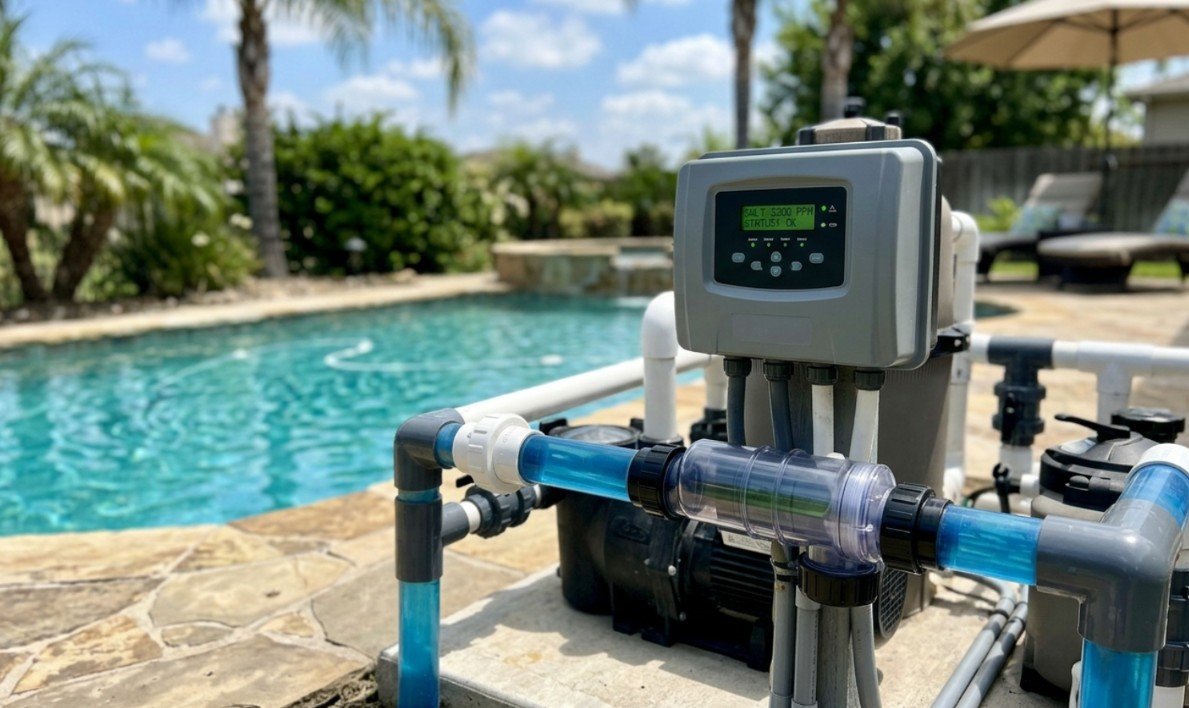
Key takeaway: Size a salt chlorinator to your pool’s actual litre volume, not its surface area: a 30,000 litre pool needs roughly 20–30g/hr of rated chlorine output, and undersizing the cell is the single most common buying mistake. Budget for cell replacement every 3–5 years (8,000–15,000 hours of runtime) as a real recurring cost, and keep salt between 2,700 and 3,400 ppm unless your chlorinator’s manual says otherwise.
You come home from a week away to find the pool’s turned the colour of pea soup, and the salt chlorinator’s little display is flashing a code you’ve never seen before. Most Australian backyard pools run on salt chlorination rather than manually dosed liquid or tablet chlorine, but “it’s a salt pool” doesn’t mean the equipment looks after itself, and buying the wrong size cell is why so many salt pools struggle to hold a chlorine reading within the first year. This guide covers what actually matters when choosing a chlorinator or salt system, not brand names, so you can size and specify one properly before you buy.
At a Glance: Sizing a Chlorinator to Your Pool
| Pool volume | Chlorinator output needed | Typical cell life | Approx unit cost (AUD) |
|---|---|---|---|
| Up to 40,000 L | 15–20 g/hr | 3–5 years (8,000–15,000 hrs) | $600–$900 |
| 40,000–70,000 L | 20–30 g/hr | 3–5 years | $800–$1,300 |
| 70,000–120,000 L | 30–40 g/hr | 3–5 years | $1,100–$1,800 |
| 120,000 L+ | 40 g/hr or more | 3–5 years | $1,800–$2,800+ |
Figures are typical ranges across Australian residential salt chlorinator models, not one specific product. Always check the manufacturer’s own sizing chart for your exact pool volume.
A Safety Note
A salt chlorinator’s control unit is mains-wired electrical equipment sitting on the pool’s circulation line, so it falls squarely under AS/NZS 3000:2018, the Wiring Rules. Every circuit supplying equipment in a classified pool zone, including the chlorinator, pump and any pool lighting, must be protected by a 30mA RCD (safety switch), and metal fixtures within reach of the pool edge need to be equipotentially bonded to earth. This applies Australia-wide; it’s a wiring rule, not a state-based one. The plumbing side of a chlorinator install is reasonably DIY-friendly, but the electrical connection into the switchboard must be done, or at least signed off, by a licensed electrician.
Self-Cleaning Cells vs Manual-Clean Cells
Calcium and other minerals in pool water deposit on a salt cell’s electrode plates over time, which cuts its chlorine output long before it actually fails. A self-cleaning cell reverses the polarity across the plates at set intervals, knocking most of that scale off automatically. A manual-clean cell needs the plates hosed off or dunked in a mild acid solution by hand every few months. Self-cleaning is now the standard on most mid-range and premium Australian units; a manual-clean-only cell on a new purchase is a sign of an older or budget design, not necessarily a dealbreaker, but it’s extra maintenance you should know you’re signing up for.
Salt Levels: What “Ideal” Actually Means
SPASA puts the workable range for salt chlorinators at roughly 3,000 to 7,000 ppm, wide enough that almost any correctly dosed pool sits inside it. In practice, most Australian pool professionals aim narrower: 2,700 to 3,400 ppm, with around 3,200 ppm treated as the sweet spot for cell efficiency and plate life. Run it too low and the cell struggles to produce enough chlorine; run it too high and some units will shut down altogether, and the water can start to taste noticeably salty. Your own chlorinator’s manual is the final word, since brands genuinely disagree on their target by a few hundred ppm either way.
Is a Salt Pool Actually Chlorine-Free?
No, and this is the most common misunderstanding buyers bring to this decision. A salt chlorinator doesn’t replace chlorine, it manufactures it on site: the cell runs an electrical current through the salty water and converts dissolved salt into chlorine through electrolysis, which then sanitises the pool exactly the same way chlorine added from a bottle or tablet does. “Salt water” and “chlorine-free” are not the same claim, and a pool shop or listing implying otherwise is overselling. What you’re actually buying is a chlorine delivery method that’s more consistent and less hands-on than dosing manually, not a different sanitiser.
Running Costs and What Drives Them Up
A correctly sized salt chlorinator is genuinely cheaper to run day to day than buying liquid or tablet chlorine at retail prices, since you’re paying for pool salt (roughly $20 for a 20kg bag) topped up occasionally rather than chlorine on an ongoing basis. The real running cost most buyers miss is the cell itself: a replacement cell typically costs $300–$700 depending on output rating, due every 3–5 years. Running the cell at 100% output continuously, rather than matching output to bather load and season, shortens that lifespan and pushes the replacement forward. Pair the chlorinator with an efficient variable-speed pool pump where possible; the chlorinator can only produce chlorine while the pump is circulating water past the cell, so pump run time and chlorinator output need to be planned together, not treated as separate purchases.
Maintenance and Buying Checklist
- Confirm the chlorinator’s rated output (g/hr) against your pool’s actual litre volume, not its surface area or a rough guess.
- Check whether the cell is self-cleaning; if it isn’t, budget the extra time for manual acid cleaning every few months.
- Ask what a replacement cell costs and how long it’s rated to last before you buy the whole unit, since the cell is the real recurring cost.
- Confirm the installation includes a 30mA RCD on the chlorinator’s circuit and proper equipotential bonding, not just a plumbing connection.
- Check compatibility with any metal fixtures, ladders, heat exchangers or fittings around the pool; salt water is more corrosive to some lower-grade metals than freshwater is.
- Don’t buy on the promise of “maintenance-free”: every salt system still needs regular salt, pH and stabiliser testing to work properly.
When to Call a Pool Professional
Sizing and buying a chlorinator is a job most owners can do themselves with a manufacturer’s chart and their pool’s litre volume in hand. Call a licensed pool electrician or plumber for the actual switchboard wiring and RCD installation, for diagnosing a cell that’s producing little or no chlorine despite correct salt and pH, or if a heat exchanger, pool heater or other equipment needs to be integrated into the same circulation line as the chlorinator. For everyday dosing questions once the system is running, see our guides to how much salt to add to a pool and chlorine dosing, and the broader pool water chemistry guide for how salt chlorination fits into overall water balance.
Frequently Asked Questions
Is a salt chlorinator cheaper to run than liquid chlorine?
Usually yes, day to day. Pool salt is a one-off cost topped up occasionally, roughly $20 for a 20kg bag, compared with buying liquid or tablet chlorine on an ongoing basis. Factor in cell replacement every 3‑5 years ($300‑$700) as part of the real running cost, not just salt.
How long does a salt cell actually last?
Most quality cells are rated for 8,000 to 15,000 hours of operation, which works out to roughly 3 to 6 years of normal Australian pool use, depending on how many hours a day the pump and chlorinator run and how well salt and pH levels are maintained.
What salt level should my pool be?
SPASA’s general range for salt chlorinators is 3,000 to 7,000 ppm, but most Australian pool professionals aim for a narrower 2,700 to 3,400 ppm, with around 3,200 ppm as a common sweet spot. Check your own chlorinator’s manual first, since brands set slightly different targets.
Can I install a salt chlorinator myself?
The plumbing connection is reasonably DIY-friendly, but the electrical connection into the switchboard must be done or signed off by a licensed electrician. AS/NZS 3000:2018 requires a 30mA RCD on the circuit and equipotential bonding of nearby metal fixtures, and getting this wrong is a genuine safety risk.
Does a salt pool damage pool equipment or fixtures?
It can, if fixtures aren’t rated for it. Salt water is more corrosive than freshwater to some lower-grade metals, so ladders, handrails, heat exchangers and other equipment on a salt pool should be specified as salt-water compatible. A correctly balanced, correctly salted pool won’t damage equipment that’s actually rated for the job.
